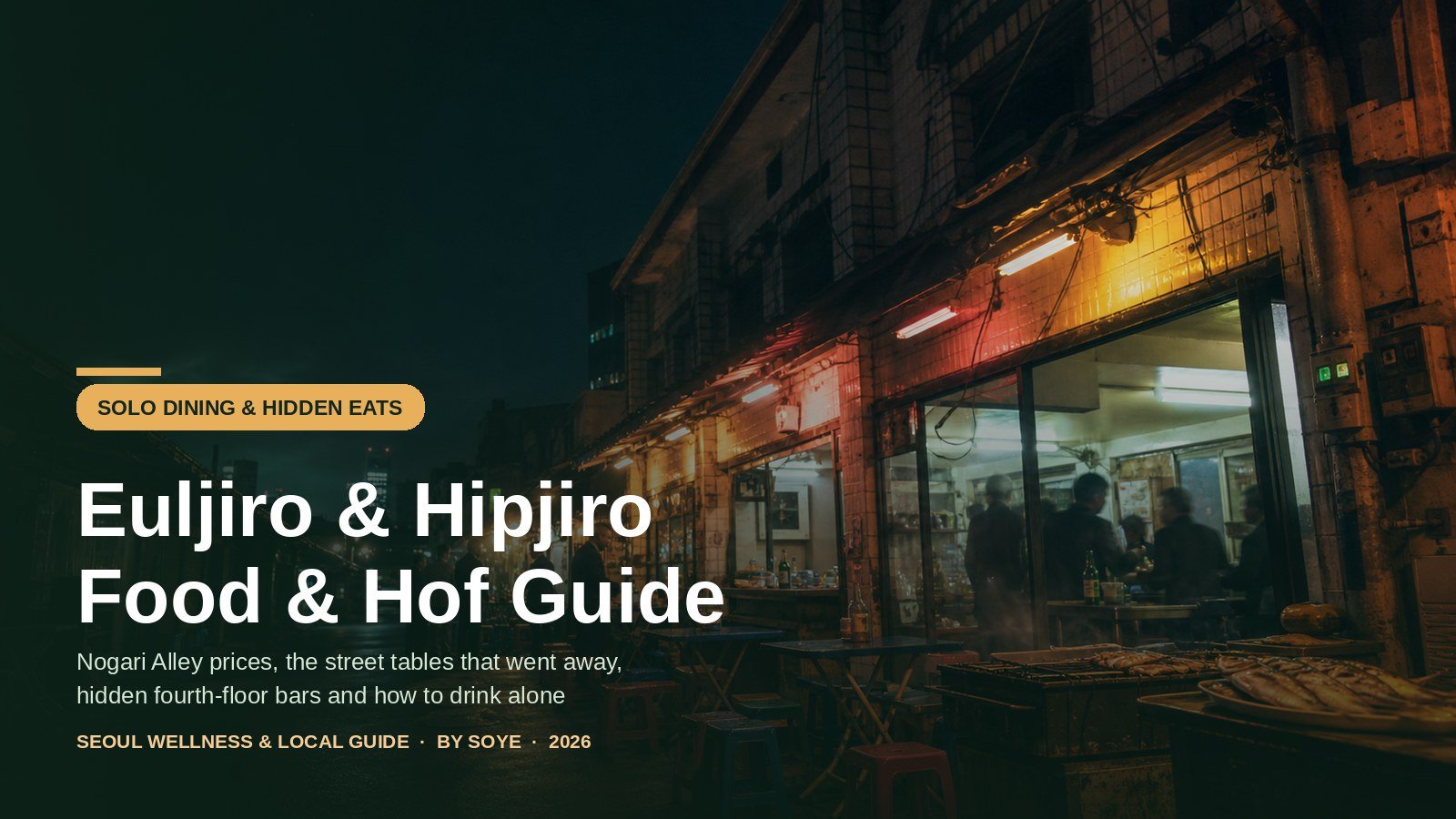
The photograph you have seen of Euljiro — plastic tables end to end, strangers’ shoulders touching, a plate of dried pollack between two beers — is out of date. The tables left the road in November 2022. The beer halls, the alleys, the golbaengi and the unmarked fourth-floor bars are all still there, and this is how they work now.
The one line that matters: outdoor tables on Nogari Alley lost their road permit in November 2022 and are now set out only on private ground, shop by shop — so plan for an indoor seat. Manseon Hof runs 12:00–03:00, the golbaengi alley 13:00–02:00, and your last train from Euljiro 3-ga leaves at 00:46–00:59 on a weekday but 23:46–23:58 on a Saturday.
Quick Verdict
Go on a Tuesday or Wednesday: Manseon Hof by 17:30 for nogari and a 5,000-won draft, the golbaengi alley behind Exit 12 for a 31,000-won plate split two ways, then an unmarked fourth-floor bar — and leave by 23:30, because Saturday’s last train is an hour earlier.
Two alleys, one station
Euljiro 3-ga is a transfer station on Lines 2 and 3 with twelve exits, and the two alleys that matter sit on opposite sides of it. Nogari Alley — dried pollack and beer — is a hundred metres up Eulji-ro 13-gil from Exit 3, 86 m on the city’s own measurement. Golbaengi Alley, where the sea-snail salad comes with a free omelette, is behind Exit 12, on Supyo-ro, formed around 1968 and listed as a food alley of its own.
The history is one shop. In 1980 a branch of OB Beer’s draft-beer chain opened here as Eulji OB Bear, serving grilled pollack and cold beer to printers finishing the night shift. Munich Hof followed in 1989. The IMF crisis of 1997 pushed office workers into cheap beer, the alley filled, and in 2015 Seoul designated it Future Heritage 2015-029.
Two things follow for a visitor. First, addresses here are useless: Eulji-ro 13-gil runs behind the station and the numbers do not follow walking order. Navigate by exit and by the yellow Manseon sign, not by map pin. Second, this is a redevelopment zone, not a museum. The Supyo and Euljiro 3-ga 12th districts have been under construction for years, hardware merchants sit in grey containers along the alley, and roughly half of the old hofs may not survive the next round.
What happened to the street tables
For five years the city treated the alley as an attraction. In May 2017 the district licensed outdoor seating on 465 m of Eulji-ro 11- and 13-gil — seventeen beer halls, tables from 18:30 for eight hours. That licence is what the photographs show. In November 2022 the district cancelled the permit, citing safety at the surrounding construction sites, and began removing tables and issuing fines. The car-free street, which had run 20:00–23:00, was lifted in July 2023.
What replaced it is not a clean rule. Manseon Hof’s management told reporters in 2024 that the remaining tables stand on private land with the owner’s agreement, not on the road; neighbours in the same article said inspectors still come twice a day and that customers asking for an outside table are turned away. In August 2026 the city’s own press material still called the lane a “nogari open-air table street”. Both things are true: on some evenings a dozen tables appear on forecourts and the alley looks like the postcard, and on others there is nothing outside at all.
Plan accordingly. Do not build an evening around sitting outdoors. Assume you will be inside, in a fluorescent-lit room with laminated menus in a napkin holder and a television showing baseball, and you will never be disappointed. In November the question answers itself: nobody drinks outside in a coat.
Manseon Hof at half past six
Manseon Hof, at Eulji-ro 13-gil 19, is the reference point: open 12:00–03:00 daily, three levels plus a rooftop, and the only place where a first-timer learns the whole grammar of the night in an hour. Prices from 2026 menus: nogari 2,000 won a fish (a larger one at 2,500–3,000), dried pollack 2,000, garlic chicken half 21,000, golbaengi salad 30,000, draft beer 500 cc at 5,000 on the first two floors and 5,500 on the roof. Drinks are priced by floor — the only place in Seoul where the view costs 500 won.
Timing is predictable. At 17:30 the room is half full; by 18:30 it is full and the rooftop queue starts; on a weekend the wait runs about forty minutes, written by hand on a paper list — no app, no number, so stay within earshot. From 19:30 on a Friday the alley is a wall of people.
Ordering: the menu is taped inside the napkin holder on every table, you say the number or point, and you pay at the counter or to the floor staff at the end — cards work, split bills are normal. The nogari arrives whole and hot; peel the skin back, break it along the grain with your hands, and dip it in the gochujang-mayonnaise that comes alongside. One fish and one beer is a legitimate order for one person, and it costs 7,000 won.

I go up. The rooftop is three flights of concrete stairs, a plastic canopy, and the roofs of Euljiro with the Namsan tower behind them; every drink costs 500 won more than downstairs and I have never once regretted it. On a Wednesday in November I was up there at 17:20 with six other people, four of them alone, all of us watching the alley lights come on.
Two warnings. The stairs are steep and the handrail is a pipe. And the rooftop closes first when it rains — you get moved down, which means you queue again.
Munich Hof and the OB Bear across the road
Munich Hof opened in the alley in 1989 and no longer sits in it: redevelopment moved it across Chungmu-ro to Eulji-ro 14-gil 30 in Cho-dong, 82 m from Exit 9. It is the beer drinker’s choice — stored and poured at 4°C, glasses out of a fridge, free popcorn on the table before you order. Hours are 12:30–23:30 on weekdays, from 13:00 at weekends (one listing says noon to midnight; the kitchen closes earlier than the door). Draft 500 cc 5,500, garlic chicken 22,000, golbaengi 30,000, nogari 3,000. On Fridays, Saturdays and holidays the outdoor tables run on a 150-minute limit, with a three-hour “manner time” when someone is waiting; the list is handwritten, and a weekend wait of forty minutes is normal.
Eulji OB Bear is the other half of the story. The original closed in April 2022 after a six-year lease fight and six forced evictions, reopened in Mapo, and came back to Euljiro in February 2024 — not to the alley but across the main road near Exit 10, in a ground-floor unit with no room for outdoor seating. It opens 15:30–23:00, takes orders on a tablet, and keeps its prices frozen: nogari and dried pollack 6,000, draft OB Lager 5,000, sausage 9,000, fried chicken 9,000, with a ㄱ-shaped counter built to the old plan for people drinking alone.
Which to choose: Manseon for the alley itself and the 03:00 last order; Munich for the best-poured beer and a table you can talk at; OB Bear for history, quiet and the cheapest plate of fish. All three take foreign cards.
The golbaengi alley behind Exit 12
Two hundred metres around the corner is a second, older alley with a different logic: one enormous cold dish, two free side dishes, and a bill that only makes sense for two or more. At Eulji Golbaengi (Supyo-ro 43-1, 13:00–02:00) the golbaengi is 31,000 won, up from 30,000 in February 2026, and it arrives with a thick rolled omelette that is refilled free and a pot of fish-cake soup. The snail is whole, so scissors come with it; the sauce is chilli, garlic and sesame with shredded scallion and dried pollack on top. When the bowl is empty you order noodle 4,000 and mix it into what is left — note that it is jungmyeon, a thicker noodle than somyeon, which surprises people who expect the thin version.
Supung Golbaengi next door (Supyo-ro 43) runs the same formula at 29,000–31,000, with kimchi pancake appearing unasked halfway through, and does lunch sets at 10,000 for one person from 13:00. That lunch is the honest way in for a solo traveller: 31,000 of snail salad is a meal for three, and there is no half portion.
Hipjiro after nine: no signs, four flights
“Hipjiro” is what the district is called after dark, and it means one thing architecturally: a bar with no sign on the fourth floor of a print shop, behind a door with a bell. The rule of thumb — if you can see the name from the street, it is not the bar people mean.
Listings checked in November 2026 give the shape of it. Euljiro V (Chungmu-ro 51, 4F) runs 17:30–01:00, closed Mondays. Gamgak-ui Jeguk (Chungmu-ro 7-gil 19, 4F) is a dim room from 18:00 to 01:00, to 02:00 on Fridays and Saturdays. Hotel Susunhwa (Chungmu-ro 7-gil 17, 4F) is a vintage cafe from noon that becomes a bar until midnight, its stairs marked by a painting rather than a sign. Yusagil, which calls itself a solo-drinking bar, opens on a third floor in Cho-dong at 19:00. For quiet there is Inhyeon Golbang, a reservation-only listening bar where talking is not the point, and SookHee, where the door is an unmarked cabinet and there are about ten seats.
Cocktails run 18,000–26,000 won; signatures at the high end. Many of these rooms take reservations only through Instagram direct messages and are full by Friday afternoon, and almost all ask for one drink per person and expect the volume to stay low. Look for the address plate by the door, ring, and close the door behind you.
Drinking alone here
Korea’s drinking culture is group-shaped, but this neighbourhood is the exception, and has been since printers started coming in alone. Nobody at a hof asks why you are by yourself, and there is no minimum order — which is also the difference from most of Seoul’s other late tables, as our solo dining guide to Seoul sets out.
The mechanics that matter: arrive 17:00–18:00, before the office crowd, and ask for the counter or the rooftop edge rather than a table for four. When the room is full, sitting at a vacant chair on a long shared table is normal — a short “yeogi anja-do dwaeyo?” is enough. Order one draft and one anju; at Manseon that is 7,000 won, at Munich 8,500, and it buys an unhurried hour. Flag a server by eye and a raised hand, pay inside at the end, and there is no tipping.
Two limits to know. Outdoor tables at Munich carry a 150-minute limit on Friday, Saturday and holidays, and the alley empties from about 22:30 as people catch the last trains. Bars are different: one drink minimum, and a two-hour cap when someone is waiting. None of this is posted in English; all of it is enforced politely.
The four, compared
Four stops, four reasons to be there. What separates them is not quality but what each is built to do: a whole alley on three floors, the coldest glass, a frozen 1980 price list, or one enormous shared plate.
| Spot & order | 2026 prices | Room & crowd | Best time | Soye’s one-liner |
|---|---|---|---|---|
| Manseon Hof Nogari Alley, Exit 3 |
Nogari 2,000; draft 5,000 (roof 5,500); garlic chicken 21,000; golbaengi 30,000 | Three floors plus roof; full by 18:30; 40-min weekend wait | 17:00–18:00, or after 22:00 | Learn the alley here: one fish, one beer, 7,000 won, rooftop worth the extra 500. |
| Munich Hof Eulji-ro 14-gil 30, Exit 9 |
Draft 5,500; garlic chicken 22,000; golbaengi 30,000; nogari 3,000 | Best-poured beer, big screens, free popcorn; 150-min limit Fri–Sat | 12:30 opening or a weekday 17:00 | Coldest glass in the district; come for the beer, not the nostalgia. |
| Eulji OB Bear Chungmu-ro 49-2, Exit 10 |
Nogari & pollack plate 6,000; draft 5,000; sausage 9,000 | Quiet, tablet ordering, ㄱ-shaped solo counter, no outdoor seats | 15:30–19:00 | The 1980 original, back across the road with its prices frozen. |
| Golbaengi Alley Supyo-ro 43–43-1, Exit 12 |
Golbaengi 31,000 with omelette (refill) and soup; noodle 4,000 | Bright, family-style, two floors; lunch sets 10,000 for one | 13:00–16:00, or after 21:00 | A three-person dish; solo travellers should come at lunch. |
One evening, 17:30 to 23:30
About 900 m on foot, no taxis, ending at the station with twelve minutes to spare on a weekday — and on a Saturday, subtract an hour.
| Time | Where | What to do | Money & transit note |
|---|---|---|---|
| 17:20 | Exit 3 → Eulji-ro 13-gil | Walk 86 m, find the yellow Manseon sign, ask for the roof | Carry ₩30,000 in notes; cards work |
| 17:30–19:00 | Manseon Hof | Nogari, one draft, watch the room fill; leave before 19:00 | 7,000–9,000 per person |
| 19:10–20:30 | Exit 12, Supyo-ro | Golbaengi with omelette and noodle mixed in at the end | 31,000 shared; 4,000 noodle |
| 20:50–23:00 | Chungmu-ro side streets, 3F–4F | One unmarked bar: ring, one drink, low voice | 18,000–26,000 a cocktail |
- Fix your last train before your first beer. Weekday 00:46–00:59, Saturday 23:46–23:58 — a full hour earlier, on the night you least want to check.
- Take the roof if it is free. 500 won a drink more, and the whole alley below you.
- Eat the golbaengi before nine. The noodle course needs appetite, and the alley fills from 21:00.
- Ring, do not push. Fourth-floor bars are homes with a licence; the door is closed for a reason.
- Stop at one bar. The 03:00 closing is a trap when the station shuts at midnight.
November nights and getting home
This month the alley is a cold-weather place: steam off the grill, coats on chair backs, doors kept shut. Two layers and a windproof shell cover the walk between stops; the rooms are warm and the beer is 4°C. Indoor-only also compresses the crowd, so a Tuesday in November is a different city from a Friday.
The trains are the part people get wrong. From Euljiro 3-ga, the last Line 2 inner circle (towards Euljiro 4-ga) is 00:46 on weekdays and 23:46 on Saturdays; the outer circle (towards Euljiro 1-ga) is 00:59 and 23:58; Line 3 runs to 00:52 towards Dokripmun and 00:55 towards Ogeum on weekdays, both around 23:55 on Saturdays. Terminating stations matter more than the clock: on a weekday the last train towards Hongdae leaves at 00:47, towards Sindorim at 00:36, towards Seoul National University at 00:22, and towards Ogeum at 00:05. If your hotel is further out than the destination board says, you are already too late.
After that, the night buses. Walk 500 m north to Jongno 3-ga and the N26 runs across the city to Cheongnyangni and Gangseo until 03:25, while the N15 links Uidong to Nantaeryeong via Jongno and Seoul Station until 03:30 — fare 2,500 won, paid by card. Kakao T takes foreign cards, and the rank at Exit 9 is the reliable pickup, with a 20% night surcharge after 22:00.
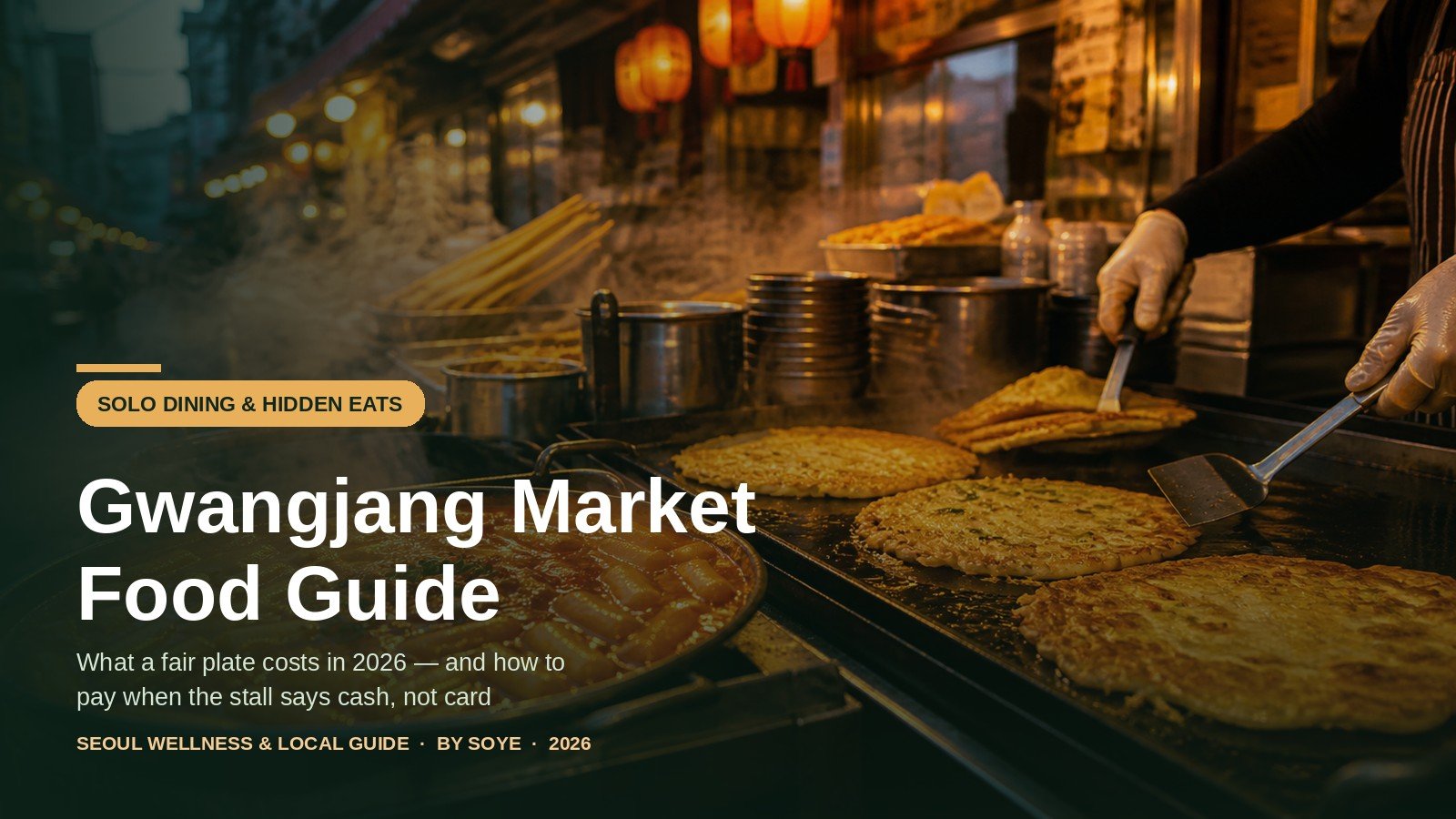
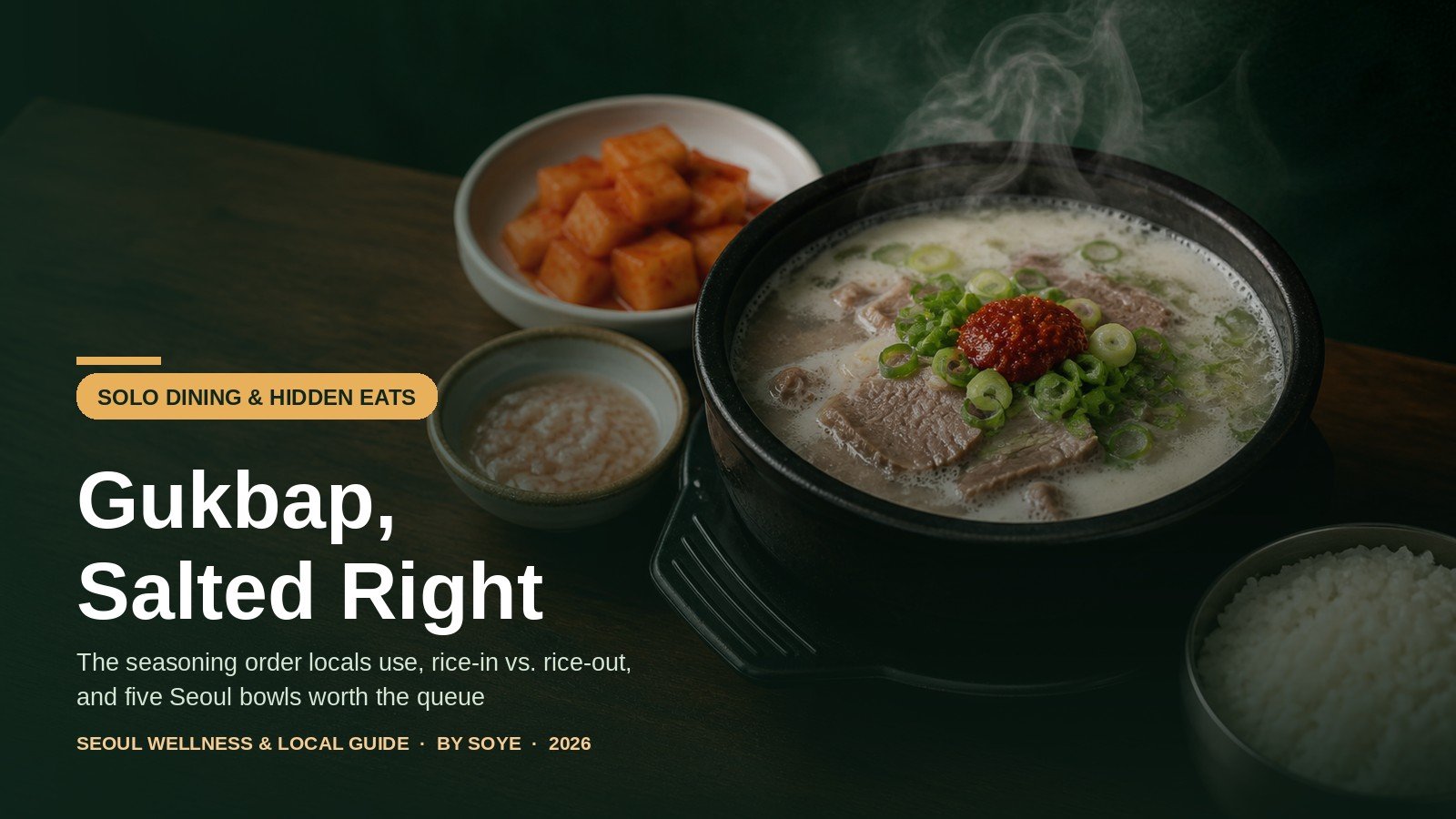
If you miss it, or you want food rather than another drink at 23:00, the market alleys ten minutes east are the answer: our Gwangjang Market guide covers the closing hours and the cash problem, and the gukbap guide lists the soup kitchens that never shut. Meat instead? The solo Korean BBQ guide is how you grill for one.
If you are back the next morning, the same streets are the start of a good run: the Cheonggyecheon 5.8 km route begins ten minutes away and burns off the previous night better than coffee.
- No outdoor tables promised — plan for an indoor seat and a paper waiting list.
- ₩30,000 in notes, card as backup; there is no tipping.
- Check the Saturday last-train time before the first round, not after.
- Manseon roof: steep stairs, closed in rain.
- Golbaengi: no half portion; go at lunch if you are alone.
- Fourth-floor bars: one drink minimum, reservation by Instagram on weekends.
FAQ
Are the plastic tables still out on the street?
Not as a rule. The district cancelled the road permit in November 2022 and the car-free street ended in July 2023. Some shops still set tables on private ground with the owner’s agreement, so you may see them on some evenings and none on others.
Do I need a reservation for Manseon Hof or Munich Hof?
No, and you cannot easily make one. Both use a handwritten list at the door. Arrive at 17:00–18:00 on a weekday and you walk in; on a Friday or Saturday expect forty minutes from 18:30, and Munich’s outdoor tables have a 150-minute limit.
Can one person eat and drink here?
Yes, and it is common. Hofs have no minimum order and no table minimum; one nogari and one draft is 7,000 won at Manseon. Ask for the counter or the rooftop edge. Bars ask for one drink per person. The exception is the golbaengi alley, where a 31,000-won plate is built for two or three.
How much does a night in Euljiro cost?
Alone, 25,000–45,000 won: one hof round, 31,000 divided if you join others for golbaengi, and a cocktail at 18,000–26,000. Two people drinking properly land around 70,000–90,000 with food.
Do they accept foreign credit cards?
At Manseon, Munich, OB Bear and the golbaengi restaurants, yes — Visa and Mastercard are normal. Payment happens inside, even if you are sitting at a table on the forecourt. Keep ₩20,000–30,000 in cash for the odd stall and for taxis.
Which exit do I actually want?
Exit 3 for Nogari Alley (86 m), Exit 4 also works, Exit 9 for Munich Hof and Chungmu-ro, Exit 10 for OB Bear and Eulji Dabang, Exit 11 or 12 for the golbaengi alley and Neon Alley. The two alleys are three minutes apart, not two neighbourhoods.
What time do places close, and what if I miss the train?
Manseon to 03:00, OB Bear to 23:00, Munich to 23:30, the golbaengi alley to 02:00, most hipjiro bars to 01:00 or 02:00. Trains stop at 00:46–00:59 on weekdays (an hour earlier on Saturdays). After that, the N26 and N15 night buses from Jongno 3-ga run until about 03:30.
Cheat sheet
Final Summary
- The street tables are gone as a guarantee: the road permit ended in November 2022; some shops use private forecourts. Plan to sit inside.
- Start at Manseon Hof by 17:30: nogari 2,000, draft 5,000 (5,500 on the roof), garlic chicken 21,000, open to 03:00.
- Golbaengi is a shared dish: 31,000 with a free-refill omelette and soup, noodle 4,000 extra — or a 10,000 lunch set if you are alone.
- Exit 3 for nogari, 12 for golbaengi, 9 and 10 for beer and the 1980 original.
- Last train, not last order: 00:46–00:59 weekdays, 23:46–23:58 Saturdays, night buses N15 and N26 from Jongno 3-ga.
Last checked: 20 November 2026 against Visit Seoul’s Nogari Alley entry, the Seoul Future Heritage listing 2015-029, Korea Tourism’s Manseon Hof page, Seoul Metro timetables and local reporting on the 2022 permit cancellation. Menu prices and opening hours change without notice; the sign on the door wins.
2 thoughts on “Euljiro & Hipjiro Food Guide: Old Hofs, Hidden Bars & Solo Eats (2026)”