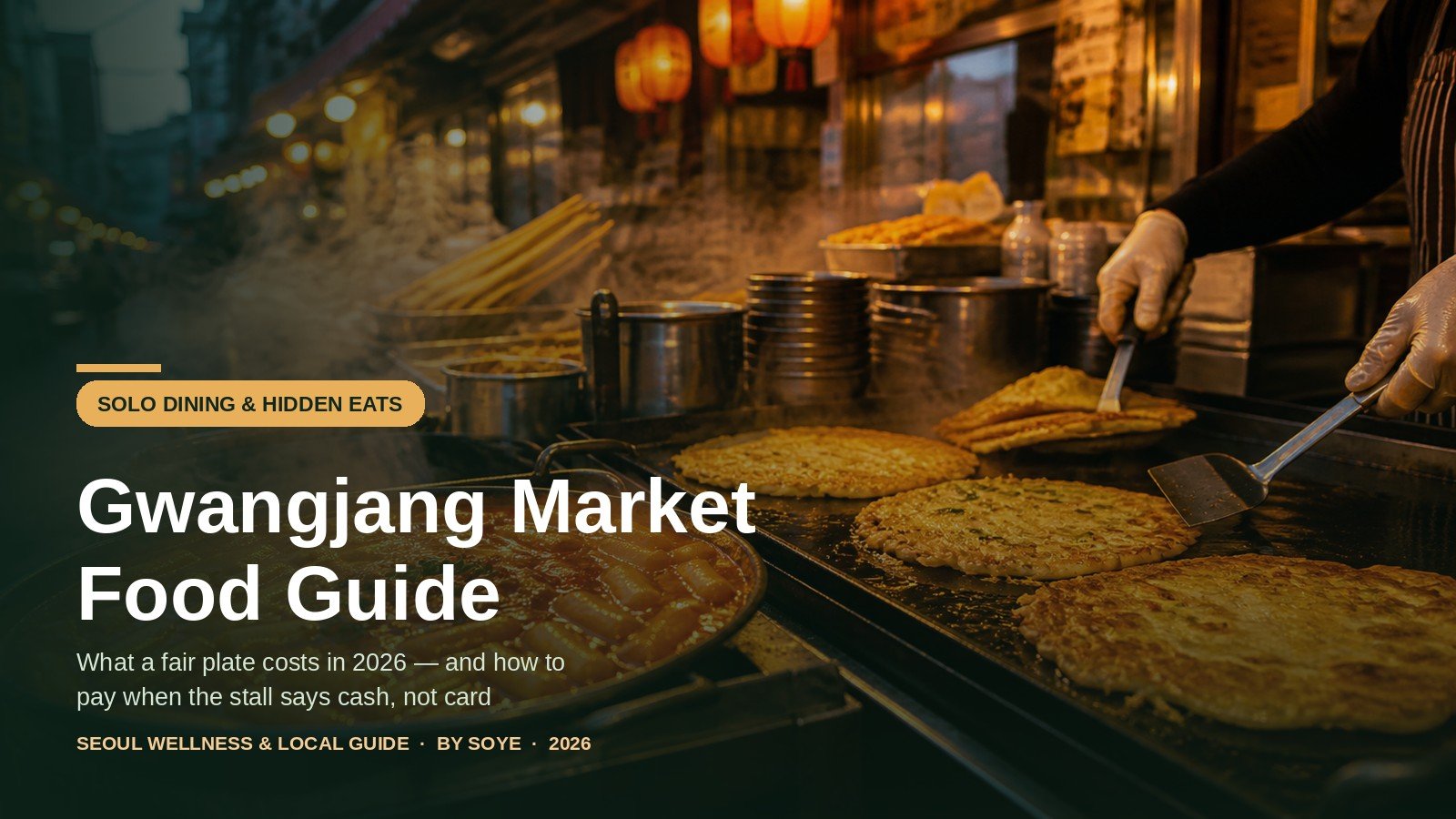
The first bill at Gwangjang Market is never only about the food. You fold onto a bench forty centimetres wide, a plate of mung-bean pancake lands, and then comes the sentence that decides your afternoon: 현금이요, 계좌이체요 — cash, or a bank transfer. Not card. Two stalls down the same pancake is ₩1,000 cheaper, and nobody explains why.
The one line that matters: since 1 September 2026 a stall that fails to post its prices — or charges more than it posted — faces a five-day suspension on the first offence. Stalls still test it; your defence is the board, the weight beside the price, and a photograph.
Quick Verdict
Gwangjang is fair-priced in 2026, not cheap. Expect ₩6,000 for bindaetteok, ₩23,000 for 200 g of yukhoe, ₩3,000–4,000 for mayak gimbap, ₩1,000 for a kkwabaegi. Carry ₩30,000 in cash, read the weight on the board, and ask “카드 돼요?” before you sit. The food alley runs to 23:00, Sundays included.
Five dates that explain the board in front of you
Gwangjang has drawn more price reporting than any market in Korea, but visitors get the outrage rather than the rules that followed — and those rules decide whether the number a vendor says has to match the one painted on his stall.
December 2023 put the weight on the menu. Seoul City, Jongno-gu and the two merchant bodies agreed a quantity-labelling system (정량표기제): every price sits beside a weight or a count. The city’s example was yukhoe at ₩19,000 for 200 g at one stall and ₩28,000 for 300 g at another — which is why a plate without a weight is worth questioning.
May and June 2026 brought the inspections: 159 restaurants and 109 food stalls checked, price display verified across 51 mandatory retail categories, and mystery shoppers — foreign nationals among them — sent in to test prices and hygiene. The city says the checks became standing practice.
1 June 2026 gave the stalls names. Under Jongno-gu’s real-name system (노점 실명제), each operator holds a road-occupancy permit stating area and term, reviewed annually; 120 demerit points or four violations inside the permit period can cost the right to trade there. About 250 food stalls fall under it, so the name board is something you can quote.
1 September 2026 added the stick. The Ministry of Food and Drug Safety made a missing price, or a charge above the posted one, a five-day suspension on the first offence, ten days on the second, twenty on the third. It was written with tourist markets in mind, and it is the most useful fact here.
What the dates do not promise. Enforcement is uneven: in April 2026 a reporter found vendors answering “bank transfer” to every card question and boards with no weights, and in August a crew posing as Japanese tourists was quoted ₩1,500 for water the board priced at ₩1,000. The board is the contract, and refusing to honour it is now a reportable offence.
Card, cash, or a transfer you cannot make
Gwangjang’s food stalls are the hardest place in Seoul to pay by card, for bureaucratic rather than greedy reasons. Most are unregistered businesses without fixed premises, which in Korea has meant no merchant account and no terminal. Jongno-gu and the merchants’ association attacked that in 2024 with payment-gateway terminals issued without registration: 58 food stalls had one by late August, 76 of the market’s 94 street stalls were card-capable, and the association said every food stall was covered.
Then came the honest tests. In November 2025 a reporter tried ten stalls in one afternoon and got one yes; days later stalls near the East Gate all took cards while other sections wanted cash, Onnuri certificates or a bank transfer — one board read “NO CARD ONLY CASH”. Some vendors had a terminal and declined to use it, one saying he did not know how. Reporting in April and November 2026 found the same split.
That deflection is a dead end. 계좌이체 moves money between Korean bank accounts through an app that needs an Alien Registration Card and a Korean phone number, so “bank transfer only” means no sale. Pay cash and move on.
- Cash in small notes — ₩1,000 and ₩5,000 bills. ₩30,000 covers a solo crawl of three stalls; ₩50,000 covers two people with a yukhoe plate.
- A terminal in sight. Ask 카드 돼요? (kadeu dwaeyo?) with the card raised. A machine, fine; an account number, order small or leave.
- A prepaid tourist card. WOWPASS and Travel Wallet are Visa or Mastercard products: they work where a terminal takes foreign cards and fail where cash is demanded.
- A shop with an address. Buchon Yukhoe, Gohyang Kalguksu and the clothing floors take cards routinely, being ordinary businesses rather than street stalls.
Onnuri gift certificates (온누리상품권) are the local answer and a poor one for a short trip: 347 affiliated shops, 292 of them digital too, but only 23 restaurants. Paper certificates are bought with cash and an ID at a bank counter; the digital version needs Korean identity verification.
Cash has to come from somewhere, and the market is well served. Four ATMs that take foreign cards sit within two minutes, checked in November 2026: NongHyup by the North Gate at 196 Jong-ro (07:00–24:00, only the middle machine is global), IBK at 189 Jong-ro (07:00–23:55), Suhyup at 207 Jong-ro (07:00–23:30, English, Chinese and Japanese screens only) and Woori at 399 Dongho-ro, 80 m from Jongno 5-ga Exit 7 (07:00–23:30). For a card rather than cash, the CU at 215-1 Cheonggyecheon-ro, 120 m from Exit 7, runs a WOWPASS machine around the clock and exchanges 16 currencies.
The five dishes at fair 2026 prices
Portions are not standardised, which is what the quantity label was meant to fix. These are the named shops’ published 2026 prices, and what a fair board looks like.
| Item | Fair price | Portion / what you get | Card at the stall | Must-know |
|---|---|---|---|---|
| Bindaetteok (nokdujeon) | ₩5,000–6,000 | One pancake, about 20 cm, with bean sprouts and kimchi; a snack for two, a light meal for one | Often — terminals arrived in 2024; still ask first | Order the single pancake (단품). A mixed platter (모둠전) runs ₩16,000–20,000 and is where portions thin out. |
| Yukhoe (seasoned raw beef) | ₩23,000 | 200 g of beef with pear and egg yolk, plus free beef-and-radish soup and kimchi | Yes in practice — a licensed restaurant; confirm at the door | One dish per person is enforced at Buchon Yukhoe, with a 90-minute table limit. Yukhoe bibimbap ₩11,000. |
| Mayak gimbap (mini rolls) | ₩3,000–4,000 | Eight to ten thumb-sized rolls with a mustard-soy dip | Mixed; some counters cash only | Bakga-ne lists ₩5,000 a plate, so prices genuinely differ. Some stalls now call it kkoma gimbap. |
| Chapssal kkwabaegi | ₩1,000 each | One sugared twisted doughnut fried to order; red-bean version ₩1,500 | Usually cash | At North Gate 2, 10:00–22:00, closed the first Sunday of each month. The queue is takeaway and moves fast. |
| Kalguksu / mandu | ₩7,000 / ₩8,000 | One bowl of noodles in anchovy broth, or dumpling soup; sujebi ₩8,000 | Yes in practice — a shop with a counter and a till | Gohyang Kalguksu, from Netflix’s Street Food, is ₩7,000 and closed Mondays. |
Tteokbokki at the pancake stalls is about ₩5,000 and sundae ₩7,000–8,000, both portions built for sharing and both present in the 2025 case where a stall charged ₩10,000 for sundae its board priced at ₩8,000 and lost ten trading days. If a plate arrives with meat you did not order and the price rises, refuse before it is cut and photograph the board.
Bindaetteok is the dish most often bought badly. Soaked mung beans are ground coarse, mixed with sprouts and kimchi, and fried until the edge shatters. Two stalls grind beans on a stone mill in the window: Bakga-ne, open from 08:00, and Sunhee-ne, ten metres inside the east gate, open 11:00 to 21:00 and closed Tuesdays. A single pancake with onion-soy dip is ₩6,000; the meat version ₩10,000–12,000.
Yukhoe is the market’s second identity and its priciest plate. Buchon Yukhoe, in the yukhoe alley at Jong-ro 200-12 and a Michelin Guide Bib Gourmand address, runs like a machine: scan the QR at the door to join the queue and walk the market while you wait. Inside, a sign states one dish per person and ninety minutes. The free soup is not a garnish; with rice it is a meal.
Out of Jongno 5-ga Exit 8 — the station’s sign says 62 metres — the first thing you meet is the kkwabaegi queue at North Gate 2. Do not join it yet: the lane beside the gate runs straight into the yukhoe alley, so you reach Buchon in about three minutes without crossing the busiest stretch of the market. My shortcut when I want one plate of beef.
Two habits save me money. I buy the single pancake, never the platter, because the platter is where a ₩6,000 dish becomes a ₩16,000 plate with less food on it. And I photograph the board before ordering: in a market this loud, it is the only record of what the number was.
Eating alone at a shared bench
Gwangjang may be the most solo-friendly eating in Seoul and the least explained. Nothing about the benches is designed for one person, and everything assumes you will sit beside a stranger.
The bench. A counter is a wooden ledge with stools, or two long benches facing each other: no armrests, no gaps. You will touch the knee of the person next to you, which is neither an invitation nor a problem. Sit, put the bag on your lap or under the bench — never on an empty stool — and hold up one finger. The words are 한 명이에요 (han myeong-ieyo), “one person”, but the finger is what works.
The order. Each stall sells one thing, ordered from the person in front of you. Carrying food from the next stall onto someone’s bench is mildly rude; eating it standing in the aisle is normal. Pay at the end by catching the vendor’s eye and holding out the cash. No tipping and no reservation you can rely on.
The clock. Only sit-down restaurants impose one: Buchon’s ninety minutes is generous for a solo plate and soup, tight for four. Stalls move faster — a pancake is fifteen minutes, kalguksu about twenty-five. After 18:00 someone is standing behind your stool, and the local move is to finish your tea and go.
Solo ranking, cheapest to slowest. Kkwabaegi at the gate is a walk-away snack. Mayak gimbap is a ten-minute counter stop and the easiest first order here. Bindaetteok is a twenty-minute sit with a hot pan in front of you. Kalguksu is a proper bowl at a counter. Yukhoe is the one meal to budget forty minutes for. Yukhoe bibimbap at ₩11,000 gets you the same beef with rice, no sharing conflict, and change from ₩20,000.
What to skip alone. The mixed platter, for the reason above. And bottled water, the market’s most reliable overcharge: ₩1,000 on a board, ₩1,500–2,000 asked. Ask for barley tea instead; most stalls keep a thermos and hand it over free.
Hours, Sundays and the 15:00 window
Gwangjang runs on three clocks, and the classic wasted trip is a Sunday shopper who arrives for fabric and finds only pancakes.
The clocks. General shops — silk, hanbok, bedding — keep 09:00–18:00, Monday to Saturday, closed Sundays; the second-hand clothing floors keep 10:00–19:00, also closed Sundays. The food alley keeps 09:00–23:00 every day of the year. Eating, Sunday is fine; shopping, Sunday is shuttered.
23:00 is a ceiling. Stalls set their own closing and most shut between 21:00 and 22:00, with last orders earlier: treat “open until 23:00” as “be seated by 20:30”. Some take a weekday off — Sunhee-ne on Tuesdays, Gohyang Kalguksu on Mondays, the kkwabaegi cart on the first Sunday of the month.
The crowd cycle. Roughly 65,000 people pass through daily, in aisles narrow enough that the figure becomes shoulder contact. Weekday lunch, 12:00–14:00, is the first peak; the evening peak, 18:00–20:00, is worse. The gap between them, 15:00 to 17:00, is the best ninety minutes in the market — grills hot, tables free, light at its best. Weekends never empty, and mornings are deceptive: several stalls do not light the grill before 10:00, so a 09:15 visit can mean more shutters than pancakes. Bakga-ne, open at 08:00, is the exception.
Before leaving the hotel, check Seoul’s live crowd index: the city’s real-time data page carries a hotspot for 광장(전통)시장 with four levels and a twelve-hour forecast. It counts residents more accurately than tourists, so read one level up. In November the alley is roofed but open at the sides: sit away from the aisle mouth.
Getting in: Exit 8 and the layout
The address is 88 Changgyeonggung-ro, Jongno-gu, with two useful approaches.
From Jongno 5-ga (Line 1), Exit 8: sixty-two metres, about a minute, straight to North Gate 2 and the food alley. Exits 7 and 9 often sit closer to a specific stall.
From Euljiro 4-ga (Lines 2 and 5), Exit 4: about 100 m across Cheonggyecheon stream — better from Myeongdong or Dongdaemun, and it saves a transfer.
The layout in thirty seconds. Food stalls fill the covered lanes between North Gate 2 and South Gate 1, with the East Gate at the Jongno 5-ga end. Pancake and gimbap counters cluster east and centre; the yukhoe alley runs along the western edge by Jong-ro, where Buchon sits; the kkwabaegi cart is outside North Gate 2. The upper floors are fabric, bedding and hanbok.
Practical edges. There is no market car park; Jongmyo public car park at Jong-ro 157 is a five-minute walk, and a taxi driver will understand 광장시장 북2문 better than a street address. For a wheelchair, Jongno 5-ga is the accessible station — follow the lift signs, because the lift does not open at Exit 8.
Order like a local in six steps
- Walk the aisle once before sitting. Both sides, looking for a price and — beside it — a weight or a count. A board with neither is a stall to pass.
- Compare two stalls, not ten. The same pancake varies by ₩1,000 and gimbap by ₩2,000.
- Ask about the card before ordering. 카드 돼요? with the card raised. An account number means cash — arguing will not open a terminal.
- Sit, one finger, 한 명이에요. Bag on your lap, single item rather than the platter.
- Photograph the board while you wait. One photo with the weights is the dispute-prevention kit.
- Check the total, then pay. If it is higher, say so once and point at the board. If the stall insists, pay under protest, keep the photo, and report it on Seoul’s Dasan helpline, 120 (02-731-2120, 24 hours), or the tourist complaint centre, 1800-9008 — a report attaches demerit points to a named stall, the only mechanism that has ever changed behaviour here.
Gwangjang, Namdaemun or Myeongdong?
The three are often offered as equivalents, but differ in seating, payment and the hour that makes them worth a trip.
| Market | Top dishes | Vibe & seating | Payment ease | Best hours |
|---|---|---|---|---|
| Gwangjang | Bindaetteok, yukhoe, mayak gimbap, kalguksu, kkwabaegi | Covered alleys, communal benches, knees touching, genuinely good alone | Hardest. Cash-first stalls; cards at the big names and inside buildings | Food alley daily 09:00–23:00; quiet 15:00–17:00; Sunday food only |
| Namdaemun | Galchi jorim (braised hairtail), kalguksu, king dumplings, oxtail soup | Wholesale market with alleys and proper tables; fish stew is a two-person dish | Easiest. Most shops take foreign cards; small stalls prefer cash | Weekdays 10:00–15:00; kalguksu alley 06:00–21:00; mostly shut Sundays |
| Myeongdong street food | Tteokbokki, hotteok, egg bread, grilled skewers | Pedestrian street of carts; no seats; eat standing and keep moving | Improved — many carts take cards since 2025, cash still safest | Carts from about 16:00 to 22:00; busiest 18:00–21:00 |
FAQ
Can I pay by card at Gwangjang Market?
Often, but not reliably. Food stalls received card terminals in 2024 and the sit-down names — Buchon Yukhoe, Gohyang Kalguksu — take cards. Smaller counters ask for cash or a Korean bank transfer, which a visitor cannot make. Carry ₩30,000 and treat the card as backup.
What should bindaetteok and yukhoe cost in 2026?
A single mung-bean pancake is ₩5,000–6,000, with ₩6,000 at the two famous stalls. A 200 g plate of yukhoe is ₩23,000 and yukhoe bibimbap ₩11,000. If a price has no weight beside it, ask — the market’s own rule requires that number on the board.
Is Gwangjang Market open on Sundays?
The food alley is open every day of the year, Sundays included, 09:00–23:00. General shops, fabric floors and second-hand clothing close on Sundays. Individual stalls still take their own days off, so check the shop, not the market.
Is it awkward to eat alone there?
No — it is one of the easiest places in Seoul to eat alone. Sit at a communal bench, hold up one finger and order from the counter. The only formal restriction is Buchon’s one-dish-per-person rule and 90-minute limit, which suits a solo diner better than a group.
Where can I get cash near the market?
Four ATMs that take foreign cards are within two minutes: NongHyup beside the North Gate (07:00–24:00, only the middle machine is global), IBK at 189 Jong-ro (07:00–23:55), Suhyup at 207 Jong-ro (07:00–23:30) and Woori near Jongno 5-ga Exit 7 (07:00–23:30). The CU at 215-1 Cheonggyecheon-ro has a 24-hour WOWPASS machine.
What if a stall charges more than its posted price?
Point at the board once and note the higher figure. Photograph the board and the bill, then report it on the Dasan helpline, 120 (02-731-2120, 24 hours), or 1800-9008. Since 1 September 2026 a missing price or a charge above it carries a five-day suspension, and stalls are registered by name.
Cheat sheet
Final Summary
- Cash is the plan; the card is the backup. Bring ₩30,000 in small notes. Ask 카드 돼요? before sitting — “계좌이체” means no sale for a visitor.
- Read the board twice. Price plus weight: ₩6,000 bindaetteok, ₩23,000 yukhoe, ₩3,000–4,000 gimbap, ₩1,000 kkwabaegi, ₩7,000 kalguksu.
- Order the single dish. The mixed platter (₩16,000–20,000) is where portions thin out.
- Go at 15:00. Lunch ends at 14:00, dinner starts at 18:00, Buchon breaks around 16:00–17:00. Sunday is food only.
- The rules are on your side: since September 2026 a missing or inflated price costs a stall five days. Photograph the board; report overcharges on 120 or 1800-9008.
Last checked: 19 November 2026 against Visit Seoul’s Gwangjang Market listing for hours by section, Jongno-gu’s English site and its 2025–26 street-stall notices, and Seoul City’s May 2026 joint inspection announcement, plus the food-safety enforcement change effective 1 September 2026. Prices are each shop’s 2026 menu; the board in front of you wins. For fares, use our Seoul transit fare calculator.