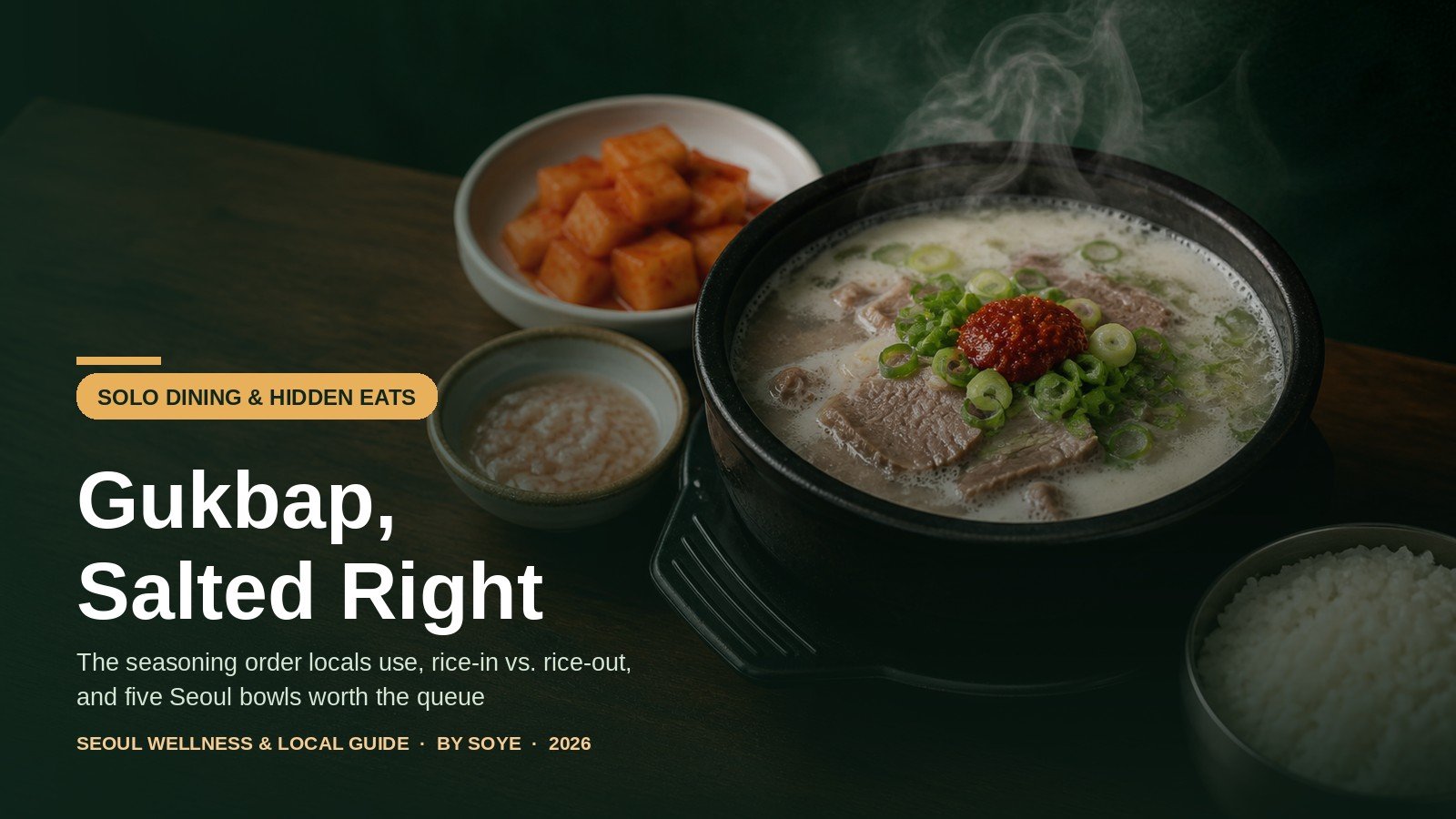
Your first bowl of gukbap in Seoul will probably taste like hot water. Not because the restaurant is bad, and not because you ordered wrong: the broth is supposed to arrive unsalted. Every table around you is quietly fixing it with a spoon of salted shrimp, a shake of pepper and a splash of radish-kimchi juice, and nobody tells you the order.
This Seoul gukbap guide is about that ten-second adjustment: which of the four classic bowls you are actually ordering, how locals season each one, whether the rice comes in the soup or on the side, what a bowl costs in 2026, and five addresses where a solo diner can sit down without a plan. Prices, hours and station exits were checked in Seoul on 18 November 2026 against the restaurants’ own menus and the Korea Tourism Organization’s English food pages.
The seasoning order, and 2026 prices: Seoul gukbap is served unsalted on purpose: taste first, then add salted shrimp (one teaspoon is about right for a bowl) or salt, then a spoon of chili dadagi, then pepper and a little kkakdugi brine, one step at a time. In November 2026 a bowl of sundae-guk runs about ₩11,000 and a seolleongtang about ₩15,000, with several houses open around the clock.
Quick Verdict
Seoul gukbap arrives almost unseasoned on purpose. Taste first, then add salted shrimp or salt, then a spoon of chili dadagi, then pepper and a little kkakdugi brine, one step at a time. Done in that order, an ₩11,000 bowl of sundae-guk or a ₩15,000 seolleongtang becomes the best solo lunch in the city.
Why your first bowl tastes like nothing
Korean bone broth is cooked to be seasoned later. A restaurant simmering ox legs for ten hours reduces the liquid as it goes, so salt added at the start would concentrate into something undrinkable; salt goes in the bowl, at the table, by the person eating it. That is also why a pot of gukbap survives a lunch rush: the base is neutral, and the kitchen only reheats and assembles. The Korea Tourism Organization’s English page on seolleongtang says it plainly: add salt, black pepper and chopped scallions before eating.
Some houses push the idea further than others. Yeongdong Seolleongtang in Sinsa, open around the clock, serves only seolleongtang and boiled meat, and puts down a completely unsalted bowl with salt, scallions and kimchi on the side. At the other end, a Seoul-style seonji haejangguk like Cheongjinok’s is already seasoned in the kitchen with doenjang, so anything more than pepper is a mistake. The first spoonful tells you which one you have.
Two habits cause most of the disappointment. One is treating the small dish of saeujeot, salted shrimp, as a side to nibble: it is the salt shaker, and one teaspoon is roughly right for a whole bowl. The other is reaching for soy sauce, which is usually not even on the table; where it is, it belongs to the boiled meat, not the soup. And many sundae-guk kitchens stir dadagi, a chili-and-soy paste, into the pot before serving, so if your broth is already orange at the edge, taste it before you add anything.

Whenever I take someone for their first gukbap, I make them taste the broth before they reach for the salt. Half the disappointment in this dish is a bowl that was made correctly and then buried under seasoning, and the other half is a seonji haejangguk that arrived already seasoned and got the same treatment.
My own order at a 24-hour seolleongtang house is a bowl, a side of boiled meat and a refill of kkakdugi, and I go at 6 a.m. or after 22:00. At those hours the room is full of taxi drivers rather than office workers, the tables turn slower, and nobody minds a solo bowl.
The four bowls, compared
“Gukbap” simply means soup with rice, and the four bowls visitors meet most in Seoul are built on different animals, different bones and different seasoning. Get the family right and the rest of the meal follows, because the condiment set on the table is chosen to match the broth.
| Style | Broth base | In the bowl | 2026 price | Season with |
|---|---|---|---|---|
| Seolleongtang 설렁탕 |
Ox leg bones, 10+ hours; milky | Brisket, shank, thin noodles, scallion | ₩12,000–15,000 (special ₩18,000) | Salt, pepper, scallion, kkakdugi brine |
| Sundae-guk 순대국 |
Pork leg bone and spine; opaque | Sundae, head meat, offal | ₩11,000–13,000 | Saeujeot, dadagi, perilla powder |
| Kongnamul-gukbap 콩나물국밥 |
Anchovy and kelp; clear, light | Bean sprouts, rice, egg or suran, gim | ₩8,500–9,500 | Saeujeot, crushed gim |
| Dwaeji-gukbap 돼지국밥 |
Pork bone (milky) or meat only (clear) | Shoulder or neck meat, chives | ₩10,000–13,000 | Saeujeot, dadagi, chives |
The price band is the part most English guides get wrong. In 2026 a plain bowl in Seoul sits between ₩8,500 and ₩13,000, with beef at the top: standard seolleongtang at a 120-year-old house is ₩15,000, and the special with more meat is ₩18,000. Kongnamul-gukbap is still under ₩10,000 almost everywhere, the cheapest hot meal near Gwanghwamun that is not a convenience store. For that other end of the budget, our CU, GS25 and 7-Eleven combo guide covers it.
The tabletop seasoning matrix
Five condiments do all the work, and each one has a job. The tray in front of you is not a puzzle to solve all at once; it is a dial you turn in order. What follows is the starting point I use, then adjust by taste, because the same bowl at the same restaurant varies slightly from day to day.
| Condiment | What it does | Start with | Best in |
|---|---|---|---|
| Saeujeot 새우젓 (salted shrimp) |
Salts and adds a fermented, savoury depth without making the broth cloudy | 1 teaspoon, mash the shrimp into the broth | Seolleongtang, sundae-guk, dwaeji-gukbap, kongnamul-gukbap |
| Salt 소금 |
Pure salinity, no aroma; the cleanest fix for a milky beef broth | A pinch, stir, taste, repeat | Seolleongtang, gomtang |
| Dadagi 다대기 (chili seasoning paste) |
Heat, garlic and soy; turns a mild pork broth into a spicy one | Half a spoon, or a full spoon if you like heat | Sundae-guk, dwaeji-gukbap |
| Perilla powder 들깨가루 |
Nutty, thickening, slightly bitter; softens the pork smell | A light shake over the surface | Sundae-guk, gamjatang-style broths |
| Kkakdugi brine 깍두기 국물 |
Acid and gentle heat; cuts the fat and brightens beef broth | 1–2 spoons from the radish-kimchi dish | Seolleongtang, gomtang |
| Cheongyang chili and chives 청양고추, 부추 |
Raw crunch and fresh heat; chives are an aromatic, not a salad | 2–3 chili slices, a small handful of chives | Sundae-guk, dwaeji-gukbap |
The order matters more than the amounts. Follow it once and you will not need a recipe again:
- Taste the broth plain. One spoon, no additions. Decide whether it is already seasoned (many sundae-guk are) and how salty your palate wants it.
- Salt with shrimp, not soy. One teaspoon of saeujeot for a pork or mixed bowl, half a teaspoon for kongnamul-gukbap. Stir once and taste before the second spoon.
- Add dadagi for heat. Half a spoon for a warm tingle, a full spoon if you want it to taste like the bowl the man at the next table is eating. Never pour it in before tasting, because it cannot be taken out.
- Finish with perilla or pepper. Perilla powder for pork, black pepper for beef. Both are aromatics: a shake, not a pour.
- Use the radish kimchi last. Two spoons of kkakdugi brine in a seolleongtang, a slice of the radish on the side. This is the step that makes the bowl taste like a Seoul local’s, and the one almost no guide mentions.
If the bowl still tastes thin after that, the answer is another pinch of salt, not another condiment. What not to do is dump the whole dish of saeujeot in at once: that is how a good ₩11,000 lunch becomes a salt bomb you cannot send back.
Rice in, rice out, and the toryeom trick
Gukbap is defined by the rice being in the soup before it leaves the kitchen, not by the diner combining them at the table. That is the whole difference between gukbap and an ordinary Korean set meal, and it is why the bowl arrives full.
You still have a choice. “밥 따로 주세요” (bap ttaro juseyo) asks for the rice on the side, which is useful if you want to control the texture or eat the soup first. The opposite, tipping your rice bowl into the soup yourself, is called mara meokda, and no one will look at you strangely for it. What does confuse people is the name ttaro-gukbap: in Daegu that is a different dish altogether, a spicy red beef soup with the rice on the side, so ordering “ttaro gukbap” in Seoul may get you a dish you did not mean.
The old technique worth knowing is toryeom: hot broth poured over cold rice and drained, sometimes two or three times, until the rice is warm without going soft. Cheongjinok still does it, and it is why the rice in a good haejangguk holds its shape to the last spoon. Jeonju-style kongnamul-gukbap uses the same idea in reverse, with the broth kept just below a rolling boil so the sprouts stay crisp.
At a Jeonju-style shop you will also meet the suran, a poached egg in its own small bowl. Do not tip it into the soup: spoon two or three spoons of broth into the egg bowl, break it up, and eat it alongside. That is the version the shop intends, and it keeps the broth clear.
Reading a gukbap menu in 20 seconds
Most menus follow the same skeleton, so four Korean words cover almost everything.
- 보통 / 특 (botong / teuk) means regular and special. The difference is meat and offal, usually ₩2,000–3,000, and it is the best value upgrade on the board.
- 정식 (jeongsik) is a set: the soup plus a plate of boiled meat and sundae. It is often served only in two windows, for example 11:00–13:00 and 17:30–19:30, and it sells out.
- 고기만 / 순대만 / 섞어 / 모듬 means meat only, sundae only, mixed, and assorted. If you are unsure about offal, order 고기만 the first time; the sundae sausage itself is mild and worth trying on its own plate.
- 술국 (sulguk) is the same soup with more meat and no rice: drinking food, not lunch. 수육 (suyuk) is a boiled meat platter for sharing.
Two smaller words save money and embarrassment. 공기밥 (gonggi-bap) is an extra bowl of rice, usually ₩1,000, and at some chains rice and sprouts are refilled free; 사리 (sari) is an add-on such as squid, udon noodles or glass noodles, ₩2,000–3,500. And the rule that surprises visitors: at lunch one bowl per person is expected, which is exactly why gukbap is such an easy solo meal. If you want the same solo-dining logic applied to a tabletop grill, our solo Korean BBQ guide covers the two-serving rule.
Five Seoul bowls worth the queue
Not the five best bowls in the city: five that are reliable, easy to reach alone, and different enough that you learn the whole family in a week. Hours and prices are as posted in November 2026, and they do change.
1. Imun Seolnongtang 이문설농탕, Jongno. Trading since 1904 and widely listed as the oldest restaurant still running in Seoul, this is the reference bowl of seolleongtang: milky, beefy, unsalted, with a plate of kkakdugi that does half the seasoning for you. Order the plain bowl at ₩15,000 before you consider the ₩18,000 special. Hours are 08:00–15:00 and 16:30–21:00, Sundays until 20:00. Jonggak Station exit 3-1, about 175 m. One person, one bowl, and nobody hurries you.
2. Cheongjinok 청진옥, Jongno 3-gil. Open since 1937 and a Seoul Future Heritage site, Cheongjinok is the archetype of Seoul-style seonji haejangguk: ox bone and doenjang, blood curd, brisket, cabbage and sprouts, already seasoned and faintly red. A regular bowl is ₩12,000, the special ₩15,000. It ran 24 hours a day from 1982, when the city’s curfew ended; today it opens at 06:00 and closes at 22:00 with last order at 21:30. Five minutes from Gwanghwamun Station exits 2 and 3. If blood curd is not for you, ask for it without (“선지 빼주세요”).
3. Nongmin Baegam Sundae 농민백암순대, Yeoksam. The Gangnam branch, 305 m from Gangnam Station exit 4, is the one a solo diner wants: you write your name on the list by the door, wait, and get a ttukbaegi of pork-bone broth with sundae, head meat and offal, plus a dish of radish kimchi that is sharper than most. ₩11,000 regular, ₩13,000 special, ₩17,000 set with meat and sundae. Weekdays 11:00–21:00, Saturdays only until 15:30, closed Sunday. The set sells only 11:00–13:00 and 17:30–19:30, and it runs out.
4. Sambaekjip 삼백집, Gwanghwamun and Jamsil. A Jeonju kongnamul-gukbap chain that has been at it since the 1940s, with a branch at Gyeongbokgung Station exit 4 (Sajik-ro 133-3) and others at Jamsil and Central City, where the doors open at 07:00. A bowl is ₩9,000–9,500. The printed house guide on the wall is worth reading: season the broth with saeujeot rather than salt, use the soy-braised beef on the side to adjust saltiness, and crumble the sheet of gim over the top. For a cheaper, more industrial version with free rice and sprout refills, the Hyundaeok chain sells the same bowl at ₩8,500.
5. Anmok 안목, Seongsu. Busan-style dwaeji-gukbap in a clean, bright room on Ttukseom-ro 13-gil, seven or eight minutes from Seongsu Station exit 3. ₩13,000 for the standard bowl, ₩13,500 mixed, ₩23,000 for the one-person set with meat. The broth is the rich, bone-boiled kind rather than the clear style, the chives are free and generous, and there is a self-service bar for kimchi and radish. You order on a tablet, which removes the language problem entirely. The Busan original holds a Michelin Bib Gourmand.
24-hour and 6 a.m. windows
Gukbap has always been shift food. Broth is made in batches, reheated per order and assembled in a minute, so a kitchen can stay open when nothing else is. That is why the reliable late-night meals in Seoul are soups, not rice plates.
Four genuinely round-the-clock options in 2026: Yeongdong Seolleongtang in Sinsa; Hanyang Sikdang, three minutes from Seoul Station exit 1, with sundae-guk and seonji haejangguk at ₩10,000 and an English menu; Jeongdamok at Jamsil-saenae, sundae-guk at ₩11,000; and Boseung Hoegwan near Gyodae Station, sundae-guk at ₩11,000 with a spicy “jiok” version for the brave. All four are full at 2 a.m. on a Saturday, which is the only review that matters.
The 6 a.m. shift belongs to Cheongjinok and the kongnamul-gukbap chains. The Seoul subway guide covers what happens if you tap in at the wrong platform at that hour, and the late-night airport guide covers the buses that run before the trains do.
Runners get a specific version of this. A bowl of gukbap after a long run is close to an ideal recovery meal, with 25–35 g of protein, rice for glycogen and enough salt to replace what you sweated out, which is why the 24-hour shops near the Han River do a quiet trade at 7 a.m. on Sundays. Our running site prices five of those bowls against a protein shake in post-run nutrition in Seoul.
Eight rules for eating alone
- Put your name down before you look at the menu. At busy sundae-guk houses the paper list by the door is the queue, and writing your name and party size is expected, not rude.
- Order one bowl per person. Gukbap is not a sharing dish. If you want meat, add a plate of suyuk for the table.
- Serve yourself. Kimchi, radish, water and often chives sit at a self-service bar. Refills are free; taking a container home is not.
- Keep the tongs and lids clean. Use the tongs for kimchi, close the lid, and put the dish back where it came from. This is the fastest way to be treated as a regular.
- Do not season before tasting. If the kitchen already added dadagi, you cannot undo it.
- Eat the soup with a spoon. Chopsticks are for the meat and the side dishes. Slurping is normal; the bowl stays on the table.
- Pay at the counter or the kiosk, and do not tip. Cards work everywhere, including at market stalls; there is no service charge and no tipping line.
- Leave when you finish. Lunchtime tables turn in fifteen minutes, and the next person is standing by the door with your name now erased from the list.
Before you sit down
- Check the closed day: many sundae-guk restaurants close Sunday, and old seolleongtang houses close for the Lunar New Year holiday.
- Note the afternoon break: 15:00–16:30 is dead time at Imun Seolnongtang and at many mid-size kitchens.
- Arrive before 11:45 or after 13:30 to skip the office lunch queue; the 11:00 opening at Nongmin Baegam Sundae already has a line.
- Carry ₩20,000 in cash as a backup, even though cards are accepted almost everywhere.
- Learn four phrases: 밥 따로 주세요 (rice on the side), 다대기 빼주세요 (no chili paste), 덜 맵게 해주세요 (less spicy), 김치 더 주세요 (more kimchi).
- Do not book anything that needs a clean shirt right after: garlic, chives and perilla stay with you.
FAQ
Why is the soup served without salt?
Because the broth is reduced over many hours and salt added early would concentrate with it. Salt goes in at the table: saeujeot for pork and mixed bowls, plain salt for beef, pepper and scallion for aroma.
Is gukbap spicy?
Rarely. Sundae-guk and dwaeji-gukbap are mild unless you add dadagi, and the cheongyang chili on the tray is separate. Seolleongtang and kongnamul-gukbap are not spicy at all. Seoul-style seonji haejangguk such as Cheongjinok’s is the exception: it arrives with a gentle chili heat already in the pot.
Can I eat gukbap if I do not eat pork?
Yes, but choose carefully. Seolleongtang and gomtang are beef; sundae-guk and dwaeji-gukbap are pork. Kongnamul-gukbap contains no meat, though its broth is usually anchovy and kelp, so it is not vegetarian. Say “돼지고기 빼주세요” (no pork, please) only where the dish allows it.
Do I need to speak Korean to order?
No. Most shops have photo menus, and the chains have kiosks with English. The four phrases in the checklist cover the rest, and pointing at the bowl on the next table works everywhere.
What is the white powder on the tray?
Perilla seed powder, ground roasted perilla. It is nutty and slightly bitter, and it is meant for pork broths, where it rounds off the smell. A shake over the surface is enough; a spoonful turns the broth chalky.
How much should I budget for a gukbap lunch?
₩9,000–13,000 for a regular bowl in 2026, with beef at ₩15,000 and up. Side dishes, water and tea are free, rice refills are often free at chains, and a set with meat is ₩17,000–23,000. Two people with one special and one regular bowl usually spend under ₩30,000.
Can I take leftovers away?
Usually yes: ask for 포장 (pojang) and the kitchen will pack the soup, rice and side dishes separately. It is common at lunch and nobody will think it strange. Broth travels well; fried pancakes and meat do not.
Cheat sheet
Final Summary
- The trap: the broth arrives unsalted on purpose. Taste first, then season at the table. Never start with soy sauce.
- The order: saeujeot (1 tsp) or salt, then dadagi (half to one spoon), then perilla or pepper, then 1–2 spoons of kkakdugi brine. Skip a step rather than doubling one.
- Which bowl: milky beef for seolleongtang, nutty pork with sundae for sundae-guk, clear and light for kongnamul-gukbap, rich or clear pork for Busan-style dwaeji-gukbap.
- Rice: it is already in the soup; ask for “밥 따로 주세요” to get it on the side. Do not confuse 따로국밥, the spicy Daegu beef soup.
- Money and hours: ₩8,500–13,000 for most bowls, ₩15,000 for beef. 06:00 openings at Cheongjinok and the kongnamul chains; four true 24-hour shops in Sinsa, Seoul Station, Jamsil and Gyodae.
Last checked: 18 November 2026, against the restaurants’ own menus and posted hours (Imun Seolnongtang, Cheongjinok, Nongmin Baegam Sundae, Sambaekjip, Anmok, Yeongdong Seolleongtang, Hanyang Sikdang, Jeongdamok, Boseung Hoegwan), the Korea Tourism Organization’s English pages on seolleongtang and dwaejigukbap, Visit Seoul’s guide to Seoul’s best foods, the Michelin Guide listing for Imun Seolnongtang and Cheongjinok’s own history. Prices and hours move with the season; confirm before you travel.