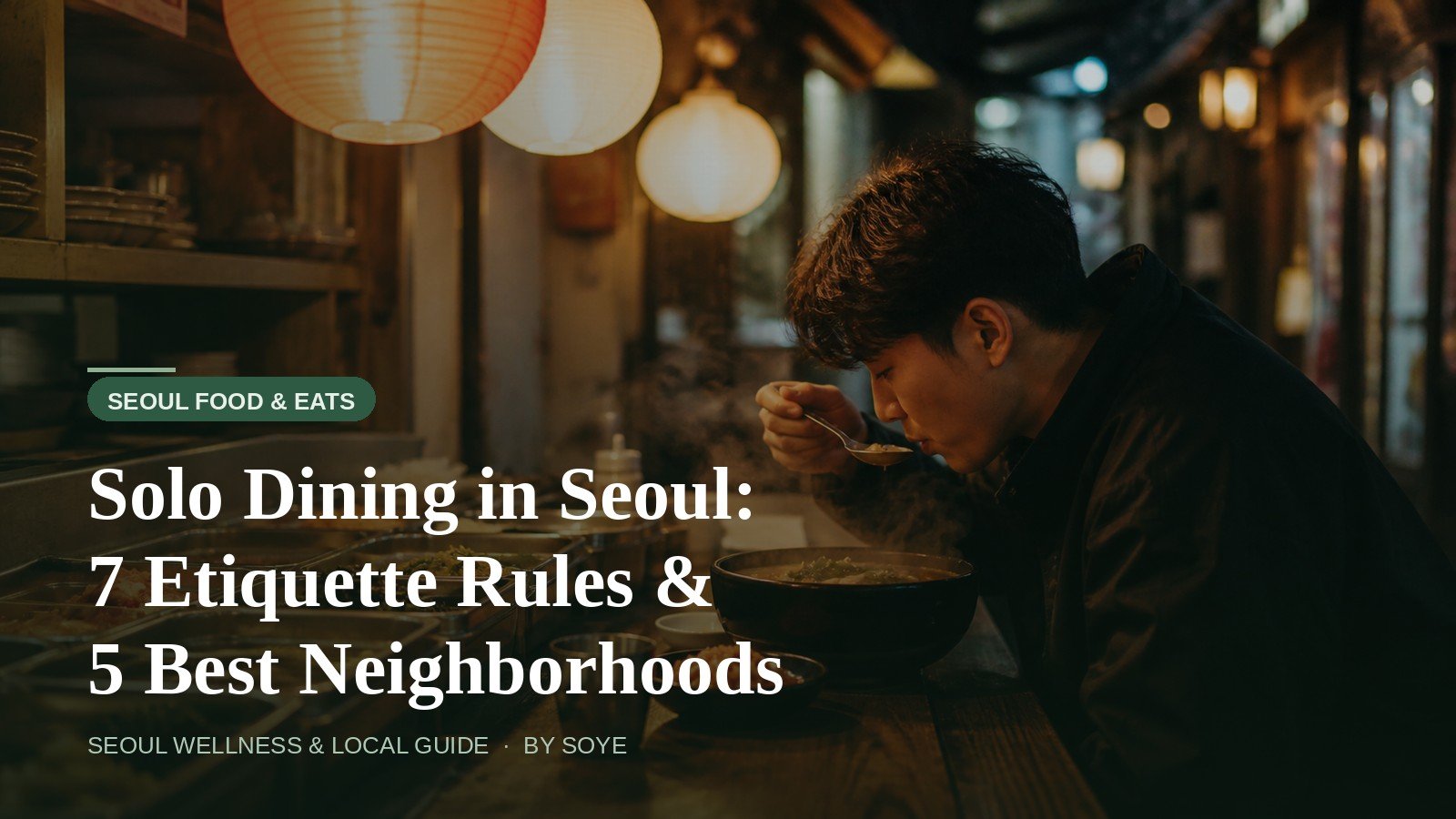
Eating alone in Seoul is not a compromise. It is a whole genre of eating, with its own etiquette, its own vocabulary and its own map. Korea has a word for it — honbap (혼밥, “solo meal”) — and a growing number of restaurants have quietly redesigned their menus, counters and kiosks around the person who walks in alone at 7 p.m. on a Tuesday.
But the first-timer still hits the same three walls: the grill restaurant that won’t sell you one portion, the kiosk with no English, and the side-dish counter nobody explained. This guide removes all three. Below are the seven unwritten rules that make a solo meal smooth, the five neighbourhoods where solo dining is easiest, and the Korean phrases that turn a hesitant entrance into a normal one.
Quick Verdict
Solo dining in Seoul works best at lunch and at the counter. Eat your one-person meals at noodle shops, soup houses, kimbap counters and department-store food halls, where a single serving is the default and nobody looks up. Save the grill houses for a two-portion order (₩30,000–₩45,000) or skip them. If you only remember one thing: say han myeong-i-yo (한 명이에요 — “one person”) at the door and let staff seat you.
The 7 unwritten rules of eating alone in Seoul
None of these appear on a menu. All of them are obvious to everyone in the room except you, which is exactly why they are worth ten minutes of reading.
- At a grill house, the minimum is two portions — not two people. Korean barbecue restaurants price meat per serving (1인분, usually 150–200 g), and most require an order of at least two servings per table. A solo diner can absolutely eat there; you simply order two portions, which comes to roughly ₩30,000–₩45,000 with rice and stew. If that is too much food, look for a sign reading 1인분 가능 (“single portions available”) or a 1인 고기 specialist, where a plastic tray of meat for one is normal.
- Say how many you are, then wait to be seated. Han myeong-i-e-yo at the door. In most casual places you may sit anywhere that isn’t marked 예약 (reserved), but in a busy restaurant, standing at the entrance is the correct signal — staff will point at a table.
- Side dishes are free to refill — but ask, don’t assume. Banchan come with the meal and refills are free at nearly every restaurant. At fast casual places there is often a 셀프바 (self-service bar) where you take your own kimchi, radish and sauce. Rice and soup are usually paid items even when banchan is not.
- Water, cutlery and tissues are usually self-service. Look for a water dispenser (정수기) near the counter, chopsticks and spoons in a drawer at the table end, and a tissue box on the wall. Nobody will bring them, and nobody minds that you got them yourself.
- Lunch is a sprint, dinner is a sit. Between 12:00 and 13:00 the restaurant’s economics depend on turning tables fast; a solo diner eating in 25 minutes is a gift, a solo diner reading for an hour is a problem. After 19:00, or at any time in a café, staying long is fine.
- Pay at the counter on the way out, and do not tip. Say gye-san-hae ju-se-yo (계산해 주세요 — “the bill, please”). Card and mobile pay are accepted nearly everywhere; tipping is not a Korean custom and adding one can confuse staff.
- Drinking alone is acceptable, loud is not. A solo beer or a bottle of soju with dinner at a 분식 or pojangmacha is unremarkable. What draws attention is volume — in a Korean restaurant the room is quiet enough that a phone call on speaker is a small event.
| Situation | What to do | What it costs |
|---|---|---|
| Walking in alone | Say 한 명이에요 and wait | — |
| Grill restaurant, one person | Order two portions of meat | ₩30,000–₩45,000 |
| Counter or kiosk shop | Order and pay first, then sit | ₩6,000–₩12,000 |
| Extra banchan | Ask 리필 해 주세요 or use the self-service bar | Free |
| Paying | Counter on the way out | No tip |
Ordering at a Korean kiosk, step by step
Since roughly 2022, unbranded kiosk terminals have replaced the front counter at a large share of kimbap chains, noodle shops, sandwich shops and food-court units. They are faster than queuing and intimidating exactly once. Most have an English button in the top-right or a small flag icon.
- Start on the first screen. Choose 매장 (eat in) or 포장 (takeaway). Getting this wrong is the only mistake that matters — a takeaway ticket at a table gets you a bagged meal.
- Switch the language if there is an English option. If not, match the photos; almost every kiosk shows a picture, a price and a number for each item.
- Tap each item, then use the + button to raise the quantity. Spicy level, rice size and add-ons appear as extra tiles.
- Check the basket screen (장바구니 or 주문내역) — this is where you see the total and can delete a mis-tap.
- Choose payment. 카드 takes a physical Korean or foreign chip/tap card at the terminal; 간편결제 opens a QR/app payment. Cash is increasingly rare on kiosks.
- Take the receipt and the buzzer. A small round device (진동벨) vibrates when your food is ready; collect it at the counter and return the buzzer. In a food court, the number on the receipt is called out instead.
One practical note: a foreign Visa or Mastercard usually works at these terminals, but some older kiosks accept only Korean-issued cards. If the card is refused twice, order at the counter instead of trying a third time.
The 5 easiest neighbourhoods for solo diners
Seoul has 25 districts and solo dining is fine in most of them. These five are where it is easiest — by concentration of one-person restaurants, by how used the staff are to foreign customers, and by how little explanation you need to give.
| Neighbourhood | Why it works for one | Typical solo meal | Best hours | Subway |
|---|---|---|---|---|
| Hongdae (홍대) | Young, international, counter seats everywhere; many kitchens serve single portions by design | ₩9,000–₩15,000 | 12:00–15:00, 18:00–22:00 | Line 2 Hongik Univ. |
| Euljiro (을지로) | Old print-district alleys full of 노포 (old-school taverns) and soup shops where a solo bowl is the norm | ₩8,000–₩14,000 | 11:30–14:00, 17:30–21:00 | Line 2 Euljiro 3-ga |
| Myeongdong (명동) | Tourist-density means menus in four languages and staff who seat singles without blinking; also the most department-store food halls per block | ₩10,000–₩18,000 | 10:30–21:00 | Line 4 Myeongdong |
| Yeonnam-dong (연남동) | Café-and-small-kitchen district; ramen, curry and rice-bowl counters built for one, and cafés where a laptop for two hours is normal | ₩11,000–₩16,000 | 12:00–15:00, 18:00–21:30 | Line 2 / Gyeongui-Jungang Hongik Univ. |
| Gangnam (강남) | Office district: lunch is a solo, fast, high-turnover meal; hundreds of 1인 식당 and healthy-bowl shops between the towers | ₩10,000–₩20,000 | 11:30–13:30, 18:00–21:00 | Line 2 Gangnam |
Hongdae and Yeonnam: the easiest first solo meal
If it is your first night in Seoul and you are nervous, start here. The density of small restaurants around Hongik University station means you can walk into four places in ten minutes, and the clientele — students, artists, foreign residents — makes a table for one invisible. Walk west into Yeonnam-dong for quieter counters and the café culture that lets you sit with a book afterwards without ordering twice.
Euljiro: the local version
Euljiro is where Seoul eats at 11:40 a.m. Tiled soup houses serve seolleongtang and gomtang to men in work jackets who sit alone by default. Prices are lower than anywhere else on this list, the food arrives in ninety seconds, and no one will ask why you are by yourself. Come at lunch; the alleys are a different place after dark.
Myeongdong: the no-translation-needed option
Myeongdong is a tourist district, and that is precisely its advantage: menus carry photos and English, staff are used to being asked, and department-store food halls (식당가) on the upper floors of Lotte and Shinsegae are the most solo-friendly rooms in the city — you order at a counter, take a tray, and eat at a communal table with no interaction at all.
Gangnam: fast, clean, and uninterested in you
Gangnam’s lunch crowd eats alone because everyone’s break is 50 minutes. Salad bars, 국수 shops, Japanese set-meal restaurants and the basement floors of office towers all price a single serving. It is not the prettiest meal in Seoul, but it is the least self-conscious.
Restaurant types that welcome one person
If you remember nothing else, remember this list. These categories treat a single diner as the default customer rather than an exception.
- 분식 (bunsik) — kimbap, tteokbokki, ramyeon; order at the counter, eat in 15 minutes.
- 국밥 / 해장국 (soup with rice) — the archetypal solo meal, often open 24 hours.
- 냉면 (cold noodles) and 칼국수 — one bowl, one person, no sharing culture.
- 라멘 / 우동 (ramen, udon) — counter seating and ticket machines.
- 돈까스 (pork cutlet) — set meals built for one.
- 백반 / 한정식 lunch sets — a tray of small dishes, priced per person.
- Department-store food halls — tray service, communal tables, no conversation.
- 회 / 초밥 lunch counters — sushi sets at lunch cost half the dinner price.
12 Korean phrases for a solo meal
| Korean | Meaning | When |
|---|---|---|
| 한 명이에요 | One person | At the door |
| 혼자 왔어요 | I came alone | When asked |
| 이거 주세요 | This one, please | Pointing at a menu |
| 1인분 돼요? | Can I order one portion? | Grill houses |
| 리필 해 주세요 | Refill, please | Banchan |
| 물 주세요 | Water, please | Anywhere |
| 덜 맵게 해 주세요 | Less spicy, please | Ordering |
| 포장 해 주세요 | Takeaway, please | Leaving with leftovers |
| 계산해 주세요 | The bill, please | At the counter |
| 카드 돼요? | Do you take card? | Small shops |
| 화장실 어디예요? | Where is the toilet? | Anywhere |
| 맛있어요 | It’s delicious | On the way out |
A solo eating day in Seoul, with real costs
Here is how I would spend a solo day — a version of what I actually do when I am in the city without plans.
- 08:00 — soup for breakfast. A 24-hour 해장국 or 국밥 house near any subway exit. One bowl, ₩9,000–₩11,000, and the room is full of people eating alone before work.
- 12:30 — lunch at a counter. Kimbap and tteokbokki at a 분식, or a ramen counter in Yeonnam. ₩8,000–₩12,000. Fifteen to twenty minutes.
- 15:00 — coffee, no second order. A café where one drink buys two hours of table. ₩5,500–₩7,000.
- 19:00 — the one “real” dinner. Either a two-portion barbecue (₩35,000 with rice and stew, and a doggy bag is normal) or a 1인 고기 tray set (₩15,000–₩20,000).
- 21:30 — dessert or a night market snack. ₩4,000–₩6,000. Total for the day: roughly ₩45,000–₩65,000, or about $32–$46.
FAQ for first-time solo diners
Can I really eat alone at a Korean barbecue restaurant?
Yes, provided you order two portions of meat. The minimum in most grill houses is two servings per table, not two people. A two-portion order with rice and a stew comes to about ₩30,000–₩45,000, and staff will cook or turn the meat for you if you ask. Restaurants advertising 1인분 or 1인 고기 sell a single tray.
Do I need to tip in Seoul?
No. Tipping is not a Korean custom, service charges are not added, and the price on the menu is what you pay. Pay at the counter on your way out with a card or mobile pay.
Is it rude to eat alone during the lunch rush?
Not at all — it is considerate, as long as you don’t hold the table for a long time. Between 12:00 and 13:00 in office districts, eat in 20–30 minutes and move on. If you want to linger, come after 13:30 or after 19:00.
Are side dishes really free to refill?
Banchan refills are free at nearly all Korean restaurants, and many fast-casual places have a self-service bar. Rice and soup are paid items. If a refill isn’t obvious, say 리필 해 주세요.
Can I order in English at the kiosk?
Most kiosks in tourist areas and chains have an English option on the first screen. Where they don’t, order by the photo and the price — the item numbers match what is called at the counter. If a foreign card is refused twice, order at the counter instead.
What if I want a drink with dinner alone?
One beer or a bottle of soju with a meal is completely normal, especially at 분식, soup houses and pojangmacha. Korean drinking culture is social but not exclusive; what stands out is noise, not solitude.
Final Summary
- Walk in and say 한 명이에요. Staff seat you; no explanation needed.
- Grill houses: two portions, ₩30,000–₩45,000. Or find a 1인분 / 1인 고기 shop for a single tray.
- Default solo meals live at 분식, 국밥, 냉면, 라멘, 돈까스 and department-store food halls — ₩6,000–₩15,000, ordered and paid at a counter or kiosk.
- Easiest neighbourhoods: Hongdae, Euljiro, Myeongdong, Yeonnam, Gangnam. Lunch 12:00–13:00 is fast; after 19:00 you can sit.
- No tipping. Banchan refills free, water and cutlery self-service, bill at the counter.
Last checked: 15 November 2026. Prices are typical Seoul ranges and move with inflation; barbecue minimums and kiosk payment rules vary by shop, so confirm at the door.