Nobody gets lost in Seoul because the trains are confusing. They get lost at the gate. You tap in, walk down the stairs, watch your train leave from the other side of a wall, and find that your direction sits behind a second set of ticket gates — with your card already charged once.
This Seoul subway guide is about those fifteen metres: the 15-minute re-entry rule that turns a wrong turn into a free correction, the emergency gate that opens a walled platform, the transfer clock that expires while you buy coffee, and why the map on your phone cannot walk you out of the station. All of it was checked in Seoul on 18 November 2026 against Seoul Metro’s passenger terms, the city’s transit notices and Visit Seoul’s fare table.
Verified Local Transit Policy · Active for November 2026
Field Checked in Seoul
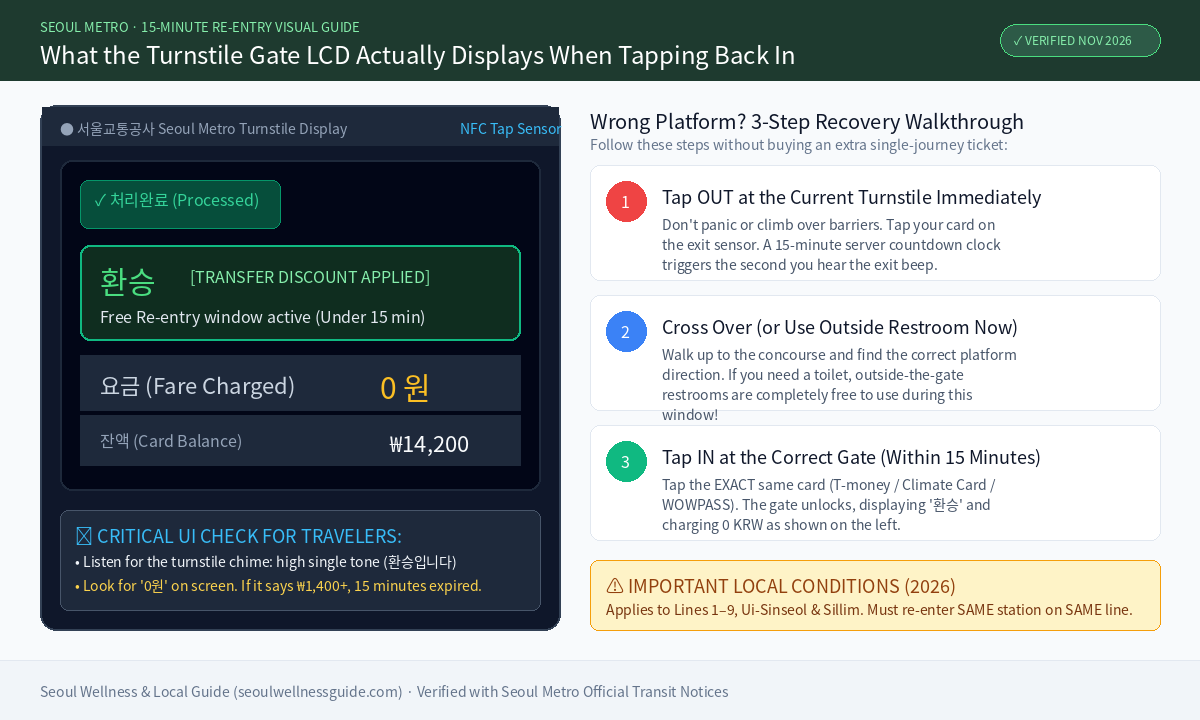
Seoul Metro 15-Minute Free Re-Entry Rule: Re-tagging your transit card at the exact same station within 15 minutes is officially coded as a transfer (환승) with 0 KRW fare charged across Lines 1–9, Ui-Sinseol Line, and Sillim Line. Confirmed active and tested on T-money, Climate Card, and WOWPASS.
Quick Verdict
Tap out and back in at the same station within 15 minutes and Seoul Metro will not charge a second base fare — it counts as a transfer instead. That one rule fixes a wrong platform, a missed stop and a toilet break, on every line Seoul Metro runs.
Why Google Maps still cannot walk you anywhere
Arrive at Incheon, open Google Maps, search a restaurant 400 metres from your hotel. The pin is there. The route is not. Walking and driving directions have never worked in Korea, and in November 2026 that is still true — but the story is in its last act, and most English guides have caught up with neither half of it.
The cause is a map-export rule, not a glitch. Korea treats large-scale map data as a security asset, so the base map leaving the country needs government approval. Navigation is not drawing lines on a picture; it is millions of route calculations on servers worldwide, which means the detailed road network has to sit outside Korea. Google had the 1:5,000 base map for display through a domestic partner, and display data cannot route. Naver Map and KakaoMap calculate inside the country, which is why they walk you to the door.
The timeline matters if you travel this winter:
- February 2025 — Google applies again to export the 1:5,000 national base map.
- 27 February 2026 — the land ministry approves it with conditions: coordinate display limits, blurred security imagery, data processed on Korean servers, a named security officer.
- 13 November 2026 — the review committee confirms the conditions are met. Korean press reports walking and driving directions arriving “as early as early next year”.
Until then, treat Google Maps as a saved-places and timetable tool: transit routing works, the English place data is decent, but step outside a station and it becomes a list of pins. The Yonhap report of 13 November 2026 is the clearest account.
Which app to open in which moment
Four apps cover Seoul, and they are not interchangeable: Naver Map for walking and door-to-door, Subway Korea for the platform, KakaoMap for buses, Google Maps for the list you saved at home.
| Feature | Google Maps | Naver Map (EN) | KakaoMap | Subway Korea |
|---|---|---|---|---|
| Walking directions | No — transit only | Yes, English voice | Yes | No — subway only |
| Subway + bus routing | Basic, no live data | Yes, with exits | Yes, best live buses | Subway only |
| English names and exits | Yes | Yes, complete | Partly — details stay Korean | Yes, five languages |
| First and last train | Approximate | Yes | Yes | Yes, per station |
| Carriage / best exit tip | No | Exit number only | Yes, which car stops by your stairs | Exit saved in bookmarks |
Naver Map goes on the home screen first: switch it to English and station names, transfers and exit numbers all follow, and its transit tab has an avoid-stairs option that matters with a suitcase. KakaoMap earns its place for buses — the best live vehicle tracking in the country, plus the carriage that puts you by the right staircase. Subway Korea (지하철종합무선망) is single-purpose: routes, timetables, first and last trains, station facilities, offline maps — the app to open on a platform with no signal. Seoul Subway — Official App, Seoul Metro’s own, follows your phone’s language and carries live delay notices for lines 1–8.
What a ride costs, and how the gates count it
Seoul prices by distance, and the number that matters is the card fare: ₩1,550 for an adult ride under 10 km, which covers almost every visitor trip inside the city. Between 10 and 50 km another ₩100 is added every 5 km, and past 50 km every 8 km. A single-journey ticket costs ₩1,650 plus a ₩500 deposit refunded by machine at your destination. Youth pay ₩900 with a card, children ₩550. The airport railway’s independent stretch and the Shinbundang line add supplements; everything else, including the Ui-Sinseol and Sillim lines, runs on the standard fare. Visit Seoul’s Getting Around Seoul page carries the current table.
Here is what visitors miss: a subway-to-subway transfer inside the paid area is not a transfer at all. Tap once at the start and once at the end, and the system prices the whole distance as one ride — which is why nobody changing from line 2 to line 5 at Chungjeongno keeps the card out of their pocket twice. Transfers only start to matter when a bus is involved, or when you leave the paid area and come back.
The 15-minute re-entry rule, in full
Seoul calls it 재승차 — riding again. Tag out, realise you are on the wrong side, tag back in at the same station within 15 minutes, and the gate charges no second base fare. Instead the re-entry is treated as a transfer: no new ₩1,550, but one transfer slot is spent.
The scheme began as a ten-minute pilot on 1 July 2023 after years of refund complaints, and widened to fifteen minutes on 7 October 2023 when the Sillim and Ui-Sinseol lines joined. Seoul Metro’s passenger terms, revised in March 2026, write it in as Article 25 — the same article that gives period-pass holders a five-minute window. The city’s announcement of the expansion is the primary source; Seoul Metro publishes the English version of its fare and ticket rules.
What qualifies, exactly:
- Prepaid or postpaid transit cards only — T-money, Cashbee, a credit card with a transit chip, a mobile card. Single-journey tickets do not qualify.
- Same station, same line — at a transfer station such as Sindorim or City Hall it applies only if you return on the line you left; the other line is an ordinary transfer.
- Within 15 minutes of the exit tag, and once per journey. A second exit and return is charged normally.
- Period passes get five minutes, under a different clause with a different clock.
- Climate Card works — confirmed in Seoul city’s October 2026 transit FAQ, but only at stations where the pass itself opens gates.
Two catches. First, the rule lives in Seoul Metro’s terms, so it covers the sections Seoul Metro runs: all of lines 2, 5, 8 and 9; lines 1 (Seoul Station–Cheongnyangni), 3 (Jichuk–Ogeum), 4 (Jinjeop–Namtaeryeong), 6 (Eungam–Bongsan) and 7 (Jangam–Onsu); plus Sillim and Ui-Sinseol. Cross into a Korail-run section and that operator’s rules decide. Second, the clock runs from the moment your card touches the exit reader — a wrong exit, a lift queue and a toilet stop can eat most of it.
Wrong platform: six steps that cost nothing
- Do not tap the exit gate yet. Read the platform sign above the escalator and work out which direction you are actually facing.
- Pick the fix. Leaving and coming back? Exit-and-re-enter. Platform behind a wall? Emergency gate.
- Exit and re-enter inside 15 minutes — tap out, walk to the other gate line, tap in with the same card. The balance should not move; check the display.
- Or press the call button on the emergency gate at the end of the gate line and say 반대편으로 가야 해요 (ban-daepyeon-euro gaya haeyo — I need the other side).
- Ride one stop and come back if you are already on a train: get off, cross inside the paid area, ride back. You pay the extra distance, usually ₩100.
- If the gate refuses you, do not climb or push — use the fare adjustment machine by the gates or the staffed customer service centre.
Stations where the other platform is behind a wall
Seoul has a name for them: 승강장 횡단 불가역, stations where you cannot reach the opposite platform without passing the gates. They are usually side-platform stations with separate gate lines for each direction. On line 2 alone, Sinchon, Euljiro 1-ga, Yeoksam, Jamsil-saenae and Sports Complex keep the directions apart; on line 4, Mia-sageori; on line 5, Balsan and Omokgyo. The list shifts whenever a station is remodelled, so the practical rule is simple: side platforms with their own gate lines mean no crossing.
The tool is the emergency gate (비상게이트), the wide gate at the end of the line with a call button on its post. Press it, wait for the answer, explain in one sentence. Staff reply in Korean, but this exchange is short enough to survive a language barrier:
- 반대편으로 가야 해요. — I need to get to the other side. The one sentence that solves it.
- 방향을 잘못 들어왔어요. — I came in the wrong direction.
- 표를 잘못 찍었어요. — I tagged my card by mistake.
- 화장실이 어디예요? — Where is the toilet? At many of these stations it sits outside the paid area, which is exactly why the gates are split.

“Whenever I’m commuting through busy Line 2 stations like Gangnam, Sinchon, or Euljiro and need a restroom, I never waste time searching for the rare toilets inside the paid gate area. At these walled stations, the cleanest restrooms sit right outside in the public corridor.
I simply tap out through the normal turnstile, use the outside restroom, and tap back into the platform within 15 minutes. The gate screen beeps ‘환승’ (Transfer) and deducts exactly 0 KRW. As long as you tap back into the same station on the same line, Seoul Metro’s automated server treats your entire toilet break as a free transfer!”
The same gate is the answer when a card will not open the exit, when a child’s card is rejected, and for a wheelchair or pram. It is not a fare-evasion shortcut: staff see your card history and will send you to the adjustment machine if you owe money.
The emergency cheat sheet
| Situation | What to do | Time window | Say this |
|---|---|---|---|
| Wrong direction, platforms split by gates | Exit and re-enter at the other gate line, or press the emergency gate button | 15 min | 반대편으로 가야 해요 |
| Rode past your stop | Get off at the next station, cross inside the paid area, ride back | Extra distance charged | 지나쳤어요 |
| Toilet is outside the gates | Exit, use it, re-enter with the same card | 15 min | 화장실이 어디예요? |
| Card will not open the exit | Fare adjustment machine by the gates, or customer service centre | Before you leave | 잔액이 부족해요 |
| Bus transfer did not apply | Check you tapped off — a missed tap ends the transfer | 30 min (60 at night) | 환승이 안 됐어요 |
| Phone map shows no walking route | Switch to Naver Map for the last 400 m | — | — |
The four transfer rules that expire
Integrated transfer pricing is what makes Seoul cheap: a bus and a subway ride inside 10 km are priced as one journey at the higher base fare. Four rules decide whether you get it, and all four fail quietly.
One: thirty minutes. From exit tag to next entry tag you have 30 minutes; between 21:00 and 07:00 the window stretches to 60. The clock starts when you tap off, so coffee before the gate costs nothing and coffee after it can cost a fare.
Two: four transfers, five rides. One journey takes up to four transfers — five vehicles — priced together. A sixth starts over.
Three: tap off, always. Seoul’s buses expect the card on the way out as well as in. Miss it and the system has no record of where you got off: the transfer is void and the next leg is billed as a new journey.
Four: the same line is not a transfer. Re-boarding the same bus line or the same train pays the base fare again — which is the gap the subway’s 15-minute rule fills, and why a bus is a bad place to discover you are going the wrong way.
One ceiling nobody plans around: a single transfer journey has to finish within five hours on subway and city buses, or one hour on village buses.
The cash trap at the recharge machine
This is the one that strands people at 23:00 with ₩400 on the card. Seoul’s machines changed a lot from 2025, and the change is easy to misread: the new kiosks take foreign cards for some products and still refuse them for the card in your pocket.
Seoul Metro replaced its 16-year-old kiosks from 6 September 2025, starting at 25 stations and rolling 440 machines across lines 1–8. The new kiosks accept credit cards and Korean mobile payments — but only for single-journey tickets, period passes and the Climate Card, including buying the physical card and loading a pass. Recharging a prepaid T-money card is still cash only, in ₩1,000 or ₩10,000 units; Seoul city’s transit FAQ of September 2026 says the same.
- Use the machine with won in hand. It sits to the right of the unmanned information machine at most stations: put the card on the tray, insert ₩1,000 or ₩10,000 notes. There is an English menu.
- Top up at a convenience store. CU, GS25 and 7-Eleven recharge at the counter, also in cash — the most reliable option after the station staff go home.
- Charge the phone instead. A mobile T-money card tops up in the T-money app with a card, which sidesteps the machine entirely.
- Buy a single ticket with your card. The new kiosk sells ₩1,650 single tickets on a foreign Visa or Mastercard. You lose the ₩100 card discount and must collect the ₩500 deposit, but it works at 23:00 with no cash.
WOWPASS users have their own version: the card carries a T-money chip, but its kiosk does not load the transit balance — exchange and load, then put the card on a T-money machine with won. Climate Card holders are the lucky ones: the short-term pass is bought and loaded at the new kiosks with a foreign card, with a service fee of roughly 3.7%.
FAQ
Does the 15-minute rule work with a single-journey ticket?
No. It is written for prepaid and postpaid cards, so exiting and re-entering on a paper ticket means buying another ₩1,650 ticket. For anything longer than a day, a T-money card pays for itself at the first mistake.
Will it work with my Climate Card?
Yes, at stations where the pass can be used. Seoul city confirmed it in an October 2026 FAQ with that caveat: the exemption exists only where the pass itself opens gates.
I tapped out and back in at the same station but my balance dropped. Why?
Usually one of five things: a transfer station where you re-entered on a different line; more than 15 minutes passed; a different card for the second tap; a second exit-and-return in the same journey; or a section run by another operator with its own terms.
Can I recharge T-money with a foreign credit card at the station?
Not onto the card itself. Foreign cards work for single tickets, period passes and the Climate Card at the new kiosks, but prepaid top-ups stay cash — at machines and at convenience store counters alike.
Does Google Maps work for the subway in Seoul?
Yes, for transit routing — lines, stations, timetables. It cannot walk or drive you, because routing needs the detailed base map outside Korea and the export only cleared its final security check on 13 November 2026. Walking directions are expected in 2027, not this winter.
What happens if I do not tap off a Seoul bus?
The transfer discount is lost and each leg is billed separately, so the next ride starts a new fare instead of continuing your journey. Tap out even when the doors are open and everyone else is already walking away.
Is the subway open late enough for a late dinner?
Trains run from about 05:30 to around midnight, with the last departure from central stations between 23:30 and 00:00 depending on line and direction. Check your own station in Subway Korea or Naver Map first — the differences between lines are bigger than visitors expect.
Cheat sheet
Final Summary
- Wrong platform: exit and re-enter at the same station within 15 minutes with the same card — no second base fare, one transfer slot spent. Cards only; period passes get 5 minutes; single tickets get nothing.
- Walled platform: press the call button on the emergency gate and say 반대편으로 가야 해요. Sinchon, Euljiro 1-ga, Yeoksam and Mia-sageori need it.
- Transfers: 30 minutes between taps, 60 from 21:00 to 07:00; four transfers or five rides; always tap off, or the discount ends.
- Money: ₩1,550 by card under 10 km; ₩1,650 plus a ₩500 refundable deposit for a single ticket. T-money tops up with won only; foreign cards work at the new kiosks for single tickets and the Climate Card.
- Maps: Naver Map for walking and exits, Subway Korea for platforms and last trains, KakaoMap for buses. Google Maps cannot walk you anywhere until 2027.
Last checked: 18 November 2026, against Seoul Metro’s passenger transport terms (Article 25, revised March 2026), Seoul city’s 2023 re-entry expansion notice and its 2026 transit FAQs on the Climate Card and kiosk payments, Visit Seoul’s Getting Around Seoul fare table, the land ministry’s 13 November 2026 map-export review as reported by Yonhap, and current App Store listings for the apps compared here. Fares, rules and app features change — confirm before you travel.
Planning the airport legs too? The AREX versus airport bus comparison covers arrival day, the night bus and taxi guide covers landings after midnight, and our Climate Card versus WOWPASS versus T-money breakdown prices the three cards against a three-day trip. For bags, the Seoul Station city airport terminal guide shows where to drop them first.