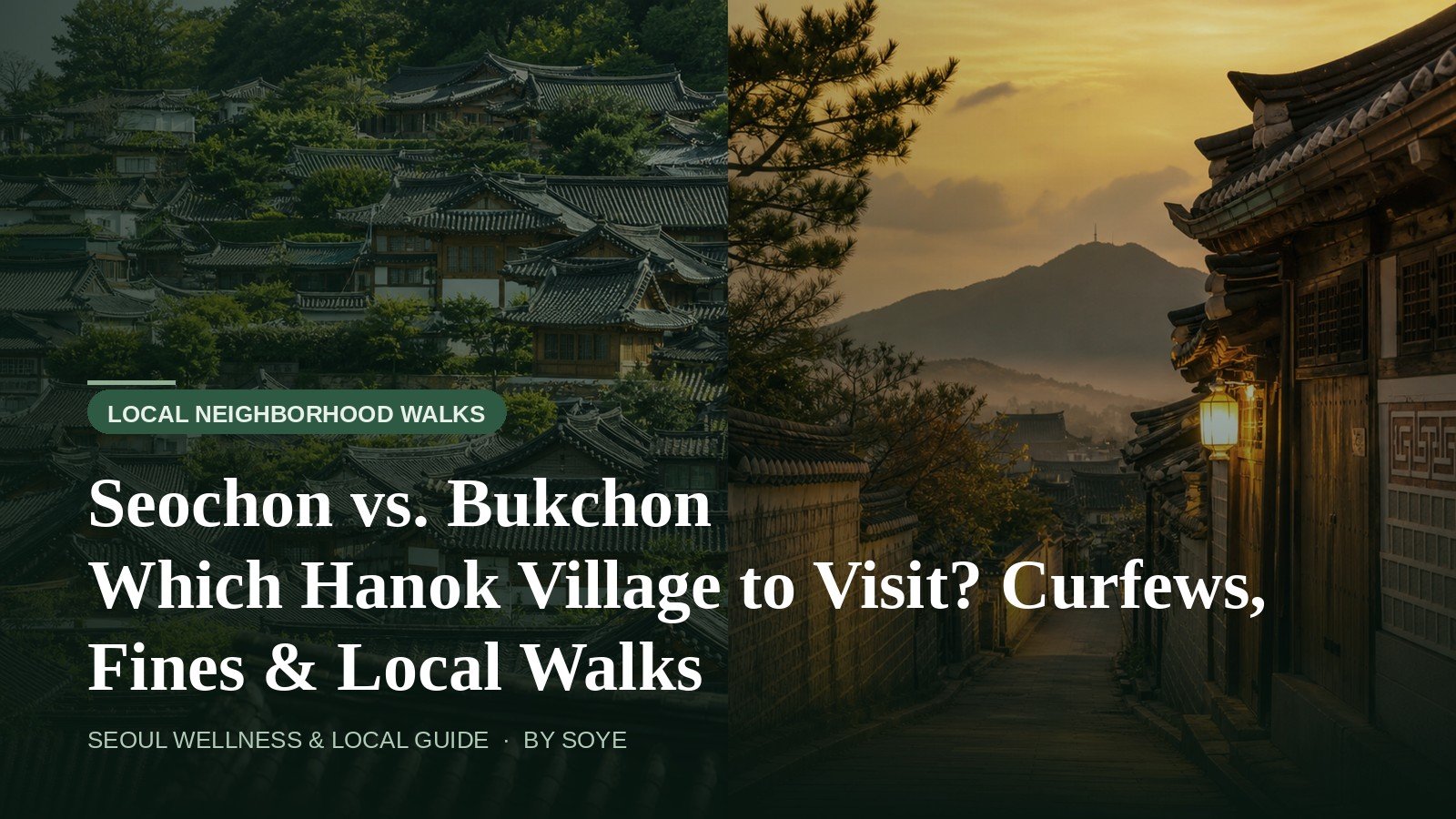
Bukchon and Seochon sit twenty-five minutes apart on foot, both pressed against the walls of Gyeongbokgung, both full of tiled hanok roofs. They are not interchangeable. One has a legally enforced visiting window and a ₩100,000 fine; the other has a brass-coin market, a 1951 bookshop and no closing hour at all.
This is the comparison most Seoul guides skip: not “which is prettier”, but which one you can actually walk at 6 p.m., where the fine zone starts and ends, how the Tongin Market lunchbox works in 2026, and what a local does with a free afternoon west of the palace.
Quick Verdict
Seochon wins for a relaxed walk, evening light and food. Bukchon wins for a single, concentrated hanok photo walk — but only between 10:00 and 17:00, because tourist entry to the Bukchon red zone outside those hours carries a ₩100,000 fine.
The difference in one minute
Bukchon (북촌, “north village”) is the postcard: a hillside of tightly packed, well-preserved hanok between Anguk station and the palace’s east wall, with the famous view down Bukchon-ro 11-gil toward the city. It is beautiful, small, and by 11 a.m. on a Saturday it is a queue. It is also the only hanok neighbourhood in Korea with a special legal status, which is the part visitors find out too late.
Seochon (서촌, “west village”) is the same age and the same architecture without the staging. It spreads west of Gyeongbokgung through Nuha-dong, Tongin-dong, Pilun-dong and Ogin-dong: low hanok, one-storey shops, a working traditional market, a 1942 inn turned art space, and Inwangsan rising at the end of every alley. Painters and poets lived here — Yi Sang, Yun Dong-ju, Lee Jung-seob — and the neighbourhood still reads as lived-in rather than preserved.
The practical consequence is simple. In Bukchon you are a visitor in a residential zone with hours. In Seochon you are a visitor in a residential zone without hours — which means the etiquette is on you rather than on a security officer.
Seven-point comparison
| Metric | Bukchon Hanok Village | Seochon |
|---|---|---|
| Atmosphere | Polished, dense, cinematic; restored hanok in rows; the classic tiled-roof photograph | Lived-in, uneven, quiet; hanok mixed with 1970s houses, studios, bookshops and a working market |
| Crowds | Heavy 10:00–17:00, worst 11:00–15:00 and all weekend; tour groups with guides | Light on weekdays; busy only inside Tongin Market at lunch and on café streets after 14:00 |
| Access restriction | Red zone: tourists allowed 10:00–17:00 only. Outside that, tourism carries a ₩100,000 fine (enforced since 1 March 2025) | None. No curfew, no fine, no gate; open streets 24 hours |
| Best time | 10:00 sharp, or 16:00–17:00 for low sun — knowing you must leave by 17:00 | 15:00–19:00; sunset from the Inwangsan trail is the reason to come late |
| Food | Cafés and dessert shops aimed at visitors; few cheap meals; expect ₩12,000–₩20,000 | Tongin Market: brass-coin lunchbox from ₩10,000; noodles, mandu, tteokbokki at local prices |
| Photo spots | Bukchon-ro 11-gil slope, Bukchon Hanok Village viewpoint, the alley to the “8 views” markers | Daeo Bookstore doorway, Yi Sang’s House balcony, Cheongun Literature Library courtyard, Inwangsan ridge over the roofs |
| Subway | Anguk station (Line 3) exit 2, 8–10 min uphill | Gyeongbokgung station (Line 3) exits 2 and 3, 5–10 min; also Gwanghwamun (Line 5) |
Both are on Line 3, one stop apart — Anguk to Gyeongbokgung is a three-minute ride, or a twenty-five-minute walk along the palace wall. Doing both in one afternoon is realistic: Bukchon first at 10:00, palace wall walk south, Seochon from 14:00, sunset on the mountain.
Bukchon’s curfew, exactly
Jongno-gu designated Bukchon a Special Management Area on 1 July 2024 — the first of its kind in Korea — and split it into red, orange and yellow zones by how much residents were suffering. The red zone is the dense residential hanok block around Bukchon-ro 11-gil, about 34,000 m². The visiting-hour rule began as a trial on 1 November 2024; from 1 March 2025 fines are actually issued.
What it says, in plain terms:
- Tourists may be in the red zone from 10:00 to 17:00. That is the entire legal window. Not “recommended hours” — the visiting hours.
- Outside 10:00–17:00, entering the red zone “for tourism purposes” carries a ₩100,000 fine. The same applies to foreign visitors, and the notice explains how to pay on the spot or before leaving the country.
- “Tourism” is defined broadly: taking photos or video, standing and looking around, and wandering the streets for reasons unrelated to a shop. A selfie at 18:00 on that slope is exactly what the ordinance describes.
- There are real exceptions. Registered residents and their family and guests, customers of red-zone shops, shopkeepers, guests staying in red-zone accommodation, people simply passing through without touristic activity, and vehicles not there for tourism are all exempt. If you have booked a hanok stay inside the zone, you may come and go — but you may not sightsee.
- Enforcement is by people, not cameras. “Bukchon security officers” (북촌보안관) walk the lanes, explain the rule and ask visitors to move on; a fine follows refusal, not a first mistake. Jongno-gu said in mid-2025 that no fine had yet been issued. That is a measure of how the rule is applied, not a promise that it is optional.
- Since 1 January 2026, charter buses are restricted on Bukchon-ro, Bukchon-ro 5-gil, Bukchon-ro 4-gil and Changdeokgung 1-gil — about 2.3 km, weekends and holidays included — with fines of ₩300,000, ₩400,000 and ₩500,000 for repeat offences. Group tours now drop further out and walk in.
The zone boundary is not obvious on the ground. Jongno-gu publishes the red, orange and yellow polygons on the Smart Seoul Map (map.seoul.go.kr), and the leaflets posted at each lane entrance show the same map; check it before you plan an evening photo walk. In practice the red zone is the slope and the lanes around Bukchon-ro 11-gil, while Gahoe-dong’s café streets, the museum row and the main Bukchon-ro below are outside the strictest block.
What this means for a visit: arrive at 10:00, walk uphill while the lanes are still empty, and be out by 16:45 rather than at 17:00 when officers begin moving people along. If you want golden-hour roofs, get them from outside the red zone: the palace wall path, Samcheong-dong, or the view from Seochon across the roofs. And if your only free hours are in the evening, choose Seochon. It is not a lesser version — it is the same architecture with the lights on.
Seochon: no curfew, same residents
Seochon has no special designation, no visiting hours and no fine. Somebody’s grandmother lives behind that gate, though, and the same courtesies apply: no peering over or through walls, no tripods blocking a doorway, voices down in the alleys after dark, and no photographing people’s windows. The difference is that in Seochon nothing will be posted at the entrance to remind you.
What is there to walk to: Daeo Bookstore (대오서점), open since 1951 and Seoul’s oldest bookshop, now a two-room café at 55 Jahamun-ro 7-gil where you take your shoes off and drink in near silence — 12:00–20:00, and bring cash, because it has long been a cash-only counter. Yi Sang’s House (이상의 집), the poet’s small house and archive, free, Tuesday–Sunday 10:00–17:00, closed Mondays. Boan 1942 (보안여관), a 1942 inn that became an art space at Hyoja-ro 33, 12:00–18:00, closed Mondays. And Cheongun Literature Library, a hanok public library in the trees at Jahamun-ro 36-gil 40, free, Tuesday–Friday 09:00–21:00 and weekends 09:00–19:00, closed Mondays.
For tea rather than coffee, Seochon is better than Bukchon. Hojeon Dasil (호전다실) at 16-2 Jahamun-ro 11-gil is a tea house run by a tea scholar, open daily 10:00–21:00; Seochon Ssanghwa (서촌쌍화) in Pilun-dong makes ssanghwa from twelve ingredients; a pot of daechu or omija tea runs ₩7,500–₩9,500. Traditional tea is the thing to order here — the espresso scene belongs to the next neighbourhood.
A five-step Seochon walk
- Gyeongbokgung station, exit 2 (13:30). Line 3, five minutes to the market. Use the station lockers at exits 4 and 6 if you are carrying a bag: ₩2,200 for a small locker per four hours, ₩3,300 medium, ₩4,400 large, open 05:00–01:00. They are few, and full by midday on weekends.
- Tongin Market lunchbox (14:00). Buy brass coins on the second floor of the customer service centre, fill the tray at the stalls, eat upstairs. Details and closing days below — this step fails if you arrive after 15:00 on a weekday.
- Boan 1942 and Yi Sang’s House (15:30). Five minutes apart on the palace side of the neighbourhood. Both are small; twenty minutes each is enough, and both are free or nearly so. Closed Mondays.
- Tea in a hanok (16:30). Hojeon Dasil for oolong and Korean tea, or Seochon Ssanghwa for something hot and medicinal. This is the hour the light goes amber on the tiled roofs.
- Cheongun Literature Library, then Inwangsan for sunset (17:30). Walk or take bus 7212, 1020 or 7022 to Jahamun Pass for the library, then 15 minutes uphill to the Choso Bookshop. It is open daily 08:00–22:00, no entry fee, and from the glass front you look straight down over the roofs to Namsan Tower. Sunset in November is around 17:20 — go for the afterglow rather than the sun itself.
Total walking is about 6 km with one hill, and the route works in reverse: sunset on Inwangsan, tea, then dinner at the market before it closes at 21:00. If the mountain sounds like too much, end at the library courtyard — it is the quietest free seat in central Seoul.
The brass-coin lunchbox, step by step
Tongin Market’s yeopjeon dosirak (엽전 도시락) is not a restaurant. You buy old-style brass coins, spend them at participating stalls in exchange for small portions, and carry the tray upstairs to eat. Prices at the stalls are written in nyang (냥), a historical counting unit, which confuses Koreans as much as foreigners: 1 nyang = 1 coin = ₩500.
Here is the 2026 version, because most English pages are out of date in ways that cost you the meal:
- Buy coins at the Customer Service Centre on the 2nd floor, in the middle of the market — not at a stall. You receive a black plastic tray with six compartments.
- One coin is ₩500. A sensible lunch is 20 coins, ₩10,000 per person; the counter has been asking for roughly that minimum, and unused coins are refundable, so overbuying is safe.
- The coin window closes before the seating does: 11:00–15:00 on weekdays, 11:00–16:00 on weekends and public holidays. Arriving at 15:10 on a Tuesday means no coins, no tray, no lunchbox.
- The lunchbox café is closed Mondays and the third Sunday of each month. The Monday closure took effect on 1 April 2026 — before that it was Tuesdays, and Seoul’s official English listing still prints “Tuesday”. Check the market’s Instagram (@tongin_official) for the month’s calendar. On a Monday the market itself trades normally; only the coin system stops.
- Rice and soup are separate: ₩1,000 (2 nyang) each, back on the 2nd floor. A tray of side dishes without them is a snack, not a meal.
- Payment: cash, card, or Onnuri gift certificates. The market runs 07:00–21:00 and shuts entirely on the third Sunday.
What to spend coins on: oil-fried tteokbokki (기름떡볶이), the dry, chewy version that made this market famous, around 4 nyang; mayak gimbap, thumb-sized rolls; jeon, the flat pancakes; and grilled skewers. Twenty coins does not quite fill all six compartments — the typical item is 3–4 coins — so think of ₩10,000 as a tasting budget and top up mid-meal if you are hungry.
If you cannot manage the timing, the market still works: the same stalls sell the same food for ordinary money, and there is a noodle alley beside it. You just do not get the tray, the upstairs seats, or the coin ritual. Our solo dining guide to Seoul covers the eating-alone side of these market meals.
Etiquette, walls and drones
- The hanok behind the wall is a home. In both villages, do not open gates, look through windows, climb onto walls, or photograph into courtyards. If a door is open, it is a doorway, not an invitation.
- Keep your voice at conversation level. Tour groups are the usual offenders; a normal voice in a narrow lane carries into three houses.
- Do not block a lane with a tripod or a ring light. In Bukchon the slope down Bukchon-ro 11-gil is also a resident’s only route home.
- Ask before photographing people. A quick 사진 찍어도 될까요? is enough, and a “no” is common and fine.
- No drones. The palace, the former presidential compound and the ground around them sit inside a permanent restricted flight zone, and both Bukchon and Seochon are under it. Flying there without prior approval from the authorities is not a grey area — leave the drone at the hotel.
- Trash goes with you. Street bins are rare in both neighbourhoods; convenience stores take their own bags.
- Staying in a hanok? Book through a registered guesthouse. The zone rules in Bukchon allow lodging guests through, but your host has to be able to confirm you.
Five phrases that work
| Korean | Romanization | Meaning | When to use |
|---|---|---|---|
| 엽전 도시락 이용하고 싶어요 | Yeopjeon dosirak iyonghago sipeoyo | I’d like to do the brass-coin lunchbox | At the 2nd-floor customer service centre |
| 엽전 몇 개예요? | Yeopjeon myeot gae-yeyo? | How many coins is this? | At a stall when the card says “3냥” |
| 기름떡볶이 1인분 주세요 | Gireum-tteokbokki il inbun juseyo | One portion of oil-fried tteokbokki, please | At the most famous stall in the market |
| 따뜻한 오미자차 한 잔 주세요 | Ttatteutan omija-cha han jan juseyo | A hot omija tea, please | In a hanok tea house; add 아이스 for iced |
| 사진 찍어도 될까요? | Sajin jjigeodo doelkkayo? | May I take a photo? | Before photographing a person, a shop interior or a doorway |
FAQ
What time does the Bukchon curfew start, and is the ₩100,000 fine real?
Tourists may be in the red zone only between 10:00 and 17:00. Outside those hours, entering for tourism — including photography or simply wandering — can draw a ₩100,000 fine, enforced since 1 March 2025. Residents, shop customers, shopkeepers, lodging guests and people passing through without sightseeing are exempt, but sightseeing by an exempt person is still a violation. Officers explain before they fine.
Can I see Bukchon at night for the illuminated roofs?
Not from inside the red zone. Bukchon-ro 11-gil and the lanes around it are closed to tourist activity after 17:00. Evening roof views come from outside it: the palace wall path, Samcheong-dong, or Seochon and the Inwangsan trail, which have no hours.
Is Bukchon completely off-limits after 17:00?
No — the restriction covers tourism, not the whole neighbourhood. You may walk through to reach a shop, a museum or your accommodation, and ordinary traffic is unaffected. What you cannot do is stroll, photograph and look around. Cafés and restaurants outside the red zone keep normal evening hours.
Does wearing hanbok still get me into the palaces free in 2026?
Yes — for Koreans and foreigners alike, at Gyeongbokgung, Changdeokgung, Deoksugung, Changgyeonggung, Jongmyo and the royal tombs. The guideline requires a two-piece outfit: a jeogori with a skirt or trousers. A one-piece “cheollik dress”, a tunic over jeans, or a coat worn alone does not qualify. Note that Changdeokgung’s Secret Garden is never free (₩5,000), and Gyeongbokgung was left out of the 2026 expansion of free Wednesday openings, so it is still free only on the last Wednesday of the month or in hanbok.
Gyeongbokgung or Anguk station — which exit, and can I leave luggage?
Seochon and Tongin Market: Gyeongbokgung station (Line 3) exit 2. Bukchon: Anguk station (Line 3) exit 2, eight to ten minutes uphill. Gyeongbokgung station has coin lockers near exits 4 and 6, ₩2,200 small / ₩3,300 medium / ₩4,400 large per four hours, open 05:00–01:00. Anguk has more lockers in the B2 concourse, and a staffed unmanned luggage lounge 190 m from exit 4 with S–XL sizes, 05:00–24:00. Lockers fill by midday on weekends.
Can I do both villages in one day?
Easily. Bukchon 10:00–12:00, lunch in Samcheong-dong or Insadong, walk or ride one stop to Gyeongbokgung, Seochon and Tongin Market from 14:00, sunset on Inwangsan. It is about 8 km on foot with one hill. If you have only two hours, choose one — and if those two hours are after 17:00, it has to be Seochon.
Which is better with children or a stroller?
Seochon. Bukchon’s red zone is a steep slope with narrow lanes, no pavement in places and constant foot traffic, and strollers are awkward on the cobbled incline. Seochon is flatter around the market and the library, with toilets at the market and at Cheongun Literature Library.
Final Summary
- Pick by hour: before 17:00, Bukchon for the postcard slope; after 17:00, Seochon — Bukchon’s red zone bans tourist activity outside 10:00–17:00 with a ₩100,000 fine.
- Bukchon plan: Anguk station exit 2, in at 10:00, out by 16:45. Shops, museums and lodging guests may still enter later, but not to sightsee.
- Seochon plan: Gyeongbokgung station exit 2, market lunch, Yi Sang’s House and Boan 1942, hanok tea at 16:30, Inwangsan sunset at the Choso Bookshop.
- Tongin Market: coins ₩500 each, buy 20 (₩10,000) per person at the 2nd-floor service centre, coin window 11:00–15:00 weekdays and 11:00–16:00 weekends, café closed Mondays and the third Sunday.
- Etiquette: the hanok behind the wall is a home, no drones anywhere near the palace, ask before photographing people — in Seochon nobody will remind you.
Last checked: 16 November 2026, against Jongno-gu and Seoul city notices on the Bukchon Special Management Area, the Tongin Market coin counter and its monthly closure calendar, the Jongno Culture Foundation library hours, the Korea Heritage Service palace admission rules, and Seoul’s public locker data. Visiting hours, the Monday closure and prices do change — confirm the day before you build a day around one.