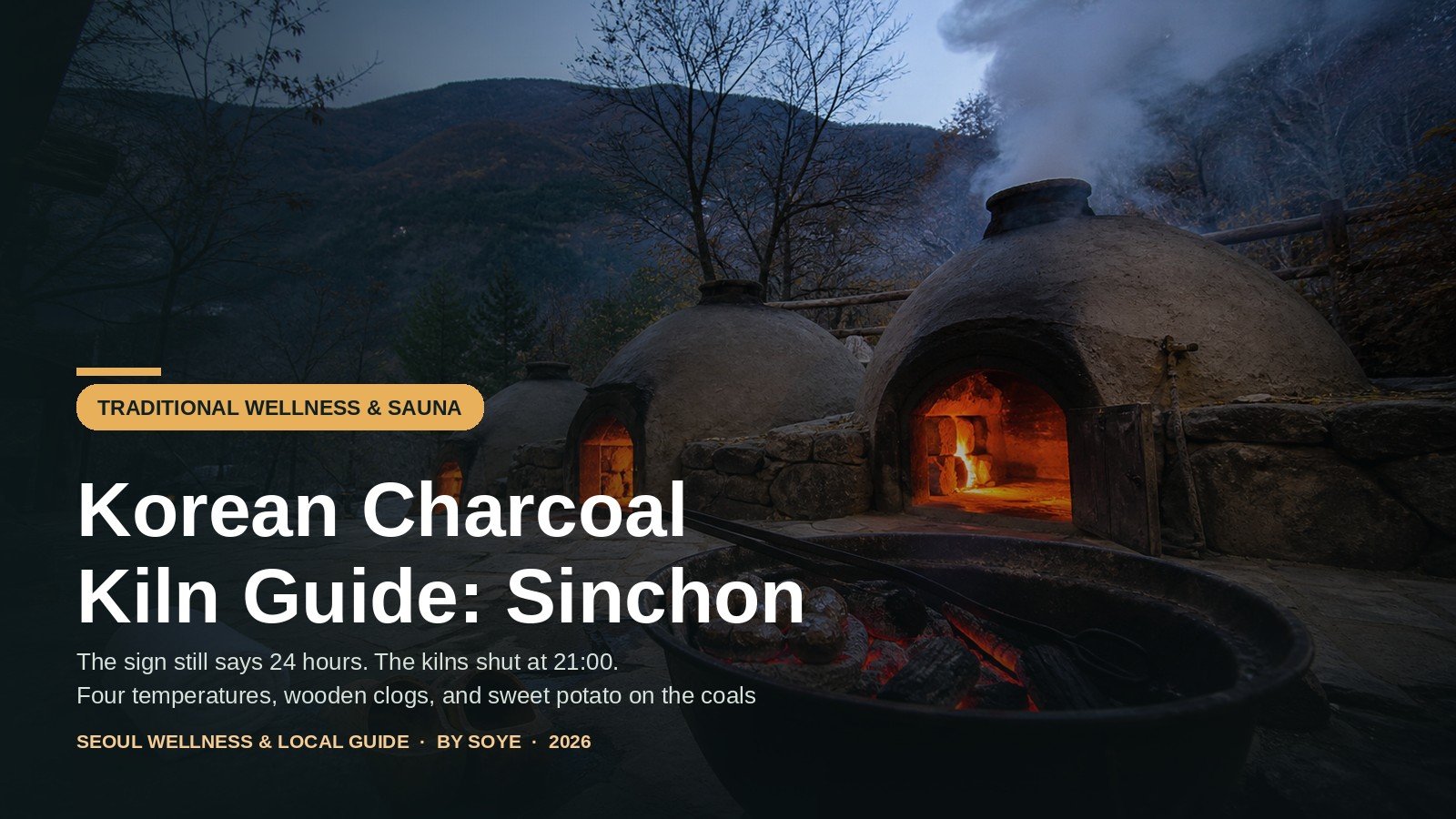
Every Korean winter sells the same promise: a hot room, a towel, an hour in which nobody asks you to buy anything. The cheapest version is also the strangest. On the lower slope of Ansan, five minutes above Sinchon, mud domes sit in an open courtyard with fire still inside them, and between them a brazier where people in cotton pyjamas roast sweet potatoes in their socks. This is a sutgama — a charcoal kiln reused as a sauna — and no hotel spa in Seoul can copy it.
The one line that matters: the sign above the gate still reads 숯가마 24시 — charcoal kiln, 24 hours. It is not. The building runs 06:30–22:00 and the outdoor kilns only 08:00–21:00, year-round, with no overnight stay. Arrive at 22:30 expecting a night in the kiln and you will find a locked car park and a mountain.
Quick Verdict
One ₩17,000 kiln ticket buys Seoul’s only outdoor oak-charcoal sauna, plus bathhouse, pyjamas and three towels. Go between 08:00 and 21:00 — the “24 hours” sign is wrong — wear thick socks, take Bus 7024 from Sinchon Station Exit 4, and roast a sweet potato on the coals.
What a charcoal kiln sauna actually is
Korean charcoal is not made in a chimney. Oak logs are stacked inside a mud-and-stone dome and burned for days with the air supply choked down, so the wood turns to charcoal instead of ash. When the charcoal is pulled out, the dome stands at kiln heat and for a few days becomes the best sauna in the country: dry air, radiant heat from clay walls and floor, and a smell of scorched oak no electric heater reproduces.
What makes Sinchon different is that no car is needed. Supsok Hanbang Land (숲속한방랜드) at 75-7 Bongwonsa-gil, Seodaemun-gu, sits on the last built-up slope before Ansan mountain, and it is the only place inside Seoul’s subway ring where the sauna is a working kiln rather than a heated room with a thermostat.
The clientele explains the place: office workers on a weekday off, grandmothers who came for the fire pit, students from the campus below, and a trickle of foreign visitors holding the same printout. Everyone wears the same mushroom-coloured pyjamas, and socks are the one thing you must bring. If a Korean bathhouse is new to you, read our jjimjilbang first-timer guide first.
Hours, tickets and the “24 hours” sign
The building runs 06:30–22:00, seven days a week: bathhouse, sleeping hall, restaurants, snack corner. The kilns and fire pits run 08:00–21:00. The gap is not a formality — the courtyard is staffed and the coals managed only inside those hours — so an 06:40 arrival gets you a bath and nothing else.
The sign over the gate has read 숯가마 24시, “charcoal kiln 24 hours”, for years, and several map listings repeat it — which is why travellers turn up at midnight. It has not been true since the pandemic; Google now shows the correct hours.
Tickets fork at the second-floor counter in a way that costs foreigners money. The kiln ticket (숯가마) — ₩17,000 adults and middle-schoolers, ₩10,000 primary school — includes the kilns, bathhouse, pyjamas and three towels. The bath ticket (목욕, ₩11,000 / ₩9,000) is the bathhouse only. Both rose ₩1,000 on 1 October 2026, so blogs quoting ₩15,000–16,000 are out of date.
Naver pre-booking takes ₩1,000 off but needs a Korean Naver account with identity verification, and visitors report the prepaid ticket refused at the desk on busy weekends. Budget ₩17,000 and treat the discount as a bonus. Two extras: a large towel for the hottest dome costs ₩2,000 plus a ₩10,000 cash deposit, and the changing-room dryer takes ₩200 coins — the one machine that will not take your card. Parking is free for twelve hours with a kiln ticket.
The four domes, from 40°C to 150°C
You reach the kilns through the ground floor, out of a door at the back, and the temperature drops fifteen degrees as you step into the courtyard: bare winter air, a row of low mud domes with steam pouring off them, people standing round a brazier with their hands out. Four domes are kept at four heats. They are not thermostats — each is a kiln at a different stage of cooling after its charcoal was drawn — so the numbers drift and staff move the wooden signs. Inside, all four are the same: a low doorway, a domed clay ceiling, and a floor much hotter than the air, because the floor is the kiln.
| Dome | Temp | What it feels like | Wear | Time inside |
|---|---|---|---|---|
| 미온 Low |
≈40°C | Warm stone floor, mild air, the only dome you can sit in for a quarter of an hour. Where a first-timer starts and where children end up. | Socks | 10–15 min |
| 중온 Medium |
≈50–60°C | The popular one. Dry heat that arrives slowly, sweat within five minutes, a queue at midday on weekends. Most Koreans never leave it. | Socks plus a small towel to sit on | 10–15 min |
| 고온 High |
≈80°C | Air that stings the eyes and the back of your throat. Sit low, breathe through the nose, leave before you feel brave. | Thick socks, towel on the floor, no phone | 3–7 min |
| 꽃탕 Kkot-tang |
150–200°C core |
The kiln opened a day after its charcoal came out. Radiant heat like standing too close to an oven; skin goes blotchy red, which is where the name (“flower room”) comes from. People stand and count seconds. | Wooden clogs, thick socks, cotton gloves, dry towel round the face | 1–3 min |
Those temperatures are not read off a gauge at the door — no Korean kiln posts one — but they are the standard bands charcoal kilns work to, and staff will tell you which dome is which. What decides your experience is less the number than how recently the coals were drawn.
There is a fifth space people underestimate. The 화로방 (brazier room) sets a shovel of glowing charcoal into a pit in the floor, and you sit on the clay rim with your back to the heat: not hot the way the domes are hot, but like standing with your back to a bonfire after a winter walk. Walk the domes low to high, a few minutes in the courtyard between each — the cool air is part of the treatment.
Kkot-tang: wooden clogs and three minutes
Everything you have read about the hottest dome is true and none of it prepares you. The doorway is low, the heat arrives before you are through it, and your eyes water instantly. There is a rack of clogs at the entrance, a heap of plastic slippers for everywhere else, and a handwritten notice that regulars read without thinking and visitors read too late.
The rules, in the order they matter. Thick socks, always: thin cotton or smooth synthetic will not survive the floor, which is what actually burns you. Wooden clogs at the kkot-tang door, not the courtyard slippers — rubber softens and sticks. Cotton gloves if you have them; the Korea Tourism Organization advises socks and gloves here. Remove metal-framed glasses, jewellery, your watch and your phone, wrap your face in a dry towel, keep your hands at your sides rather than touching the walls, and stand near the door.
Then get out. One to three minutes is the normal stay: a kiln works by repeated short exposure, not endurance. Come out, walk a slow lap of the courtyard, sit on the brazier rim, go back if you want. Nobody will be impressed if you lie down — that is how people get burned. Wet clothes and wet towels are banned inside, because water flashes to steam against the skin, and no food, plastic or foil goes in at all.

The first time I went to a kiln I wore thin cotton socks and no clogs, because the courtyard slippers looked fine and I had not understood they were for the courtyard only. I got three steps into the hottest dome before the floor went through the sole of my foot like a hot pan handle. An auntie on the brazier rim handed me a spare pair of thick socks and pointed at the wooden clogs without a word.
Since then I take two pairs and go in three times for a minute each. Her second lesson: sit on the brazier rim for five minutes before the hottest dome. Going in already warm turns the first ten seconds from shock into something you can breathe through.
The fire pit: how to roast a sweet potato
This is what makes the place a memory rather than a sauna. In front of the domes stand two or three open braziers, each with a bed of glowing oak charcoal, and around them a ring of people in pyjamas watching their dinner cook.
Buy first, roast second. The ground-floor snack corner opens at 10:00 and closes at 21:00: a foil-wrapped sweet potato around ₩3,500, a potato around ₩3,000, a long rice cake (garaetteok) around ₩1,500, plus sikhye at ₩3,000, noodles and baked eggs at about ₩1,000 each. Arrive before ten and the women’s changing-room counter sells eggs and drinks earlier.
The rule that catches tourists: eggs, chestnuts, squid and dried fish cannot go on the public braziers — they burst or perfume the whole courtyard, and staff will stop you. Sweet potato, potato and rice cake are the sanctioned menu.
- Buy at the snack corner and carry your food, in its foil, out to the courtyard. Sweet potato is the safe order; rice cake is the fun one.
- Take one gap in the ring, not a whole brazier — they are shared.
- Bury the sweet potato in the embers, not on the rim: on top it chars, buried it steams. Twenty minutes minimum.
- Rice cake on the edge, three to five minutes, turned constantly. Ask for salt at the counter; it is not on the tray.
- Mark your food. Everyone’s foil looks alike and the tongs are communal.
- Eat standing, then go back in. Dome, fire, dome — and the potato tastes best when you are too warm to want anything else.
The braziers are also where Koreans who came alone end up talking: you cannot chat at 80°C, but you can discuss a potato.
Bathhouse, scrub and samgyeopsal in pyjamas
The kiln ticket includes the bathhouse, and it is not an afterthought. Women’s bath on the basement floor, men’s on the third, counter on the second between them; the tubs are proper neighbourhood tubs — a hot pool around 42°C, a cold plunge around 16°C. Wash thoroughly before you get into anything; that is not optional in Korea.
The sesin (세신, the Korean scrub) is sold at the bathhouse counter, not the front desk, and was posted at ₩25,000 on my last visit — ask before you sit down, because it is the one price here that changes without notice. It is twenty minutes of a stranger in a black bra and rubber gloves removing a layer of you that you did not know was there. Shampoo and body wash are about ₩1,000 each; towels are included, nothing else is.
Then eat in your pyjamas. The second floor has two restaurants sharing one hall: Gamagol Sutbulgui grills pork over charcoal, Gamagol Hansikdang does stews and rice. Samgyeopsal is about ₩16,000 for 180 g, stews under ₩10,000; the pork is pre-grilled and finished at your table. The local sequence is sweat, fire, scrub, pork, nap, bus home. With three hours, cut the nap and the scrub, never the pork.
Getting there on Bus 7024
The kiln is 2.4 km from Sinchon Station as the crow flies and all uphill, which is why everyone takes the green local bus. The route is short, cheap and confusing in one specific way.
- Sinchon Station, Line 2, Exit 4. The stop — 신촌역2호선, number 13142 — is a few steps away. Visit Seoul names Exit 4; blogs saying Exit 3 mean the next stop.
- Board 7024 with 봉원사 on the front board. Not every 7024 here goes your way: the route loops 신촌 → 봉원사 → 서울역 → 봉원사 → 신촌, so read the board before boarding.
- Ride six or seven stops, six to ten minutes. Get off at 봉원사길 (227 m from the gate) or stay on to the terminus, 봉원사 (about 300 m).
- Pay ₩1,500 with T-money or cash — the flat city bus fare.
- Coming back, read the board again. At 봉원사 only the bus showing 신촌역 drops straight to the station; the one showing 서울역 takes the long way round through Seodaemun.
- Last bus is 23:10 from 봉원사, every 13–22 minutes on weekdays. The kilns shut at 21:00, so the bus is never your constraint — the 22:00 closing is.
Walking up from Sinchon takes 20–25 minutes, all uphill past Ewha’s back gate, but doing it in the dark on the way back is the one part of this trip I would not suggest.
Kiln vs city jjimjilbang vs hotel spa
The fair comparison is not “which is better” but “what do you get for the money”. A charcoal kiln does not pretend to be luxury; a hotel spa is a different service. For a multi-day trip, the Seoul transit calculator decides whether a pass pays off.
| Option | Price, adult | Hours | What you actually get | Who it is for |
|---|---|---|---|---|
| Charcoal kiln Supsok Hanbang Land, Sinchon |
₩17,000 (bath only ₩11,000) | 06:30–22:00; kilns 08:00–21:00 | Outdoor oak-kiln domes at four heats, fire pit, bathhouse, pyjamas and towels, charcoal-grilled pork upstairs | Anyone who wants the thing itself rather than a version of it. Not for anyone who needs quiet |
| City jjimjilbang e.g. Sparex Dongdaemun |
₩14,000 daytime, ₩16,000 after 20:00 | 24 hours, every day | Electric sauna rooms, salt and clay rooms, sleeping hall, food court, luggage storage; no outdoor space | Late arrivals, overnight stays, jet-lagged travellers who need somewhere to sleep at 03:00 |
| Hotel spa five-star, e.g. Sulwhasoo Spa |
₩200,000 for 50 minutes; ₩280,000–350,000 signature facial | By appointment, roughly 10:00–21:00 | A private room, one therapist, branded products, and use of the hotel pool or sauna that day | Gifting, jet lag on someone else’s budget, or a treatment you are specifically coming for |
The kiln is twelve times cheaper than the spa and three thousand won more than a city bathhouse; what that ₩3,000 buys is the only outdoor kiln in Seoul. What it does not buy is sleep: land at 23:00 and the 24-hour jjimjilbang is the correct answer. Runners will find the same heat logic in our recovery-ritual guide on Run Korea, and if dry heat leaves your scalp tight, the K-beauty site’s head spa cost guide is the quieter sequel.
What to bring
The building sells almost everything you forget, in Korean-only packaging. Bring these and you spend nothing extra.
- Thick socks, and a second pair. The floor is the hot thing. Cotton rather than smooth synthetic, and dark — white socks come out grey.
- Coins. ₩200 for the dryer, and ₩10,000 cash for the big towel.
- Your own shampoo and toothbrush. Towels and pyjamas are included; nothing else is.
- A small bag for phone and glasses. They cannot go into the kilns.
- A warm layer. You walk between domes outdoors, in bare winter air, in a cotton suit.
- Water. Dry kiln heat dehydrates faster than steam.
- About ₩30,000 on a card or in cash for the ticket, a snack and noodles.
A half-day: kiln, temple, ridge walk
The kiln sits at the foot of Ansan, one of Seoul’s least famous and most walkable mountains, and 400 m up the same road is Bongwonsa — head temple of the Taego order, founded in 889, moved to this slope in 1748, free and open 05:00–18:00. Temple and ridge before kiln makes the better day.
- 09:00 — Bongwonsa. Bus 7024 to 봉원사길, then 400 m uphill. Forty minutes covers the main hall and the old zelkova trees; the UNESCO-listed Yeongsanjae rite runs in early June.
- 10:00 — Ansan jarakgil. The 7 km barrier-free deck trail loops the mountain from the temple’s doorstep; a 1.5-hour section is plenty, and a 550 m barefoot clay path runs along it. There are no shops or water on the trail.
- 12:00 — back down. Lunch in Sinchon costs less than lunch at the kiln.
- 13:30 — check in. ₩17,000 at the second-floor counter, pyjamas, locker, three towels, courtyard door at the back.
- 14:00 — low dome, then medium. Fifteen minutes each, five in the courtyard between.
- 14:45 — fire pit. A sweet potato buried now is ready at 15:25.
- 15:30 — kkot-tang, twice. One minute, out to the brazier rim, one minute again, then the bathhouse.
- 17:00 — samgyeopsal in pyjamas, then the 7024 back to Sinchon.
If it rains the plan survives: skip the ridge, spend the afternoon between the domes, the bathhouse and the pork. The kilns are roofed, and a rainy weekday is the quietest the place gets.
FAQ
Is Supsok Hanbang Land open 24 hours?
No. The building runs 06:30–22:00 and the outdoor kilns 08:00–21:00, every day. The gate still says 숯가마 24시 and listings repeat it, but there is no overnight stay. For that, use a 24-hour jjimjilbang such as Sparex Dongdaemun.
Do I need to book, and can foreigners use the Naver discount?
No booking: buy at the second-floor counter. The ₩1,000 Naver discount needs a Korean Naver account with identity verification, and is sometimes refused on busy weekends.
Which ticket do I buy?
The kiln ticket — 숯가마 — at ₩17,000, or ₩10,000 for primary school children: kilns, fire pit, bathhouse, pyjamas and three towels. The ₩11,000 bath ticket excludes the kilns entirely.
Is it worth going in winter?
Winter is the best time: the domes are hottest when the outside air is coldest, and a weekday morning in December is the quietest the place gets. Wear a warm layer over the pyjamas.
Is the hottest dome safe for children, pregnant visitors or people with heart conditions?
Kkot-tang is not: skip it in pregnancy, with a heart condition or high blood pressure. Children do fine in the low and medium domes with an adult, and the fire pit is the family activity.
Will anyone speak English?
Some staff manage basic English at the counter; signage inside is Korean. Point at 숯가마 on the price board, and keep a translation app for the notices in the domes.
Can I bring my own food to roast?
Sweet potatoes, potatoes and rice cakes brought from outside are fine. Eggs, chestnuts, squid and dried fish are not — they burst or smell, and staff will stop you. Otherwise, a foil-wrapped sweet potato costs ₩3,500 at the snack corner.
Cheat sheet
Final Summary
- One ticket, everything: ₩17,000 at Supsok Hanbang Land, 75-7 Bongwonsa-gil, Seodaemun-gu — kilns, fire pit, bathhouse, pyjamas, three towels.
- The hours that matter: building 06:30–22:00, kilns 08:00–21:00, snack corner 10:00–21:00. The “24 hours” sign is wrong; there is no overnight stay.
- The order: low dome, medium, fire pit; the hottest dome last and twice, a minute at a time, in thick socks and wooden clogs.
- The fire pit: a foil-wrapped sweet potato buried in the embers for 20–40 minutes, and never eggs or chestnuts on a public brazier.
- Getting there: Bus 7024 from Sinchon Station Line 2 Exit 4, ₩1,500, six or seven stops to 봉원사길 or 봉원사; on the way back take the bus showing 신촌역, not 서울역.
Last checked: 20 November 2026 against Visit Seoul’s Supsok Hanbang Land listing (revised 5 November 2026) for the 06:30–22:00 / 08:00–21:00 hours, the Korea Tourism Organization’s English entry for the kkot-tang sock-and-glove advisory, the ticket board at the second-floor counter for the 2026 fares, Seoul’s published bus fares for the ₩1,500 single ride, and Visit Seoul’s Bongwonsa page for the temple’s free 05:00–18:00 opening. Snack-counter prices are the boards as last photographed and move with the season; the board in front of you wins.

1 thought on “Korean Charcoal Kiln Guide: Sinchon Sutgama Domes & Fire Pits (2026)”