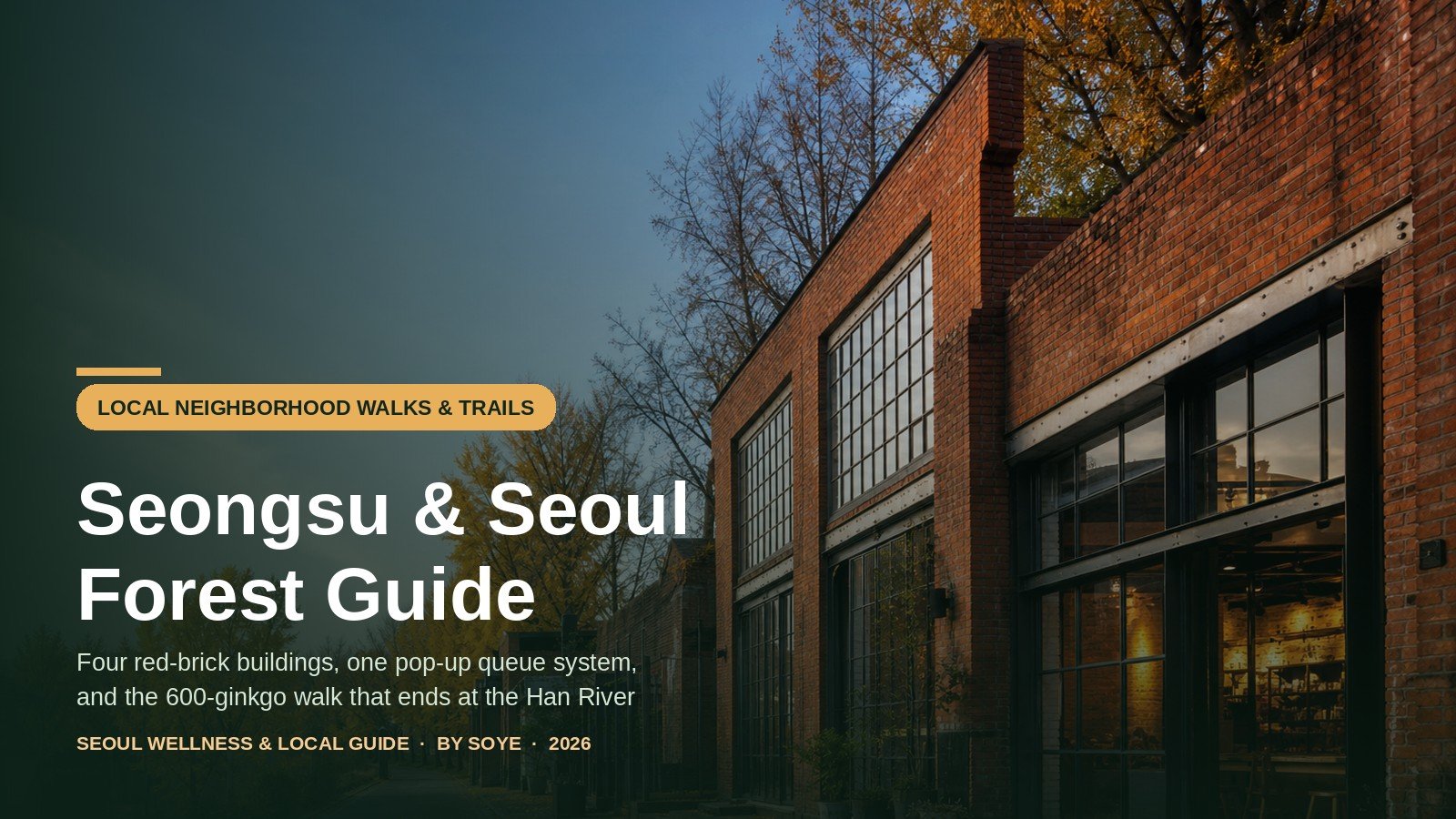
Seongsu-dong fits an unusual amount into one afternoon: a 1970s rice mill turned gallery café, a queue that lives on your phone, a hundred shades of foundation mixed by a machine, and six hundred ginkgo trees — each a fifteen-minute walk from the next. What decides whether the day works is the order you do them in.
The one line that matters: the free pop-up queue no longer needs a Korean phone number — CatchTable Global, or the tablet at the door — but the car-free street has an end date. Seongdong-gu’s weekend pedestrian zone on Yeonmujang-gil runs to 29 November 2026, Saturdays and Sundays 14:00–18:00.
Quick Verdict
Walk Seongsu west to east on a weekday: free samples at Amore Seongsu from 10:30, pop-ups on Yeonmujang-gil before 14:00, then 600 ginkgos, the deer corral and the pedestrian bridge to the Han River. Phone charged, bag in a locker, done by dark.
Two halves of one neighbourhood
Seongsu-dong is two villages under one name. Seongsu-dong 2-ga, east of the elevated Line 2 tracks, is the pop-up district: Yeonmujang-gil, red-brick warehouses, Daelim Changgo, the fashion flagships. Seongsu-dong 1-ga, west, keeps its shoe factories and workshops, holds Amore Seongsu in a converted garage, and sends the atelier alleys north into Seoul Forest. Locals say “Seongsu” for the first and “Seoul Forest” for the second.
That split is the plan. Most lists collapse the two and send you up and down the same street twice. Do 2-ga in the morning while the doors are opening, walk west through the ateliers in the afternoon, and finish at the Han River as the light goes — about 17:15 this week.
The pressure is measurable: about 46 million visits in 2020, 70 million in 2024, and 883 pop-ups in 2025 — roughly a third of the national total in one district. What is not advertised is the queue system underneath, which is why first-timers wait ninety minutes for a shop that would have taken them in twenty.
Two exits do most of the work. Seongsu Exit 3 is the warehouse exit — Daelim 304 m, Yeonbang 337 m, Yeonmujang-gil 530 m — while Exit 2 is 264 m from Amore and Exit 4 the Olive Young end of the street. Seoul Forest Station, on the Suin-Bundang line, is 242 m from the gates; Ttukseom Exit 8 is 537 m and the better link from the pop-ups.
The pop-up queue, decoded
Seongsu’s pop-ups are not shops you wander into. They are week-to-month events with hourly capacity, guarded by three doors — one usually shut to you.
Door one, the brand’s own booking: Naver Booking or a KakaoTalk channel. Both sit behind Korean carrier verification, which needs a resident registration number you do not have; a 010 number from an airport SIM does not clear it. If the bio links only to Naver, that route is shut.
Door two, CatchTable Global. Its international app — CATCHTABLE: Book Restaurants, by WADcorp — is a separate product from the Korean one: email, Google or Apple sign-up, no PASS check, about twenty languages, remote waitlists, and deposits payable with a card issued abroad. There is no usable global website, so install it before you land.
Door three, the tablet at the door — what works when everything else fails, and what staff will point you to. Find the globe icon, enter a foreign number with its country code or an email, and take the queue number.
- Check the end date, not the opening. Pop-ups here last days, and the brand’s Instagram is the only source that keeps up.
- Decide the door before you leave. CatchTable link: pre-book. Naver only: use the tablet. A Google Form in the bio is email registration.
- Register the moment you arrive. The queue number is the scarce thing; the facade photograph is not.
- Enter the exact party size, infants included — registering one and arriving two stops you at the door.
- Spell your name as your passport does; stricter venues refuse a phone photo of it.
- Stay within five minutes. The gap before cancellation is ten minutes at most, five at some venues, and free Wi-Fi drops as you walk.
Two frictions deserve names. An email saying you joined the waiting list is not a ticket; a confirmed entry carries a time and often a QR code. And venues are mostly cashless but some terminals want a Korean card, so carry a physical Visa or Mastercard plus a second card and do not rely on cash.
Timing beats every trick. On weekdays from 11:30 to 14:00 the alley is nearly empty: shops are open, office workers are inside, queues are short. Weekends peak exactly when the district shuts Yeonmujang-gil to cars, 14:00–18:00, until 29 November 2026. If a weekend is all you have, arrive before 11:00, register at two kiosks, and treat the wait as a café hour.
Four red-brick buildings worth the detour
Seongsu’s architecture is why it photographs as it does: low red brick, sawtooth roofs, steel frames, built for light manufacturing in the 1970s and cheap enough to re-use rather than demolish. Four are worth planning around.
Daelim Changgo, 78 Seongsui-ro. Rice mill, then warehouse, now the gallery café that started the trend: pitched roof, iron columns, brick two storeys high. You pay ₩1,000 for a wristband and the same ₩1,000 comes off your first drink; keep the band, it is also your re-entry pass. Daily 11:00–22:00, last orders 21:30, closed Seollal and Chuseok day, no parking, Americano around ₩6,500. Coffee and exhibitions by day, wine bar after 19:00.
Seongsu Yeonbang, 14 Seongsui-ro 14-gil. A 1970s chemical factory rebuilt as a U around a courtyard, where everyone stops and turns around. The building runs 10:00–22:00 and each tenant keeps its own hours: Olive Young and shops downstairs, brunch on two, the glasshouse café Cheonsanggaok on three, 11:00–21:30 with orders closing at 21:00. It is also the favourite pop-up and market venue.
Amore Seongsu, 7 Achasan-ro 11-gil. Amorepacific’s converted garage and the best free hour in the district: three floors where the group’s whole portfolio — Sulwhasoo, Laneige, HERA, Innisfree, thirty-odd brands, about 2,300 products — sits on open shelves to test, no purchase expected. Check in for five free samples; without a Korean number, skip the app and tell the desk. Open 10:30–20:30, closed Mondays, Seollal and Chuseok, with a roof terrace above.
The booked services are where visitors lose money. A custom foundation is not a sample: HERA’s Silky Stay Custom Match is ₩70,000, Black Cushion ₩52,000, Sensual Lip ₩45,000, each with 45–60 minutes of tone measurement and 300-plus shades. Only the ₩5,000 Mis-en-scène serum bespoke is walk-in. Book on Amore Mall’s Amore Seongsu page: slots open 14 days ahead at 00:00, free cancellation until the day before, five minutes’ lateness counts as a no-show, and one no-show blocks you for 14 days. Amore Yongsan runs the same HERA service; without a booking, the self-service colour zone — 11:00–18:30, break at 14:00–15:00 — still gets you a shade made.
LCDC Seoul, 10 Yeonmujang 17-gil. A repair shop and shoe factory with a new concrete wing between them, four floors doing one thing each: Café Ephemera 10:00–20:00; the Shop LCDC edit 11:00–20:00; the rotating brand floor Doors 12:00–19:00, closed Mondays; Jade & Water brunch 11:00–21:00 with a 15:30–17:30 break. Closed 1 January, Seollal and Chuseok. It is the far end of the street, 600 m from Exit 3 — go first or last.
The four, compared
All four are within 700 m of Seongsu Station, free to enter, and busiest in the same weekend hours.
| Space | What it is | Best window | Entry & waiting | Soye’s one-liner |
|---|---|---|---|---|
| Daelim Changgo 78 Seongsui-ro |
1970s rice mill and warehouse, two-storey brick hall, gallery café by day, wine bar after 19:00 | 11:00–12:30, or after 19:30 | ₩1,000 wristband, refunded as a drink discount; walk-in only; keep the band for re-entry | The room does the work — order the cheapest coffee and sit under the roof. |
| Seongsu Yeonbang 14 Seongsui-ro 14-gil |
1970s chemical plant around a courtyard; shops, brunch, glasshouse café, pop-up venue | 12:00–15:00 on a weekday | Free; no booking; each tenant keeps its own hours | Best free courtyard in the district, and the third-floor café when it rains. |
| Amore Seongsu 7 Achasan-ro 11-gil |
Converted garage, three floors of open-shelf beauty, roof terrace, custom-blend lab | 10:30–12:00, Tuesday to Friday | Free entry, five samples; booked services open 14 days ahead at 00:00 | Go for the free hour; book the ₩70,000 foundation only if you want the product. |
| LCDC Seoul 10 Yeonmujang 17-gil |
Repair shop and shoe factory plus a concrete wing; café, edit shop, rotating brand floor, brunch | 15:00–19:00, any day but Monday | Free; no booking; third floor closed Mondays, brunch shut 15:30–17:30 | The quietest good coffee at the loud end of the street. |
I used to lose pop-ups to my own habits: arrive at 11:40, photograph the facade, read the sign, then look for the queue — by which time the tablet had a hundred numbers on it.
Now I register first and walk. Last Tuesday I put my name in at 11:25 with my email, was told forty minutes, drank a flat white at LCDC, and walked in at 12:10. The wait on screen usually runs longer than the real one, because people give up. Don’t leave the block.
Where to leave the bag
Seongsu is a bad place to drag a suitcase: single-file pavements, cobbles on the pop-up street, a step into every café.
Seoul Metro’s T-Locker network covers 273 stations, 336 banks and 5,557 compartments; Seongsu is one of the big ones, with 63 near Exits 1 and 4 and again near Exit 3. Ttukseom has 39 near Exits 1, 2, 7 and 8. Small is 50 × 30 × 60 cm, medium 50 × 45 × 60, large 50 × 90 × 60 — the last figure is height, so a full-size case lies down and needs the large. Four hours costs ₩2,200 / ₩3,300 / ₩4,400 on weekdays and ₩3,100 / ₩4,600 / ₩6,100 at weekends, then ₩500 / ₩800 / ₩1,000 an hour.
Paying is where visitors lose twenty minutes, and the fix is one menu option. You do not need the app: scan the QR on the green sign, choose a compartment, and at payment pick “Overseas payment” (해외결제) — not “Card payment”, which is Korean cards only. The overseas option takes Visa, Mastercard, Amex, JCB and UnionPay plus Alipay, WeChat Pay and PayPal; enter an email instead of a phone number and a one-time PIN opens the door. Nothing goes in or out outside 05:00–24:00.
Seoul Forest Station has a smaller Korail bank on the first floor near Exit 3, listed at ₩1,000 small to ₩2,000 large — a fallback, with the period to confirm on the screen.
Seoul Forest: ginkgo, deer, river
Seoul Forest opened in 2005 on land that was hunting ground, a horse ranch and racecourse, then a waterworks: about 49 hectares in five parts, free, and open around the clock — though the eco forest, with the deer corral and the bridge, shuts at 21:30.
Start at Gate 9, where 600 ginkgo trees stand in a grove with a 450 m foliage path through them and a second avenue left of the park office; Seoul put 110 foliage routes on its 2026 list and this is one of them. Timing matters more than route: colour peaked in early November, so the canopy is mostly down and you are walking the carpet — yellow to the ankles, gone within days of the first hard wind.
Then west to the water. Past the family lawn, Mirror Pond is 3 cm of water reflecting the metasequoia and, on a clear day, Eungbongsan: the most photographed spot in the park and the most conditional, since the pond is sometimes drained in winter. The statue of the military horse beside it remembers that this was stable ground before it was a park.
The deer corral is a viewing pen, not a petting zoo. Formosan sika deer and water deer live in the eco forest, and the feeding machines went on 1 January 2020 for the animals’ health and visitors’ fingers: no food, no reaching through, quiet voices, 05:30–21:30. The pedestrian bridge leaves from Wind Hill, the park’s high point, crosses above the eco forest and lands in Ttukseom Hangang Park — deer to river beach in ten minutes without crossing a road.
Two indoor stops keep winter hours. The Insect and Plant Garden in the old waterworks greenhouse runs 10:00–16:00 from November to February, last entry 15:30, closed Mondays; the butterfly garden is shut November to April. The visitor centre is open 09:00–18:00 and lends strollers and wheelchairs free for two hours against an ID. There is no bike rental inside the park, the 211-space car park at ₩200 per five minutes fills early, and the riverside kiosk at Ttukseom stays open in winter, 11:00–19:00.
The four-stage walking course
- 10:00 — Amore Seongsu, from Exit 2. Check in, take the samples, walk three floors and the roof while the building is empty.
- 11:15 — Daelim Changgo and Seongsu Yeonbang, from Exit 3. Wristband first, then the courtyard; both within 350 m, and no second coffee yet.
- 12:00 — Yeonmujang-gil, between Exits 3 and 4. Register at the first kiosk, then walk the street: Olive Young N, Musinsa Terrace, the murals, LCDC at the far end. Eat standing — a sit-down lunch costs you the queue.
- 14:30 — Seoul Forest, from Ttukseom Exit 8 or on foot. One stop then ten minutes’ walk, or twenty-five through the atelier alleys. Gate 9, Mirror Pond, the deer corral, Wind Hill, and the bridge to the river by 17:00.
| Time | Where | Route tip | Subway exit |
|---|---|---|---|
| 10:00–11:10 | Amore Seongsu, then the shoe-factory lanes | Free entry, quietest in the first hour; leave by the north side towards Achasan-ro | Seongsu, Line 2, Exit 2 — 264 m |
| 11:15–14:00 | Daelim Changgo, Seongsu Yeonbang, Yeonmujang-gil, LCDC | Warehouses first, pop-ups second: queues are shortest before lunch, and the street is car-free only after 14:00 at weekends | Seongsu, Line 2, Exit 3 — 304 m to Daelim |
| 14:30–16:40 | Seoul Forest: Gate 9 ginkgo, Mirror Pond, deer corral, Wind Hill | Enter at Gate 9 and walk west; the eco forest shuts at 21:30 but the light goes at 17:15 | Seoul Forest, Suin-Bundang, Exit 4 — 242 m |
| 16:40–18:00 | Pedestrian bridge to Ttukseom Hangang Park | Cross for the river sunset, then walk back to the subway rather than hunting a bus on the riverside road | Jayang, Line 7, Exit 2 or 3 for the return |
At café pace, and where the run starts
Seongsu runs on café rules nobody prints. One drink per person is expected and enforced at peak: order at the counter before you sit, take the pager, and do not hold a table for friends who have not arrived. Many places set a 90-minute limit at weekends, and a growing number ban laptops on Saturday and Sunday afternoons. Cards work almost everywhere, cash is occasionally preferred in the smallest bakeries, there is no tipping, and outside food is refused.
For bread, Onion Seongsu at 8 Achasan-ro 9-gil opens at 08:00 on weekdays inside a stripped 1970s factory; Blue Bottle Seongsu at Achasan-ro 7, by Ttukseom Exit 1, also opens at 08:00 and is the right first stop before a forest walk. The perimeter road and the river path are a running circuit, which is why the better running shops are here. Good Runner Company’s Seoul Forest store at 47 Seoulsup-gil runs 11:30–20:00 on weekdays and 11:30–19:00 at weekends, closed Mondays, five minutes from Ttukseom Exit 8. If you are shoe-shopping rather than walking, our guide to Seoul running stores, gait analysis and fitting covers what each shop does.
Before you go
- CatchTable Global installed, Instagram checked the night before. The app for the queue, the brand’s account for whether the pop-up still exists.
- Passport in your hand. Pop-up entry, the Amore desk, and stroller rental in the park all ask for it.
- Two cards, one physical. Pop-ups are cashless; lockers take foreign cards only through “Overseas payment”.
- A weekday, and the 11:30–14:00 window. Weekend afternoons are the car-free street at its fullest, until 29 November.
- A bag that folds into 50 × 45 × 60 cm. Large compartments take the suitcases and fill first.
- A warm layer. The bridge is cold after sunset and the eco forest shuts at 21:30.
FAQ
Can I queue for a Seongsu pop-up without a Korean phone number?
Yes. CatchTable Global takes an email, Google or Apple account; the tablet at the door takes a foreign number with its country code, or an email. If a kiosk insists on ten Korean digits, staff will register you by hand. Naver Booking and KakaoTalk need Korean carrier verification, so they will not work.
When is Seongsu actually quiet?
Weekdays from 11:30 to 14:00, when shops are open and the lunch crowd is inside. Weekends are the opposite: Yeonmujang-gil closes to cars from 14:00 to 18:00 on Saturdays and Sundays, and that is the peak. The zone runs until 29 November 2026.
Do I need to book Amore Seongsu?
Not for entry: free, no booking, five samples after check-in. The custom services do — HERA foundation ₩70,000, cushion ₩52,000, lip ₩45,000 — released 14 days ahead at 00:00 on Amore Mall’s Amore Seongsu page, cancellable until the day before, and blocked for 14 days after a no-show. Only the ₩5,000 serum bespoke is walk-in.
Can I leave a suitcase at Seongsu or Seoul Forest Station?
Yes. Seongsu has 63 T-Locker compartments near Exits 1, 3 and 4; Ttukseom has 39. Four hours costs ₩2,200 / ₩3,300 / ₩4,400 for small, medium and large on weekdays, about 40 per cent more at weekends. Choose “Overseas payment”, enter an email, and collect before midnight.
Is Seoul Forest free, and when does it close?
Free, 24 hours. The eco forest, with the deer corral and the bridge, runs 05:30–21:30; the Insect and Plant Garden is 10:00–16:00 in winter, last entry 15:30, closed Mondays; the butterfly garden is shut November to April.
Can I feed the deer?
No. The feeding machines went in January 2020 for the animals’ health, and bringing your own food is worse. Watch from the walkway, keep your voice down, keep hands out of the fence.
Is the ginkgo walk still worth it in late November?
For the ground, yes: the 600 trees near Gate 9 drop a yellow carpet that lasts until the first hard wind. For the canopy, no — colour peaked in early November. Mirror Pond is sometimes drained in winter, so treat the reflection as a bonus.
Cheat sheet
Final Summary
- Split the day by station: Amore from Exit 2 at 10:30, warehouses and pop-ups from Exit 3 before 14:00, Seoul Forest at 14:30.
- The queue is free and needs no Korean number: CatchTable Global, the on-site tablet, or a Google Form in the brand’s Instagram bio.
- Four buildings, all free: Daelim Changgo (₩1,000 band, refunded), Seongsu Yeonbang, Amore Seongsu (five samples), LCDC Seoul — each with a Monday closure somewhere.
- Bags go underground: T-Locker at Seongsu (63) or Ttukseom (39), ₩2,200–₩4,400 for four hours, paid by “Overseas payment”, collected before midnight.
- The forest in one line: Gate 9 for 600 ginkgos, Mirror Pond, the deer corral (no feeding since 2020), Wind Hill, then the bridge to the Han River before 17:15.
Last checked: 19 November 2026 against Seoul’s parks department Seoul Forest visitor information and Visit Seoul’s Seoul Forest page, Seoul Metro’s T-Locker sizes, prices and hours, the district’s 2026 pedestrian-street notice for Yeonmujang-gil, and Amore Mall’s Amore Seongsu service pages. Pop-up dates, café hours and locker availability change weekly; the sign in front of you wins. For fares between these stops use our Seoul transit calculator, and for the transfer rules that catch visitors out, the Seoul subway guide.