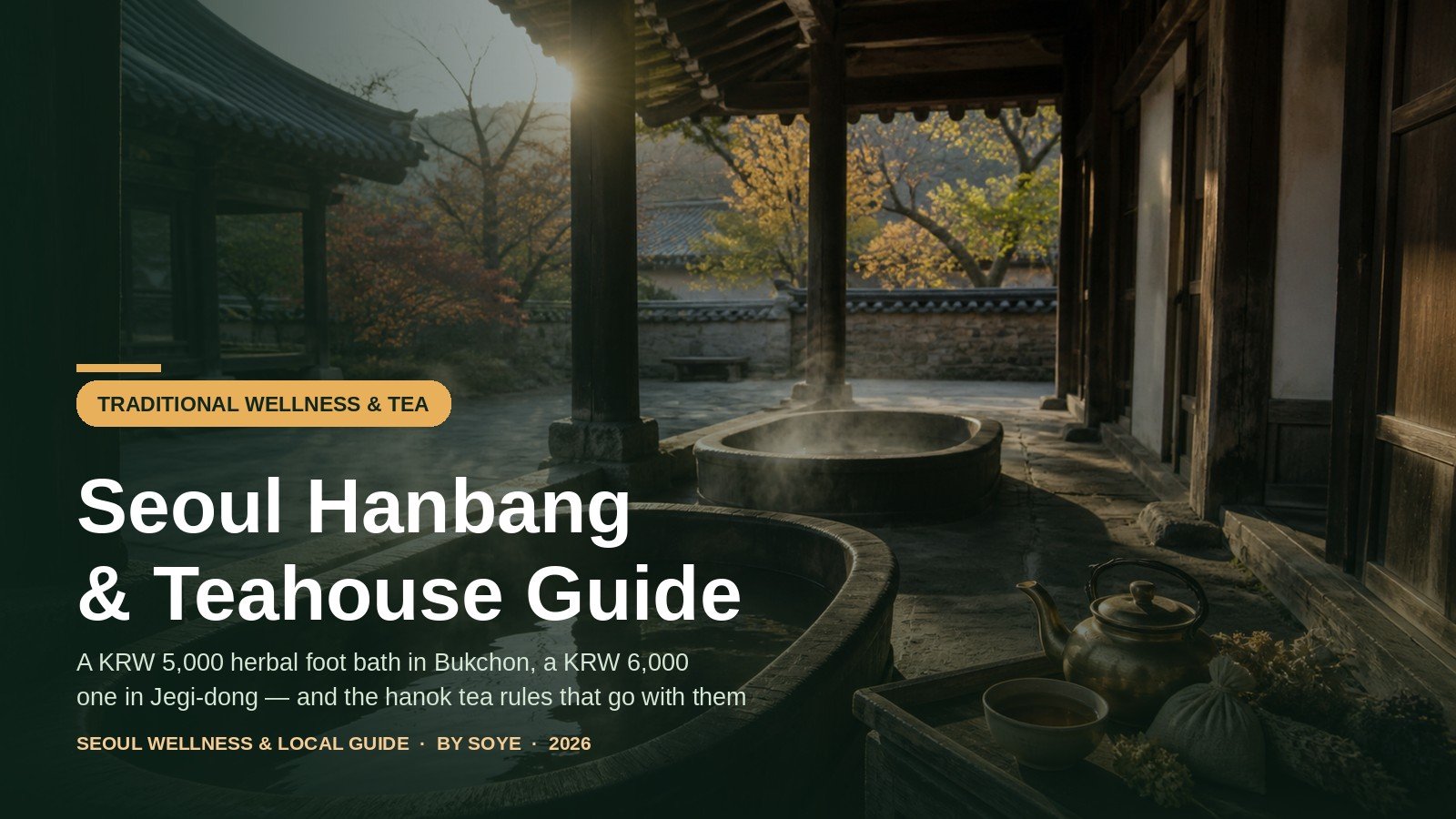
The best Korean wellness experience in Seoul costs less than a cocktail and happens outdoors, with your shoes off. A wooden tub of herb-infused water is set in front of you, a cup of something dark and sweet arrives beside it, and for twenty minutes nobody asks you to buy anything else. Two places do this properly, at opposite ends of Line 3 and Line 1: a hanok in Bukchon, and a herb-market pavilion in Jegi-dong.
The one line that matters: the herb foot bath at Seoul K-Medi Center runs March to November only and shuts for winter because the pipes freeze. In Seoul this month, the last slots of 2026 are in the next two weeks — and the winter substitute is the heated massage room upstairs, not the tub.
Quick Verdict
Two hanbang foot baths justify the trip: Tea Therapy in Bukchon (tea ₩7,000–9,000 plus a ₩5,000 soak) and Seoul K-Medi Center in Jegi-dong (₩6,000 per tub, 20 minutes, March–November only). Go on a weekday, carry ₩20,000, arrive before 16:00 and ask for the early slot.
What hanbang actually is (and why feet)
Hanbang (한방) means Korean medicine — the tradition that runs from the 1613 compendium Donguibogam to the herb shops still trading in Jegi-dong. K-beauty made the word famous through cosmetics, which is a pity: the part you can experience in an afternoon is not a serum but heat, herbs and time, priced like a cup of coffee.
The organising idea is duhan jokyeol (두한족열): keep the head cool and the feet warm. Hot water to the ankle, medicinal herbs in a cloth bag, twenty minutes of doing nothing. Koreans credit it with warm hands, rested legs and better sleep — tradition rather than prescription. What makes it a good travel hour is the price gap: a Seoul spa sells a “wellness ritual” for ₩150,000, while the city sells the same twenty minutes for ₩3,000 a person. The constraint is never money, it is timing — outdoor tubs close in winter, weekend slots vanish, and both places are small enough that one tour group can swallow an afternoon.
Two words to know: yakcho jok-yok (약초족욕) is the foot bath; Bojewon (보제원), the Joseon relief clinic for the poor, now names the heated massage in the same buildings — your December substitute.
Tea Therapy: the hanok, the test, the tub
Tea Therapy (티테라피) occupies the old servants’ wing of the house of Yun Bo-seon, second president of the Republic of Korea, whose preserved traditional house still stands next door on the walk up from Anguk Station. That explains the building: low eaves, a stone courtyard, one long bench facing the street. Three round wooden basins sit outside the entrance, and they are the reason people come.
Getting there. Anguk Station, Line 3, Exit 1, then north up Yunboseon-gil — the lane that starts beside the Amandier bakery and climbs towards Samcheong-dong — for about 390 m, six to eight minutes. The address is 74 Yunboseon-gil; some apps send you out of Exit 2, and both routes end at the same bench.
Hours and cost. Monday to Saturday 10:00–21:00, Sunday 10:00–20:00, closing earlier in the cold months. Tea is ₩7,000–9,000: ssanghwa-cha (쌍화차) and jujube at ₩7,000, omija, hyangtong (a mint blend), geonwi (digestion) and honey-ginger at ₩8,000. There are more than twenty blends, menus in English, Chinese and Japanese, and no reservation for the café.
How the soak works. Order and pay at the counter, sit down, and tell the staff you want the foot bath. The basins are outdoors in front of the building, with hot and cold taps. Expect a supplement for the herbal soak: Seoul’s official tourism site, updated in October 2026, puts it at KRW 5,000 for the soak sachet and a towel, while the shop’s own menu listing in October 2026 shows a ₩10,000 foot-bath service. Budget ₩5,000–10,000 and confirm at the counter. Twenty minutes is the norm; the basins are shared, so staff watch the clock.
Three limits the menu does not mention. The tubs are outdoors, so they close in rain and shut in the cold season — November is the last month you can count on them. The café stays warm, which is why locals treat the soak as a bonus, not the plan.
What else is here. The house doubles as a clinic and a tea school: the owner is a doctor of Korean medicine, and a one-to-one session — checklist, tasting with a tea therapist, roughly two weeks of a blend made for you — needs a booking.
I bring my mother here in the first cold week of November, because that is the week the tubs still work and the lane has emptied of summer queues. We order at the counter, take the bench by the wall, and she does the colour test twice — different answers each time, which she finds hilarious and the staff take in their stride.
Two things I have learned. Sit at 15:00, not 16:30: the light comes down the lane and the basins are still in sun, and by four the courtyard is in shadow. And soak before the tea goes cold — the pot is refilled with hot water for free, but nobody thinks to ask once their feet are in.
Seoul K-Medi Center: a ₩6,000 bath in the herb market
Jegi-dong is where Korea’s herbal medicine is actually traded: around 830,000 m² of shops at Yangnyeong-si market, some 900 to 1,000 businesses, and about 70 per cent of the country’s herbal trade. Walking out of the station into alleys stacked with dried roots is already worth the fare. At the centre of it stands Seoul K-Medi Center (서울한방진흥센터), a hanok complex named an outstanding wellness destination by the culture ministry and Korea Tourism Organization four years running, and — since a scene in the animated film KPop Demon Hunters was set here — filling with visitors who saw it on screen.
Getting there. Jegi-dong Station, Line 1, Exit 2, then some five minutes to 26 Yangnyeongjungang-ro. The roof announces it; the entrance and the booking desk are on the ground floor.
The bath. On the second floor, outdoors under a pavilion, twelve wooden tubs look over the courtyard. Water is 39–42°C to ankle height, with a seasonal sachet — mugwort and strawberry in spring, mint in summer — and a pinch of herbal salt. Twenty minutes, ₩6,000 per tub, and one tub takes two people: ₩3,000 each for a couple. Twelve baths at a time is why the slots matter.
The slots, where visitors go wrong. Weekdays are walk-in only: claim a time at the first-floor desk from 10:20, 11:00, 11:40, 13:20, 14:00, 14:40, 15:20 or 16:20. Weekends and public holidays are online only through the centre’s own ticketing page, with three slots — 10:50, 13:50, 16:10. Booking needs no membership, just a name and a mobile number, but it is a Korean-language form that expects a Korean number; on a travel SIM, plan a weekday at the desk.
Hours that move with the season. March to October the centre runs 10:00–18:00; November to February it closes at 17:00 with last entry at 16:00, which makes the 16:20 slot a summer affair. It is closed Mondays, 1 January, and the Seollal and Chuseok holidays. Note the contradiction in the official pages — the district lists Monday, the centre’s English fee page names only the holidays — so do not build a Monday trip around it.
The museum. Not included in the bath ticket: ₩1,000 for adults, ₩500 for students, and the best value in the building. Some 350–380 medicinal herbs with panels explaining each, a reconstructed Joseon pharmacy, a Donguibogam display and a stamp tour. The ticket also includes twenty minutes in a physician’s or nurse’s robe, which is why visitors in green and pink hanbok pose in the courtyard.
Bojewon, the winter answer. Third floor: a heated massage mat, a heated eye mask, a herbal hand pack and acupressure — thirty minutes for ₩5,000, slots at 11:00, 12:00, 14:00, 15:00, 16:00 and 17:00, all year. No entry for pre-school children, not recommended in pregnancy or with osteoporosis; it is a machine, not a therapist. A herbal café in the annex serves lotus-leaf rice, and parking below is 196 spaces at ₩500 per ten minutes. The bath area is up a stepped outdoor passage, so reduced mobility is a real constraint there.
The four places compared
Two foot baths and two hanok teahouses, all within twenty minutes of each other by subway and priced for a normal afternoon rather than a spa day.
| Place & area | Signature experience | 2026 price | Hours & closed days | The catch |
|---|---|---|---|---|
| Tea Therapy Bukchon / Anguk, 74 Yunboseon-gil |
Pot of herb tea in a hanok, then an outdoor herbal foot bath facing the lane | Tea ₩7,000–9,000; soak supplement ₩5,000–10,000 | Mon–Sat 10:00–21:00, Sun 10:00–20:00; café open year-round | Basins are outdoors: rain or cold cancels the bath. No booking; queue at weekends |
| Seoul K-Medi Center Jegi-dong, Seoul Yangnyeong-si market |
20-minute herb foot bath under a hanok pavilion, plus a herb museum | Bath ₩6,000 per tub (2 people); museum ₩1,000; Bojewon ₩5,000 | Mar–Oct 10:00–18:00; Nov–Feb 10:00–17:00 (last entry 16:00); closed Mondays | Foot bath runs March–November only. Weekday slots walk-in; weekends online only |
| Shin Old Tea House (신옛찻집) Insadong, 47-8 Insadong-gil |
Tea in a 130-year-old hanok wrapped round a courtyard, birdsong included | ₩7,500–9,500 a pot; rice cake ₩5,500; hangwa ₩4,000 | Mon 10:00–20:00, Tue–Fri 10:00–21:00, Sat–Sun 10:00–22:00; open daily | Two-item minimum per table, floor seating only, entrance hidden in an alley |
| Gyeongin Museum Teahouse (전통다원) Insadong, 11-4 Insadong 10-gil |
Fifteen traditional teas in a hanok inside a free art museum, garden or heated floor room | ₩7,000–11,000 a tea; yugwa ₩6,000; mini yakgwa ₩5,000 | Daily 11:00–21:20; museum 10:00–18:00; closed New Year, Seollal, Chuseok | Busiest 13:00–16:00; no parking; new exhibitions open Wednesdays |
Which tea to order: the four-colour test
Tea Therapy hands you something to read before the menu: a laminated flow chart. Follow the yes-or-no arrows and you land on one of four colours, each with its own teas. It is not the four sasang body types you may have read about on K-beauty blogs — just a habit-based classification the house uses — and nobody treats the result as a diagnosis. It is a good excuse to order something you would not have chosen.
The four, in the house’s terms: brown, dry and sensitive, whose digestion goes first under stress, pointed to citrus peel, ginger and ginseng; orange, the over-thinker with tight shoulders and poor sleep, pointed to mint, goji and the house’s hyangtong blend; green, warm-bodied and strong-appetite, told to sweat more and skip ginseng; yellow, puffy and sluggish, steered to roasted barley, buckwheat and quince.
Whatever the chart says, these five cups are the ones worth knowing.
| Tea | What is in it | Traditional use | House recommendation | Taste |
|---|---|---|---|---|
| Ssanghwa-cha (쌍화차) | Twelve or more herbs — peony root, astragalus, angelica, cnidium, rehmannia, cinnamon, liquorice, jujube, ginger | Fatigue and cold limbs; the drink students were given before exams | All four types; the safe order if you want one cup only | Thick, bittersweet, medicinal; pine nuts and sometimes egg yolk on top |
| Danggui-cha (당귀차) | Angelica sinensis root, sometimes with jujube | Blood and circulation; the classic cup for cold hands and menstrual cramps | Brown and yellow types; skip if pregnant or on blood thinners | Earthy and root-like, sweet at the finish |
| Omija-cha (오미자차) | Schisandra berries, steeped or as a concentrated syrup | Thirst, dry throat and tired eyes; “five flavours” in one berry | Orange type; the most popular cold cup in summer | Deep red, sour then sweet, faintly salty; iced or hot |
| Daechu-cha (대추차) | Simmered jujube, sometimes with ginger and pine nuts | Calming and sleep; an after-dinner cup for weak digestion | Brown and orange types; the one children like | Sweet and jammy, closer to a thin porridge than a tea |
| Mogwa-cha (모과차) | Quince preserved in honey, diluted with hot water | Sore throat and cough; the winter cup | Yellow type; add it to a ssanghwa order for the table | Sharp, floral, honeyed; the most refreshing of the five |
All five are caffeine-free, so an eight o’clock cup will not cost you the night. The sweetness is real, though: ask for it lighter (당도 낮춰 주세요, dangdo nachwo juseyo) and the big houses will oblige.
Hanok teahouse etiquette
The two Insadong houses are the best places to learn this: old buildings run the old way, and both are used to visitors getting it slightly wrong.
Shoes come off at the threshold, not the table. Wear socks you would not mind being seen in, especially October to March. There is a low step and a wooden rack at the door: shoes off there, turned to face outward, then step up.
You will sit on the floor. Cushions on heated ondol floors, or a low bench on the veranda. Cross-legged or kneeling; if your legs go numb in twenty minutes that is the normal experience. If floor sitting is impossible, the Gyeongin teahouse has ordinary tables too, and its garden seats are the best in Insadong in November.
One drink per person, often two items per table. Korean cafés expect an order per seat, and Shin Old Tea House states a two-item minimum for two. A pot is refilled with hot water on request, and one pot genuinely serves two cups of conversation.
Order and pay at the counter first. At Tea Therapy and Shin Old Tea House you go up, name the tea, pay, and carry the number back. The Gyeongin teahouse takes orders at the table and accepts cards; smaller houses are safer with cash. No tipping either — a wooden box by the till is a donation box, not a tip jar.
Keep the room quiet. These are the last places in central Seoul where a phone call at the table reads as rude. Photograph the courtyard, the tray and your own feet — not the strangers across the room.
Time and timber. No house will hurry you out, but Insadong peaks from 13:00 to 16:00 and after 16:00 at weekends, when a table is worth ₩9,000 to the owner: an hour is polite when people wait, two is fine at 10:30 on a Tuesday. And these are businesses in old wooden buildings — light nothing, lean on no paper door, and do not move the furniture for a photograph. For the same instincts in a stricter setting, see our temple stay guide; for the streets around these houses, the Seochon vs Bukchon walk.
A half-day route that fits both
Jegi-dong and Bukchon are on different lines but twenty minutes apart, which makes one afternoon enough: bath in the morning, tea in the golden hour.
- 09:50 — Jegi-dong Station, Exit 2. Five minutes to the centre, then the first-floor desk for the earliest foot-bath slot. 10:20 is first; weekday mornings rarely sell out.
- 10:20 — the pavilion. Shoes off, twenty minutes, feet on the rim of a wooden tub. Bring socks; the stone back inside is cold.
- 11:00 — the museum and the robe. ₩1,000, one floor, 350 herbs and a reconstructed pharmacy. Twenty minutes in a physician’s robe is included and photographs better than you expect.
- 12:00 — lunch in the market. The alleys around Yangnyeong-si feed traders, not tourists: soup and rice for ₩8,000–10,000.
- 13:20 — Line 1 to Line 3. Jegi-dong to Jongno 3-ga, change, two stops to Anguk: about twenty minutes, ₩1,550 on a single fare.
- 14:00 — Bukchon on foot. Up Yunboseon-gil past Yun Bo-seon’s house, then the lanes to Samcheong-dong.
- 15:00 — Tea Therapy. Counter first, then the bench, the colour test, and the soak while the sun is still on the basins.
- 17:00 — Insadong for a second pot. Ten minutes downhill to Shin Old Tea House or the Gyeongin teahouse, both open past 21:00.
If the weather turns, the order still works: skip steps 2 and 7, take Bojewon on the third floor, and spend the afternoon in the teahouses. Our Seoul transit calculator handles the fares.
Before you go: six things
- Socks. Both foot baths and every hanok teahouse are shoes-off; heated floors are warm, stone corridors are not.
- ₩20,000 in cash. It covers a tub, a museum ticket and a pot of tea, and the small houses prefer it.
- A weekday, not a weekend. Weekday bath slots are walk-in; weekends need the online form and a Korean mobile number.
- Arrive before 16:00 from November. The centre closes at 17:00 with last entry at 16:00, and the outdoor tubs shut after November.
- Loose trousers. Nobody hands out shorts, and a tight hem at the ankle makes the twenty minutes awkward.
- A translation app with the Korean names. English menus exist at Tea Therapy and in Insadong; the market and the ticketing form are Korean-first.
A full day adds up to about ₩24,000: ₩3,000 each for a shared tub, ₩1,000 for the museum, two pots of tea at ₩8,000 and ₩9,000, and ₩3,100 for the subway. Not luxury — just the cheapest way to spend an afternoon the way Seoulites do.
FAQ
Is the hanbang foot bath open in winter?
The K-Medi Center’s outdoor bath runs March to November only and closes December to February because the pipes freeze. Tea Therapy’s basins are also outdoors and shut in rain and cold. From December, the replacements are Bojewon’s heated massage (₩5,000) and any jjimjilbang — see our jjimjilbang first-timer guide.
Do I need to book the foot bath?
At Tea Therapy, no — order at the counter and wait for a basin. At the K-Medi Center, weekdays are first-come at the desk with slots from 10:20 to 16:20; weekends and holidays are online only, three slots (10:50, 13:50, 16:10). With twelve tubs, an unbooked weekend usually means no bath.
Can I do this without speaking Korean?
Yes. Tea Therapy has English, Chinese and Japanese menus and staff who explain the foot bath in English. The K-Medi Center has an English website, English museum signage and staff who will point at a slot; only the booking form is Korean, which is why weekdays at the desk are easier.
Is it suitable for children or pregnant visitors?
The foot bath is fine for children with a guardian, and Bojewon bars pre-school children. Pregnant visitors should skip Bojewon’s machine massage and ask before ordering angelica tea (danggui). The water is 39–42°C, so treat a long soak like a hot bath.
Which is better, Tea Therapy or the K-Medi Center?
Different afternoons. Tea Therapy is a small hanok, a good pot of tea and a basin on the street — a one-hour stop inside a Bukchon walk. The K-Medi Center is a museum, three experiences and a herb market — a half-day, and the only one where the bath is the main event.
Can I buy herbs and take them home?
Yes: ginseng, jujube, goji and dried roots are sold by weight in the alleys around the centre. Check your own customs rules first — roots, seeds and animal-derived ingredients are restricted in Australia, New Zealand and the United States.
Cheat sheet
Final Summary
- Two baths, both cheap: Tea Therapy in Bukchon (tea ₩7,000–9,000 plus a ₩5,000–10,000 soak) and Seoul K-Medi Center in Jegi-dong (₩6,000 per tub, two people, 20 minutes).
- November is the deadline. The Jegi-dong bath runs March–November only; the Bukchon basins stop with the cold. After that, Bojewon’s ₩5,000 heated massage.
- Go on a weekday. K-Medi slots are first-come at the desk (10:20–16:20); weekends are online only, three slots, Korean number.
- Add the ₩1,000 museum at Jegi-dong — 350 herbs, a Joseon pharmacy and a free physician’s robe for twenty minutes.
- In a hanok teahouse: shoes off, floor seating, one drink per person (two items per table at Shin Old Tea House), pay at the counter, no tipping, and order ssanghwa-cha if you order once.
Last checked: 19 November 2026 against Visit Seoul’s wellness café listing for Tea Therapy’s hours and soak supplement, Seoul K-Medi Center’s own foot bath page and visitor information, its online booking page, and Seoul City’s 2026 visitor reports on the centre and Yangnyeong-si market. Teahouse prices are the houses’ own 2026 boards; menus and hours change with the season, and the board in front of you wins.