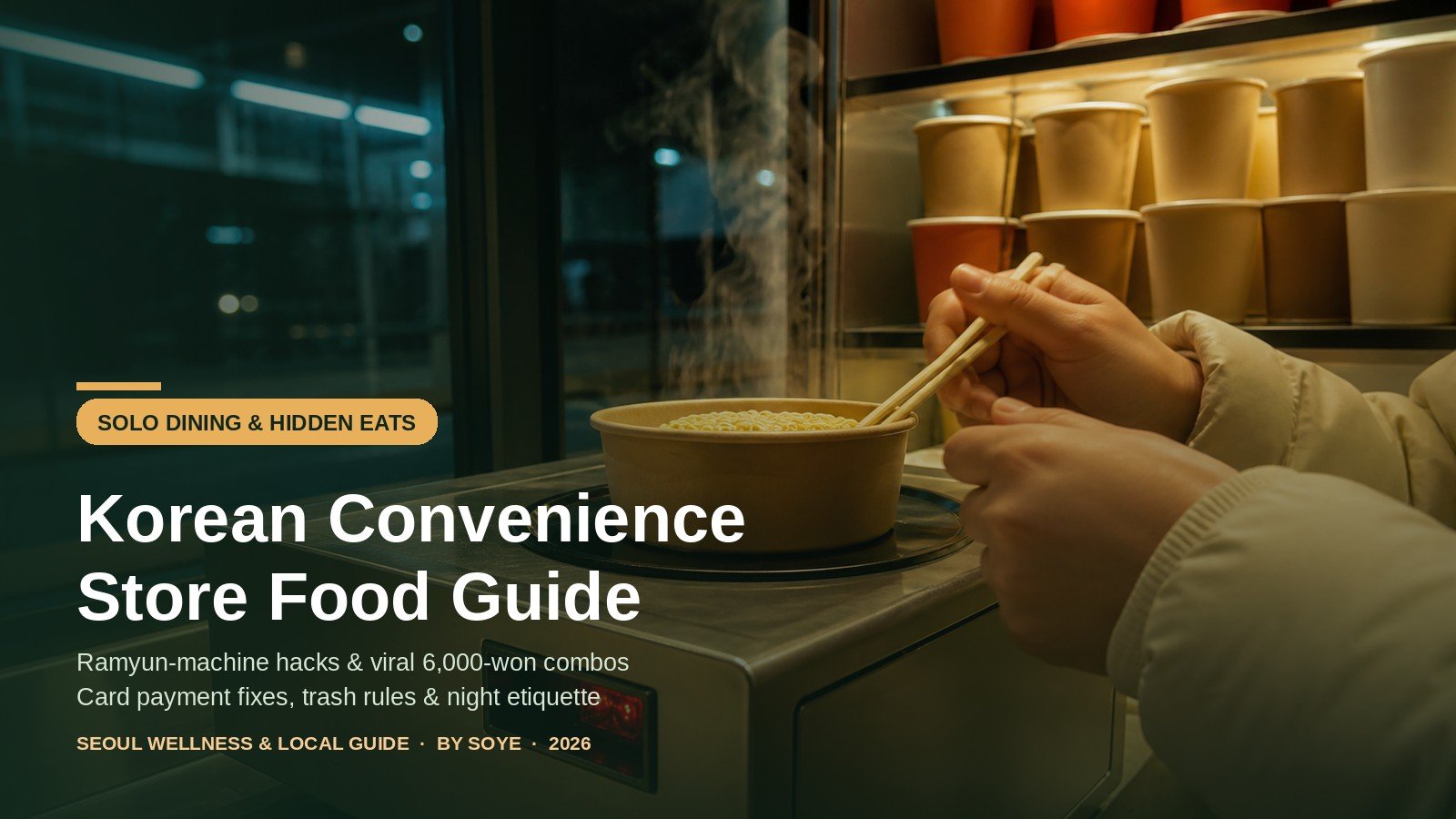
It is 1:40 a.m. and the brightest thing on the street is a convenience store. Inside, the queue is not at the till. It is at a stainless-steel box the size of a microwave, where a traveller holds a paper bowl of dry noodles under a nozzle, waiting out a four-minute countdown.
Korea had 53,266 of these stores at the end of 2025, roughly one for every 970 people, and 2025 was the first year that number had fallen in 36 years. They are not shops that happen to sell food; they are the country’s cheapest kitchen. This guide covers which chain to walk into, the combos locals build, how the noodle machine works, how to pay without a Korean phone number, and how to clear your tray. For eating alone at a table, see our solo dining etiquette guide; for the grilled version, the solo Korean BBQ guide.
Quick Verdict
Find a store with a noodle cooker, buy the paper bowl that matches your packet, scan it, press start. Four minutes later you have a hot meal for about ₩1,500. Everything else works the same way: read the shelf tag, not the video, and pay by card.
The four chains, and what each one is actually for
CU (18,711 stores at the end of 2025) and GS25 (18,005) are the two giants; 7-Eleven (11,040) and emart24 (5,510) are the smaller pair, and both lost stores last year — 7-Eleven alone closed 1,112 after absorbing Ministop. In a small neighbourhood the nearest store may not be the one you read about. What differs between the four is the private-label food and whether the store has a cooker and seats.
| Chain | Exclusive signature to try | Noodle cooker | Payment & refunds | Best time & for whom |
|---|---|---|---|---|
| CU | Yonsei Milk cream bun ₩2,800; 득템 value line ₩1,100–3,300; chewy Dubai-style macaron | Common in tourist areas; the Hongdae Sangsang branch has a 100-slot “Ramyun Library” | Tax-refund tills, WOWPASS kiosks | 14:00–18:00 for dessert restocks; any hour for tax refunds |
| GS25 | Omori kimchi-jjigae ramyeon ₩1,850; Hyeja lunch box; Seoul (see official gastronomic tips on Visit Seoul) Milk cream bun ₩2,700 | Very common, often two cooking plates | ₩1,000 pouch coffee comes with a free medium ice cup, all year | 22:00–02:00, when the cooker queue is short |
| 7-Eleven | “Hando-chogwa” oversized line; saeng-choko pie; character collaborations | Riverside and park stores; patchier elsewhere | Standard cards and Apple Pay | Weekend afternoons, for new merch and park branches |
| emart24 | “Yellow 24” ultra-cheap line (80+ items); Seongsu 310 pouch drinks ₩1,200 | Fewest stores — check the map before you plan around one | Standard cards and Apple Pay | 07:00–10:00, quietest and fully stocked |
CU is where the dessert culture lives — its Yonsei Milk cream bun has sold 100 million units since 2022, and the filling is about 80% of its weight. The 득템 line is the opposite idea: ₩1,100 for a triangle kimbap, ₩3,300 for a rice bowl. GS25 is the noodle chain: Omori kimchi-jjigae ramyeon has been a private label since 2014, built with a 40-year-old kimchi-jjigae restaurant, and the series has passed 100 million packs at ₩1,850. 7-Eleven survives on novelty — the oversized “Hando-chogwa” line, a fresh chocolate pie, character tie-ins that sell out in days. emart24 is the price floor: Yellow 24 launched with 13 items in 2025 and now runs past 80.
Four combos worth the queue
These are what Korean students and office workers actually assemble, so the ingredients are cheap, shelf-stable and microwave-friendly. Prices are 2026 shelf prices and move — a budget, not a quote.
| Combo | What to buy | Rough cost | Microwave (1,000W) | Flavour / heat |
|---|---|---|---|---|
| 1. Mark’s meal (마크정식) | Cup tteokbokki, spaghetti cup noodle, garlic frank sausage, string cheese | ₩6,500–7,500 for two people | 3:00, then 1:00–1:30 to melt the cheese | Sweet, hot, cheesy — heat 3/5 |
| 2. Bone-broth dumpling soup | 500 g beef-bone broth pack, frozen dumplings, spring onion | ₩6,500–8,000 | 3:00, loosely covered | Clean and savoury — heat 0/5 |
| 3. Ice-cup banana latte | Banana milk, hazelnut or black coffee pouch, large ice cup | ₩2,700–3,700 | None | Sweet and cold — heat 0/5 |
| 4. Kimbap kimchi fried rice | Cup kimchi fried rice, triangle kimbap, one cheese slice | ₩7,000 | 2:30, stir once at 1:30 | Mild to medium — heat 2/5 |
1. Mark’s meal: the one everybody photographs
A fan of GOT7’s Mark built this and the name stuck. Cook the cup tteokbokki first, as the lid says. Meanwhile pour boiling water over the spaghetti cup, wait two to three minutes rather than four, then drain — the noodles go back into heat. Tip the spaghetti into the tteokbokki with its powder and sauce, mix, top with sausage and torn string cheese, and give it another minute. Use two-thirds of the sauce if you do not want it cloying.
2. Bone-broth dumpling soup
The least obvious and most comforting of the four: a 500 g pack of beef-bone broth from the instant-soup shelf, plus frozen dumplings. Heat the broth, add four to six dumplings straight from frozen, microwave three minutes loosely covered, then stand for a minute so the filling catches up with the wrapper. No chilli, no cheese, no sugar — it is what Koreans eat the morning after.
3. Ice-cup banana latte, without a coffee machine
No heat at all, which is why it is the most-repeated combo on short video. Buy a large ice cup (₩1,000; extra-large ₩1,200–1,400), a pouch coffee — GS25 gives a medium ice cup free with its ₩1,000 americano — and a banana milk. Milk in first, then the coffee slowly down the side, roughly two parts to one. Drink it within ten minutes.
4. Kimbap kimchi fried rice
The rice-bowl hack: a cup of kimchi fried rice, one triangle kimbap broken over it, one cheese slice, two and a half minutes, stirred once halfway. It is the cheapest way to turn two snack-sized items into a full meal. If your fried rice came with a separate soup block, heat that separately.
The noodle machine, in five steps
Three kinds of machine look alike. The simplest is the hot-water dispenser: fill your own cup noodle to the line and wait three to four minutes. The second is the self-service cooker, an induction plate that boils a paper bowl for you. The third, in unattended noodle shops, cooks one specific product. This is about the second one.
- Buy the noodles and the matching bowl, and pay before you open anything. The bowl is a separate purchase — about ₩900 at the CU Ramyun Library — and it is not optional: the plate and the bowl are designed as a pair.
- Empty the packet into the bowl, noodles first, powders on top. Powder goes in first only if you want it scorched against the heated base. Hold back half the chilli sauce if you are unsure about heat.
- Scan the barcode and listen for the beep. Machines read either the bowl’s barcode or the packet’s. Flatten it, hold it 1–2 cm from the reader, wait for the confirmation. That scan sets the water volume and the timer — why a soup noodle and a stir-fried noodle get different water.
- Set the bowl dead centre on the plate and press start. The button says 조리시작. Water comes out of the nozzle, the plate heats, and a countdown starts — usually 3:30 to 4:00 minutes.
- Stir gently, add the egg at 1:30, lift the bowl out with two hands. Loosen the noodles without pressing the thin base. Crack a raw egg in with about a minute and a half left and break the yolk once — earlier it sinks and burns, later it stays raw.
A few things the machine will not tell you. It dispenses 400–450 ml where the packet asks for 550 ml, so the broth is deliberately stronger; 물추가 adds more, but pressing it repeatedly cools the plate. And the bowl is foil-lined, so it must never go into a microwave afterwards. If the screen shows E1 the barcode did not read: flatten it, try the second barcode on the base, then ask staff. E2 means the bowl is not sitting flat.
Paying: the four things that go wrong
Your card taps and nothing happens. Korean terminals are built around chip-and-PIN and magnetic stripes, not contactless: nationally only about a tenth read EMV contactless, though convenience stores are far ahead — Hyundai Card’s figures put availability there above 60%. When the tap fails, insert the card and use the chip. Visa and Mastercard are near-universal; Amex and UnionPay are patchier.
Apple Pay. All four chains accept it at staffed tills and self-checkout, though a few branches are not enabled — look for the contactless symbol on the reader. The trap is which card: one issued at home and already in Apple Wallet works exactly as at home, while a card issued in Korea can only be added if it is a Hyundai Card, the sole domestic issuer supported as of late 2026. Apple Pay is NFC-only, so older terminals that take Samsung Pay’s magnetic signal will refuse it.
Your transport card will not buy a sandwich. This is the most common mistake. The Seoul Climate Card is a transit product: it cannot be used at convenience stores at all. Since October 2026 only the short-term visitor passes remain (1, 2, 3, 5 and 7 days at ₩5,000 / 8,000 / 10,000 / 15,000 / 20,000, plus ₩3,000 for the card), and those are still transport-only. T-money and Cashbee are different — their balance does pay in stores — but topping them up is cash only: no foreign card, no Apple Pay, no Kakao Pay at the counter. Our Climate Card vs. WOWPASS vs. T-money guide compares all three.
WOWPASS and tax refunds. WOWPASS is a prepaid card for visitors whose chip pays anywhere a Korean card is accepted, convenience stores included; its T-money wallet is separate and still needs cash. On tax, participating stores refund at the till on a single receipt of ₩15,000 or more, up to ₩1,000,000 per transaction, against a physical passport or the Trip.PASS mobile passport — photographs are refused. Alcohol, tobacco, plain milk, fresh produce and hot food eaten in store are excluded; the discount is about 6–7%.
The yellow shelf tags confuse visitors too. 1+1 means pay for one and take two; 2+1 means pay for two and take three. Nobody hands you the free item — you pick it off the shelf and carry both to the till, where the register applies it. By default the free one must be identical, and promotions rotate on the first of the month. Kimbap and lunch boxes rarely appear in these deals; they get an evening markdown sticker instead.
The 30-second cleanup
Staff clean the store, but the tray, the broth and the sorting are yours.
- Broth first, into a drain or the designated bucket — not the recycling bin and not the food-waste bin. Soup is mostly water and salt; it is poured away.
- Rinse the bowl once, then decide. One rinse and it is recyclable; a bowl with grease that will not come off is general waste, not recycling.
- Lid film, sachets and the noodle packet are soft plastic — rinsed two or three times, or general waste if greasy. Foil lids and the foil cooker bowl are not recyclable.
- Chopsticks, spoons and straws go in their own bin, never back inside the cup.
- Wipe the table and stack the tray at the bin station, not on the next table.
- Only your own store’s rubbish. Staff do object, politely, to bags brought in from outside.
Late-night rules nobody writes down
Seats are for customers, and there may be none. A growing minority of residential stores have no seating, and some close overnight despite the 24-hour sign — read the hours on the door. Where there are seats, finish and clear; at 2 a.m. four people nursing one beer each is the fastest way to get a store to remove its tables.
Eating outside is fine; being loud is not. Convenience stores are not licensed restaurants, so drinking at their outdoor tables is not in itself an offence — but noise is. Loud late-night conversation and drunken disturbance fall under the Minor Offences Act, with on-the-spot fines of ₩30,000 and ₩50,000. Many stores stack their tables after 22:00 for that reason.
Alcohol needs a passport, and a person. The legal age is 19, staff must check ID, and a photograph of a passport is not ID. Self-checkout will not release alcohol; go to the staffed till with the photo page open.
The hot-water tap is for the noodles you just bought. It is free and unguarded, which is not the same as unrestricted: filling a thermos at it is what gets a sign put up. Fill to the line inside the cup you paid for — the water comes out at close to boiling.
FAQ
Can I pay with a foreign credit card at a Korean convenience store?
Yes, at every chain in practically every branch. Insert the card and use the chip rather than tapping: only about a tenth of Korean terminals support contactless, though stores are well above that. Visa and Mastercard are the safest bet; Amex and UnionPay work in fewer places.
Can I buy beer or soju with my passport?
Yes. The legal age is 19 and staff must check ID, so carry the physical passport — a photo will be refused. Stores sell alcohol around the clock, but self-checkout will not process it, so queue at a staffed till.
Do convenience stores do tax refunds?
Participating stores do, at the till. You need a single receipt of ₩15,000 or more, a physical passport or the Trip.PASS mobile passport, and goods you will take home unopened. Alcohol, tobacco, milk, fresh produce and hot food are excluded; the discount is about 6–7%.
Can I use my Climate Card to buy snacks?
No. It is transport-only and does not work at convenience stores, cafés or vending machines. Use a bank card, T-money or WOWPASS instead; T-money’s balance does pay for goods.
Can I use the hot-water dispenser for my own tea or flask?
Nobody will stop you; socially it is for the cup noodle you bought there. Filling a one-litre flask uses the water a whole queue is waiting for. Buy a cup noodle and use the tap for that.
Is it OK to sit and eat inside?
If there are seats, yes — they are for customers eating what they bought. Clear your tray, keep bags off the next chair at busy hours, and do not camp at 1 a.m. in a small store.
Do I need Korean to use the noodle machine?
No. Scan the barcode, press start, done. The words on the machine are 조리시작 (start), 물추가 (add water) and 시간추가 (add time). If it refuses, flatten the barcode against the scanner and try again.
Cheat sheet
Final Summary
- The meal: bag noodles plus the dedicated paper bowl (about ₩900), barcode scanned, start pressed — 400–450 ml, 3:30–4:00 minutes, egg at 1:30 remaining. Never microwave the foil bowl.
- The four combos: Mark’s meal (₩6,500–7,500, two people), bone-broth dumpling soup (₩6,500–8,000), ice-cup banana latte (₩2,700–3,700), kimbap kimchi fried rice (₩7,000, 2:30).
- Payment: foreign cards are fine — insert the chip when the tap fails. Apple Pay works at all four chains with a foreign card in Wallet. The Climate Card buys nothing here; T-money top-ups are cash-only.
- Souvenirs: spend ₩15,000 in one receipt at a tax-refund store with your passport for 6–7% off, but not on alcohol, tobacco or milk.
- Manners: broth down the drain, bowl rinsed once before recycling, chopsticks in their own bin, hot water only for noodles you bought.

Last checked: 17 November 2026, against the 2025 store-count figures from the Ministry of Trade, Industry and Energy, CU and GS25 announcements on their private-label ranges and prices, the Korea Tourism Organization’s guide to the CU Ramyun Library cooker, Korea’s tax-refund rules for foreign visitors (₩15,000 minimum since 1 January 2024), Seoul’s Climate Card terms after the October 2026 changes, and 2026 contactless-payment figures from the card industry. Prices and promotions change monthly — check the shelf tag.