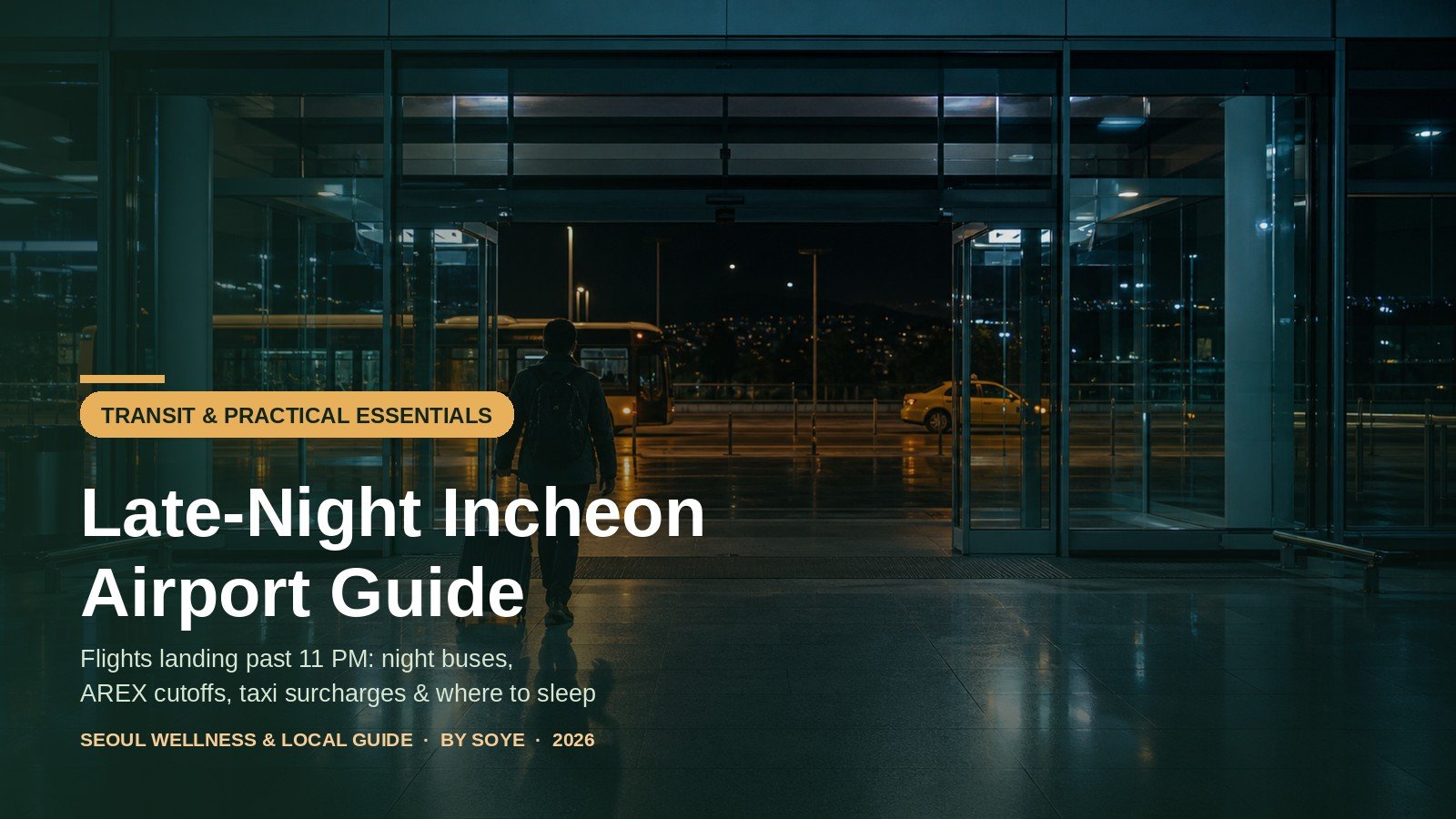
At 23:38 the last train that actually reaches Seoul Station pulls out of Incheon Airport’s Terminal 1. Eighteen minutes later another train leaves the same platform with a different destination on its board: Digital Media City, three stops short of Seoul Station. Every week, people with suitcases board it, fall asleep, and wake up at half past midnight in a business district with the subway already closed.
This guide is built around one number that is not your landing time: the moment you walk out of the arrivals hall with your bags. Incheon Airport tells arriving passengers to allow one to two hours for immigration and baggage, so a flight landing at 21:30 can be at the kerb at 23:00 — or at 23:45. Below are the four ways into Seoul after dark in 2026 and what each really costs. For the daytime version of the same routes, see our AREX vs. airport bus guide.
Quick Verdict
Clear customs before 23:38 and the AREX all-stop train still takes you to Seoul Station for ₩4,750. After that, only night buses (₩17,000–18,000), metered taxis with a 40% surcharge — or a bed at the airport. Never board the 23:56 or 23:50 train: it terminates at Digital Media City.
Four ways into Seoul, compared
| Option | Operating hours / last departure | Cost to downtown (KRW) | Travel time | Frequency | Comfort & luggage | Best for |
|---|---|---|---|---|---|---|
| AREX train | Express: last 22:48 (T1), 22:40 (T2). All-stop to Seoul Station: last 23:38 (T1), 23:32 (T2) | ₩4,750 (T1) / ₩5,350 (T2); Express ₩13,000 | 66 min all-stop; 43 min Express | Every 7–8 min (all-stop); 26 Express trains a day | Seats, racks, lifts to the platform; best option with a big case | Anyone clearing customs before about 23:20 |
| Night bus (N-bus) | From 23:40 to 04:50 (T1); 23:20 to 04:30 (T2). Nothing between 02:10 and 03:40 (T1) | ₩17,000 (N6000, N6002); ₩18,000 (N6701, N6703) | 60–110 min depending on the stop | 5–6 departures a night per route | Reclining seats, luggage in the hold, no transfers | Late arrivals heading to Hongdae, Gangnam, Seoul Station or Jamsil |
| Midnight taxi | 24 hours. Surcharge 40% from 23:00 to 02:00; 20% from 22:00–23:00 and 02:00–04:00 | ≈₩77,000–105,000 metered at night, plus ₩2,000–3,200 toll. Fixed fare ₩70,000–95,000 | 45–70 min | On demand; a queue at peak arrival banks | Door to door; fits 3–4 people and all the luggage | Groups of three or four, heavy luggage, hotels away from a bus stop |
| Stay at the airport | 24 hours: Darakhyu capsule hotel, SPA at Home sauna, landside benches | ₩32,000–38,000 (3h day use); ₩69,000–94,000 (overnight); ₩12,000 shower | 0 min — you are already there | Book ahead; walk-ins only if rooms remain | A real bed or a hot bath; 60 rooms at T1, so it sells out | Landing after 02:00, or a morning connection |
Times are departures from the airport, not arrival times of your flight. Fares checked November 2026 against Incheon Airport’s night-bus page, AREX’s station timetables and Seoul’s taxi fare schedule.
The 11 PM AREX cutoff and the DMC trap
The AREX has two services and they end at very different hours. The Express, non-stop to Seoul Station, costs ₩13,000 and runs 26 times a day with an average wait of 40 minutes; its last departures are 22:48 from Terminal 1 and 22:40 from Terminal 2. The all-stop train costs ₩4,750 from T1 (₩5,350 from T2), takes 66 minutes, comes every 7–8 minutes — and its last train that reaches Seoul Station leaves 23:38 from T1 and 23:32 from T2.
Then comes the part that catches people. A further all-stop train leaves 23:56 from T1 and 23:50 from T2, and it does not go to Seoul Station. It terminates at Digital Media City (DMC), before Hongdae, Gongdeok and Seoul Station. The departure board shows the destination in Korean and English — 디지털미디어시티 — and that is the one line to read before you step through the gate.
Why it matters: by the time it arrives, the subway connections at DMC are finished, so the train has moved you 40 minutes closer and left you with a taxi ride for the last third of the trip — you pay twice and arrive later than a bus would have. The reverse direction carries the same trap: from Seoul Station the last train that actually reaches the airport leaves at 23:40, and later departures terminate at Geomam.
So the practical rule is about your flight, not the timetable: treat any landing after about 21:30 as one that may miss the Seoul Station train, and choose your bus or taxi plan before you board.
Night buses: four routes, real times, and the 02:10 gap
Seoul’s night airport buses are not a fallback service; on a late arrival they are the best value in the building. All four routes start at Terminal 2 and call at Terminal 1 about twenty minutes later, so the T1 times below are the ones that matter if you land there.
- N6000 — Gangnam Express Bus Terminal, ₩17,000. T2 23:50, 00:30, 01:10, 01:50, 03:20, 04:00. T1 00:10, 00:50, 01:30, 02:10, 03:40, 04:20. Stops: Songjeong Station, Yeomchang, Gangnam Express Bus Terminal (about 90 minutes).
- N6002 — Hongdae, Gwanghwamun, Cheongnyangni, ₩17,000. T2 23:40, 00:10, 00:40, 01:20, 03:40, 04:20. T1 00:00, 00:30, 01:00, 01:40, 04:00, 04:40. Stops: Hongdae, Four Seasons Hotel (Gwanghwamun), Heunginjimun, Cheongnyangni.
- N6701 — Seoul Station, Euljiro, DDP, ₩18,000. T2 23:30, 00:20, 01:20, 03:25, 04:20. T1 23:50, 00:40, 01:40, 03:45, 04:40. Stops: Mapo Station, Seoul Station, Euljiro 1-ga (the stop for Myeongdong), Dongdaemun Design Plaza.
- N6703 — Gangnam, Jamsil, Gwangnaru, ₩18,000. T2 23:20, 00:00, 00:45, 01:25, 03:30, 04:30. T1 23:40, 00:20, 01:05, 01:45, 03:50, 04:50. Stops: Seorae Village, COEX, Jamsil Lotte World, Gangbyeon, Gwangnaru.
Two things surprise first-time riders. There is no N6001 any more: the old Seoul Station night route was merged into N6002 in August 2025, so any blog still listing it is out of date. And the timetable has a real hole — nothing leaves T1 between 02:10 and 03:40 (T2: 01:50 to 03:20). Land at 01:50, clear customs at 02:45, and you are waiting ninety-odd minutes or taking a taxi.
Buying a ticket. Night buses are ticketed, not tap-on: buy at the counter or self-service kiosk — T1 first floor, T2 basement transport centre — and board with the paper ticket. N6701 and N6703 also sell seats in the T-money GO app. Older posts quote ₩10,000, which is now the Songjeong Station segment fare, not the downtown fare.
The T1 capacity warning. Every bus loads at T2 first, so seats are already sold when it reaches Terminal 1. On Friday and Sunday nights, or any night with several long-haul arrivals stacked together, the T1 stop can watch one or two buses leave full. Ask at the counter which of the next departures has seats, and be ready to take the parallel route (N6002 instead of N6000, say) rather than wait an hour. Luggage rides in the hold at no extra charge.
Midnight taxis: the 40% window, tolls and scam defence
Seoul’s meter does not jump to a flat night rate; it moves in steps. From 22:00–23:00 and again from 02:00–04:00 the surcharge is 20% (₩5,800 base). From 23:00–02:00 — exactly the window a late arrival lands in — it is 40%: ₩6,700 base and ₩140 per 131 m instead of ₩100. Deluxe seven-seaters take a flat 20% from 22:00 to 04:00.
That turns a daytime fare into a night one quickly. A medium taxi to Myeongdong or Seoul Station runs roughly ₩65,000–75,000 by day and ₩91,000–105,000 at 01:00; to Hongdae, about ₩55,000–65,000 by day and ₩77,000–91,000 at night. The motorway toll is yours as well: ₩3,200 over the Yeongjong Bridge on the airport expressway, or ₩2,000 via the Incheon Bridge. Seoul taxi receipts have printed the fare and the toll as separate English lines since December 2025, which makes checking easy.
The surcharge that should not be there. You may be told a 20% out-of-district charge applies from the airport into Seoul. It does not: Incheon Airport is a joint business zone for taxis licensed in Seoul, Incheon, Goyang, Gwangmyeong, Gimpo and Bucheon, so trips between the airport and those cities carry no such charge — both Seoul’s fare schedule and the airport’s taxi page say so. A driver adding 20% “because we are leaving the airport” is overcharging, and it is common enough that Seoul’s taxi office has publicly flagged cases. The night 40% is legitimate; a second 20% on this route is not.
Where to stand. Official ranks only: T1 first floor, stands 5C, 6C and 6D for Seoul-plated taxis (7C deluxe, 8C large), T2 first floor, stand 7C for Seoul taxis, 5D for Incheon, 6D for Gyeonggi. Anyone approaching you inside the hall asking “Taxi? Seoul?” is not a taxi — unlicensed call vans quote ₩150,000 and up, and the airport issues standing warnings about them. Walk to the rank; the tourist hotline 1330 answers in English around the clock and 112 is the police.
The fixed fare almost nobody uses. Seoul licenses an International Taxi with published zone fares that do not move with hour or traffic: ₩70,000 to Gangseo, ₩75,000 to Mapo and Hongdae, ₩85,000 to Jung and Yongsan (Myeongdong, Seoul Station, Namsan), ₩90,000 to Gangnam and Dongdaemun, ₩95,000 to Songpa and Jamsil — toll included, English-speaking driver, cards accepted. At 01:00 that ₩85,000 to Myeongdong is often below the metered night fare. Booths: T1 stand 4C, T2 stand 3C; book on 1644-2255 a day ahead or walk up.
Foreign cards work in most Seoul taxis and in the International Taxi, but carry ₩30,000–50,000 in cash. Uber in Korea dispatches licensed taxis and generally accepts an overseas card; Kakao T, the app locals use, usually wants a Korean phone number. Ask for the receipt (영수증) either way — it is your evidence if the fare looks wrong.
Sleeping at the airport: Darakhyu, SPA at Home, free zones
If you land after 02:00, the honest answer is often to stop moving. Three tiers exist — a bed, a bath and a bench.
Darakhyu capsule hotel (워커힐 운영). T1: transport centre, first floor. T2: transport centre, basement 1. Both are landside, so you can use them straight after customs. Day use is a three-hour block from ₩32,000 (single) or ₩41,000 (double); an overnight block of twelve hours from check-in starts at ₩69,000 single and ₩94,000 for a double with its own shower. Weekend and holiday rates rise, T1 has only sixty rooms, and same-day bookings cannot be cancelled — so book before you fly, not at the desk. One planning note for 2027: the T1 branch stops taking bookings from 18 January 2027 for renovation, while T2 continues.
SPA at Home — the sauna formerly called Spa on Air. It was rebranded and reopened in 2025, and there is now a second branch: T1 basement 1, east side and T2 basement 1, west side, both open 24 hours with a short preparation break from 23:30 to 00:00. A shower-only visit of two hours is ₩12,000. The full spa and sleeping area costs ₩22,000 for six hours by day and ₩28,000 for six hours at night, or ₩28,000 and ₩38,000 for twelve; overtime is ₩5,000 an hour. You get a towel, a gown and a locker, and your suitcase can be stored at the desk. No reservations — first come, first served, and under-19s are not admitted between 22:00 and 05:00.
The free options, and what they are not. The airport’s nap zones — reclining beds, partitions, power sockets, open 24 hours — are on the fourth floor of the airside area at T1 (gates 25 and 29) and T2 (gates 231 and 268). They are free and genuinely good, but they sit behind departure immigration, so an arriving passenger who has cleared customs cannot use them until checking in for an onward flight. Landside you are choosing between benches, 24-hour shops and cafés on the first and third floors, and three services worth knowing at that hour: SIM counters at T1 Arrival Hall F and T2 exits 4 and 7, luggage storage at T1’s third-floor N counter (00:00–23:50) and T2’s Hanjin desk (24 hours), and 24-hour currency exchange on T1’s first floor near exits 6 and 11.
How I choose: under four hours to a connection, SPA at Home — a hot bath and a nap for ₩28,000 beats a bench. Five hours or more, Darakhyu, because a door that closes is worth ₩69,000 at 2 AM. Under two hours, stay in the terminal, buy a coffee, and keep your bags on you.
The five-step late-arrival plan
- Work from your landing time, not your hope. Add one to two hours for immigration and baggage — the airport’s own guidance — and write down the time you expect to be in the arrivals hall. That single number decides between train, bus and taxi.
- Before 23:30, get cash and a transit card. A 24-hour convenience store on the first floor or basement 1 sells and tops up T-money; 24-hour bank counters at T1’s first floor (near exits 6 and 11) change money. You need cash less than you think, but you need some.
- Check night-bus seats at the counter or kiosk, not at the door. Ask which of the next two departures still has seats, buy the ticket, and note that T1 boards twenty minutes after T2 — the bus you want may already be full.
- If it is a taxi, walk to the official rank. T1 stands 5C, 6C, 6D; T2 stand 7C. Decline anyone who approaches you inside the hall, and for a fixed, toll-included price ask for the International Taxi booth (T1 4C, T2 3C).
- Landed after 02:00? Switch to plan B before you leave the hall. Either the taxi rank, or a bed: Darakhyu if you booked it, SPA at Home if you did not. Deciding this while sitting on your suitcase at 03:00 is how people end up paying ₩150,000 to a stranger.
Late-night airport checklist
- Landing time + 1–2 hours written down before you fly
- ₩30,000–50,000 cash and a topped-up T-money card
- Night-bus route chosen by your district, with the T1 departure times saved as a screenshot
- Official rank numbers memorised: T1 5C/6C/6D, T2 7C
- Receipt requested from any taxi, meter and toll checked separately
- Darakhyu booked in advance if your flight lands after 02:00
- Passport and arrival card in a pocket, not in the checked bag
Five Korean phrases that work at 1 AM
| Korean | Pronunciation | What it gets you |
|---|---|---|
| 서울역 가는 심야버스 어디서 타나요? | Seoul-yeok ganeun simya-beoseu eodiseo tanayo? | Where do I catch the night bus to Seoul Station? (answer: N6701) |
| 티머니 결제 가능한가요? | T-money gyeolje ganeunghangayo? | Can I pay with T-money? — useful in shops and at kiosks |
| 서울 명동 호텔로 가주세요 | Seoul Myeongdong hotel-lo gajuseyo | Please take me to my hotel in Myeongdong, Seoul |
| 미터기 켜고 가주세요 | Miteogi kyeogo gajuseyo | Please use the meter — say it before the car moves |
| 영수증 발행해 주세요 | Yeongsujeung balhaenghae juseyo | Please issue a receipt — the fare and the toll are printed separately |
Say the taxi phrases slowly and show the screen if needed; drivers read the destination from your phone faster than from your pronunciation.
Frequently asked questions
Can I buy a SIM card or eSIM after 11 PM at Incheon Airport?
Yes. Each carrier keeps one 24-hour roaming counter on the arrivals level: T1 near Arrival Hall F on the west side (KT, SK Telecom, LG U+), T2 near exit 4 (KT, LG U+) and exit 7 (SK Telecom). The Hall A counters at T1 and the second T2 counter close at 22:00, so walk to the 24-hour one. Bring your passport; an eSIM bought online still needs a data connection to install, and the airport’s free Wi-Fi covers that.
What happens if my AREX train terminates at Digital Media City?
You are three stops short of Seoul Station with no useful subway connection at that hour. Get off, leave the station, and take a taxi for the remaining distance — expect to add ₩15,000–25,000 to a night meter. The better answer is not to board: the 23:56 train from T1 and the 23:50 from T2 end at DMC, and the destination is shown on the departure board. If you have already boarded, the conductor’s announcement repeats it in English before Hongdae.
Can I pay for late-night taxis with a foreign credit card?
In most Seoul taxis, yes — Visa and Mastercard are accepted widely, and the International Taxi takes cards as a matter of course. Two caveats: some older meters still prefer a physical card inserted rather than tapped, and a driver may ask for cash if the card terminal is not working. Carry ₩30,000–50,000 in cash as a fallback, and ask for the receipt so the meter fare and the toll appear separately.
Are night airport buses guaranteed to have seats?
No. They are ticketed and seats can sell out, especially on Friday and Sunday nights and during peak arrival banks. Every route loads at Terminal 2 first, so by Terminal 1 some departures are already full. Buy at the counter or self-service kiosk and ask which of the next two departures has space; N6701 and N6703 can also be bought in the T-money GO app. If the route you wanted is full, the parallel route (N6002 instead of N6000, for example) often has seats.
Is it safe to stay at Incheon Airport overnight?
Yes — the terminal is staffed and lit around the clock, with security patrols and 24-hour convenience stores. The real risks are practical rather than criminal: benches fill up, announcements run all night, and unattended bags are a bad idea anywhere in the building. If you plan to sleep, use Darakhyu or SPA at Home; if you plan to wait, keep your bags between your feet and set an alarm for your check-in time.
Do midnight buses drop passengers off in Hongdae or Myeongdong?
Hongdae yes — N6002 stops there roughly 45 minutes after leaving T1. Myeongdong has no direct night-bus stop; N6701 drops at Euljiro 1-ga, which is a five- to eight-minute walk to the Myeongdong shopping streets. N6703 covers COEX, Jamsil and Gangbyeon for the east side, and N6000 ends at Gangnam Express Bus Terminal.
What is the cheapest way to reach Seoul after midnight?
The night bus, at ₩17,000–18,000 per adult — roughly a fifth of a night taxi. It stops being the cheapest answer for a group: four people pay ₩68,000–72,000 for bus tickets, against about ₩90,000–105,000 for a taxi that takes them door to door at 01:00. For three or four travellers with luggage, the taxi is often the better deal; for one or two, the bus wins comfortably.
Cheat sheet
Final Summary
- The one deadline: the last AREX train to Seoul Station leaves T1 at 23:38 (T2 23:32); the 23:56/23:50 train stops at Digital Media City and strands you.
- Best value after that: night buses — N6002 for Hongdae, Gwanghwamun and Cheongnyangni, N6701 for Seoul Station and Euljiro, N6000 for Gangnam, N6703 for COEX and Jamsil. ₩17,000–18,000, ticket from the counter or kiosk, nothing between 02:10 and 03:40 at T1.
- Taxi reality: 40% surcharge from 23:00 to 02:00, ₩3,200 airport expressway toll on top, no out-of-district surcharge on this route — but a fixed ₩85,000 International Taxi to Myeongdong or Seoul Station, toll included, is often cheaper at 1 AM.
- If you land after 02:00: stop moving. Darakhyu from ₩69,000 overnight, SPA at Home from ₩28,000 for six night hours, both landside and reachable with your bags.
- Never: accept a ride from someone who approaches you inside the terminal, or pay a second 20% surcharge for “leaving the airport”.
Last checked: 17 November 2026, against Incheon Airport’s night-bus timetable and fare page, its taxi guide and taxi-stand numbering, AREX station timetables for T1 and T2, Seoul’s official taxi fare schedule and International Taxi zone fares, and the published 2026 rates for Darakhyu and SPA at Home. Schedules, fares and counter hours change without much notice — confirm the night before you fly.