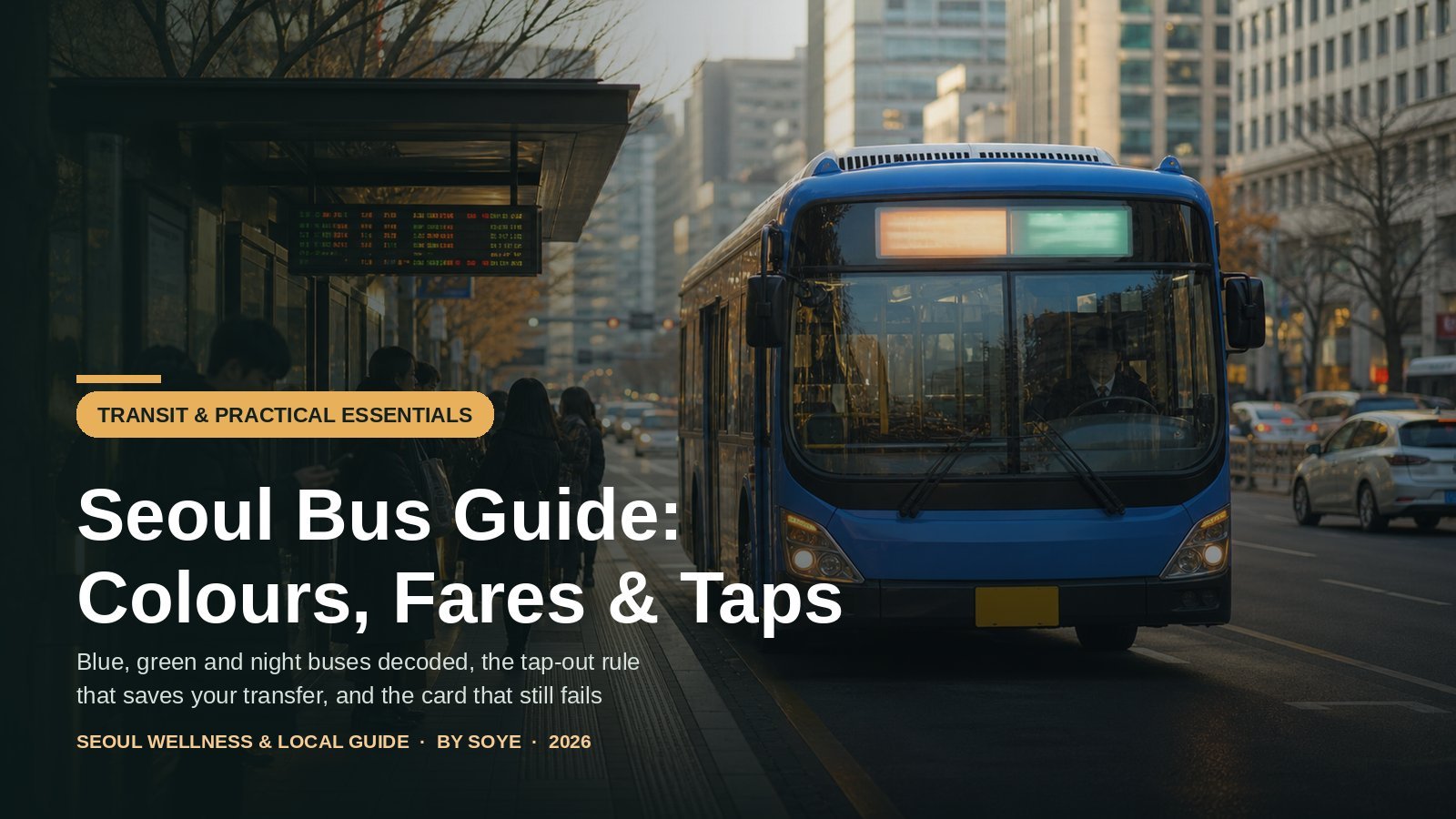
Seoul’s subway map is a colour-coded promise that everything is three stops away. It is not. Namsan’s summit, the alleys above Hyehwa and half of Seochon sit a bus ride from a station rather than a station away — and the bus is also the one part of Seoul transport your bank card cannot pay for. Four hundred routes, one flat fare, and a tap at the back door that decides whether the next leg is free.
The three lines that matter: an adult fare is ₩1,500 on blue and green buses and has not moved since 12 August 2023; 183 of Seoul’s 396 city routes no longer accept cash on the city’s January 2026 list; and no foreign Visa, Mastercard or Apple Pay taps on a Seoul bus in 2026 — that is a 2027 project, agreed with T-money only in September. Bring a transit card, tap it twice, and the network behaves.
Quick Verdict
Buy a T-money card before your first ride: no bank card taps a Seoul bus in 2026 and 183 routes take no cash. Blue and green buses are ₩1,500 flat, night buses ₩2,500 — and tapping off at the back door keeps your next leg free.
Why the bus beats the subway here
The subway is faster when both ends of your trip are near a station, and useless when they are not. Seoul is built on ridges and old street grids: the last 800 metres to a hillside guesthouse, a Bukchon hanok, a rooftop cafe in Seongsu or the base of Namsan is a bus, a taxi or a long climb. Buses also run above ground, which matters more than it should — the 143 between Jongno and Gangnam shows you the city; the line 3 train shows you the inside of a tunnel.
Two numbers explain the network’s hold. Seoul runs roughly 396 city bus routes, and 5,439 of 7,383 city buses were low-floor by January 2026, so boarding with a suitcase or a stroller is usually a level step rather than a lift. Fares are flat for a single bus ride: distance only enters the calculation when you transfer. That makes the bus the cheapest way to cross a district you would otherwise walk.
The cost of all this is a payment system built for residents, not visitors. Korean transit cards speak a domestic standard; your contactless card speaks EMV. The city has been retrofitting since 2025 and says open-loop payment arrives in stages through 2030, with city buses first. Until then the rules below are the whole game.
Read the colour, then read the number
Seoul colour-codes buses by the job they do, and encodes the direction in the digits. Learn this once and you can stand at an unfamiliar stop and guess where a bus is going before the app loads.
| Colour | What it does | Number pattern | Adult fare | Use it for |
|---|---|---|---|---|
| Blue Trunk |
Long, straight runs along the main axes, crossing several districts | 3 digits (e.g. 472) |
₩1,500 | Crossing town fast, on median bus lanes |
| Green Branch |
Feeder routes linking housing to a subway station or a trunk line | 4 digits (e.g. 6512) |
₩1,500 | The last leg up a hill or into a residential grid |
| Yellow Circular |
Short loops in the centre; the Namsan buses 01A and 01B are these | 2 digits (e.g. 01A) |
₩1,400 | N Seoul Tower, downtown loops |
| Red Wide-area |
Express runs to Gyeonggi and Incheon, 30 km included in the fare | 9 + 3 digits (e.g. 9401) |
₩3,000 | Leaving Seoul; not covered by the tourist pass |
| Green Village |
Small buses on lanes a full-size bus cannot enter | District + 2 digits | ₩1,200 | Hillside neighbourhoods, steep back streets |
| N Night |
14 owl routes that replace the subway after midnight | N + 2 digits (e.g. N26) |
₩2,500 | Any trip between roughly 23:30 and 04:00 |
Now the digits. Seoul is divided into eight zones, and the first digit of a route number is where the bus starts; the second is where it ends. Zone 0 is the old centre — Jongno, Jung, Yongsan. Then 1 northeast (Dobong, Gangbuk, Seongbuk, Nowon), 2 east (Dongdaemun, Jungnang, Seongdong, Gwangjin), 3 southeast (Gangdong, Songpa), 4 south (Seocho, Gangnam), 5 southwest (Dongjak, Gwanak, Geumcheon), 6 west (Gangseo, Yangcheon, Yeongdeungpo, Guro) and 7 northwest (Eunpyeong, Mapo, Seodaemun).
So blue 472 starts in zone 4, Gangnam, and heads for zone 7, Mapo and Seodaemun. Green 6512 links zone 6 to zone 5. Red numbers put a 9 in front of the origin zone. Yellow two-digit loops stay inside one zone, and night buses pair the two zones they connect, which is why N26 runs between the west and the east. TOPIS, the city’s transport operations site, publishes the full rule; numbers beginning with 8 are customised routes, limited-stop services that run only at set times, so they are not something to plan around.
What you can actually pay with
This is where visitors lose money or time, usually both. Seoul buses do not take bank cards, do not give change, and increasingly do not take cash at all.
The cashless list is the detail most English guides get wrong. Visit Seoul’s transport page tells readers that “buses in Seoul do not accept cash”, which overstates it: the city’s own January 2026 list names 183 of 396 routes, including the Namsan 01A and 01B. On the rest, a ₩1,500 note in the fare box works — but you get no change, no transfer discount, and no receipt of any kind. Treat cash as an emergency, not a plan.
| Option | Cost | Taps on buses? | The catch |
|---|---|---|---|
| T-money plastic card | ₩2,500–5,000, then load cash | Yes | The default answer. Top up in ₩1,000 steps, up to ₩90,000 per load, at convenience stores or station machines — cash only. |
| T-money in Apple Wallet | Free to add | Yes | iPhone XS or newer, iOS 17.2+, since July 2025. Top up in the Mobile Tmoney app’s “Foreigner” option with Mastercard, Amex, UnionPay or JCB — not Visa. |
| Climate Card short-term pass | ₩5,000 (1 day) to ₩20,000 (7 days) | Yes, unlimited | The tourist pass that survived. Covers Seoul-licensed city and village buses including night and circular routes, and the subway; not red wide-area or airport buses. |
| WOWPASS | Card fee, then load | Yes | Cash-exchange card with a transit chip. Good if you are converting currency anyway; the rates and cashback change more often than the fare. |
| Your own contactless card | — | No, not in 2026 | T-money’s link with Visa, Mastercard, UnionPay, JCB and Hana Card was signed on 17 September 2026, with development through the end of the year. Hana Card’s own announcement points at January 2027 for city buses. |
| Cash | ₩1,500 | On 213 routes only | Exact money, no change, no transfer discount, and nothing on the reader to tell you which kind of route you are boarding. |
Two things are worth knowing before you queue at a machine. Since 17 March 2026 the new ticket machines in 273 stations on lines 1–8 take foreign credit and debit cards for single-journey tickets and Climate Card passes, with an average service fee of 3.7% — that is a route to a valid card without touching a banknote. And the 30-day Climate Card no longer exists: prepaid top-ups stopped on 31 August 2026 and the last day of use was 29 September; postpaid benefits ended on 30 September. Only the 1, 2, 3, 5 and 7-day passes remain, and they must be loaded on the day you start using them, valid from the first bus at 04:00 until the last bus of the final day.
For a two-day trip the arithmetic is simple: a ₩8,000 two-day pass beats ₩1,500 a ride once you make six bus or subway journeys, and it removes every tap-balance worry from your day. Our T-money, WOWPASS and Climate Card comparison runs the same numbers for a longer stay, and the transit calculator prices your actual itinerary.
The tap-out rule that decides your fare
Board at the front door, hold one card to the reader beside the driver until it beeps, and watch the screen: it shows the fare taken on top and your remaining balance below. Hold two cards in one wallet and the reader may pick the wrong one or refuse both. Then walk to a seat or a strap — Seoul drivers close the door and pull away immediately, so find a handhold before you look at your phone.
The tap that decides your money happens at the back door. Tap the rear reader every time you get off, even when you are not planning a transfer. On a single ride it changes nothing; the moment you board another bus or enter the subway, the system uses that tap to join the two legs into one journey. Skip it and the missed leg is settled as a separate trip — the basic fare you were never charged is collected at the next boarding.
- Transfer window: board the next vehicle within 30 minutes of your tap-out, or within 60 minutes between 21:00 and 07:00.
- How many legs: up to 4 transfers, 5 rides on one journey — bus to bus, bus to subway, subway to bus.
- What it costs: the first 10 km are inside the base fare, then ₩100 for every 5 km, and the highest base fare of the vehicles you use is the one that applies. A red express bus includes 30 km instead.
- Same route, same vehicle: no discount. If you get back on the same number, you pay the base fare again.
- Maximum ride: 5 hours on a city bus and 1 hour on a village bus. Overstay and the base fare is re-charged on the way out.
One more trap: transfers are one card, one person. If you board as a group on a single card, the city’s rule is to tell the driver the number of passengers before tapping, and that group ride does not earn the subway transfer discount. Families with children should give each rider a card; under-6s travel free, up to three per paying adult.

I have a bad habit of leaving buses at a run — coat half on, phone in hand, rear reader untouched. Last autumn I jumped off the 143 at Sinsa, walked straight into the station and tapped through the gate. The subway took its own fare, and when I looked at the app the bus leg had been settled separately: a second base fare for a trip I had already paid for inside the 30-minute window.
Nothing can be undone at that point — there is no appeals desk for a missed tap. What I do now: press the red stop button one stop early, then tap the rear reader the second the door opens, before stepping down. Two seconds, and the transfer survives.
Night buses after the last train
The subway stops around midnight and restarts around 05:00. In between, 14 owl routes do the work, fare ₩2,500, no early-morning discount, running inside a published 23:00–06:00 window. The timings that matter are in the table: first departures spread from 23:10 to midnight, and the last departures leave each terminus between 03:10 and 04:10. If you are still out after 04:10 you are taking a taxi.
| Route | Runs between | Headway | First / last departure |
|---|---|---|---|
| N13 | Sanggye-dong — Jangji-dong, via Cheongnyangni, Dongdaemun and Gangnam | 20–30 min | 23:30 / 03:40 |
| N15 | Ui-dong — Sadang, via Seoul Station, Noryangjin and Sillim | 15–30 min | 23:30 / 03:30 |
| N26 | Banghwa-dong — Sinnae-dong, via Jongno, Gwanghwamun, Hongdae | 20–25 min | 00:00 / 03:25 |
| N30 | Gangil-dong — Seoul Station; the only route ending downtown | 30–35 min | 23:10 / 03:50 |
| N61 | Sinjeong-dong — Sanggye-dong, via Gangnam, Konkuk and Nowon | 10–30 min | 23:40 / 04:10 |
| N73 | Gusan-dong — Jangji-dong, via Hongdae, City Hall and Seongsu | 35 min | 23:30 / 03:35 |
Two things the timetables do not say. Headways are long, so one missed bus is a 40-minute wait on a cold pavement — check the live position before you leave the bar, not when you reach the stop. And the routes are labelled by their two termini, not by the streets in between, so the endpoint name tells you less than the stop list does. The airport version of this problem is worse and has its own rules; our late-night Incheon Airport guide covers the N6000-series buses and the 40% taxi surcharge.
Finding the right stop on the right side
The most common failure is not the fare, it is the pavement. Seoul stop names repeat: the stop opposite yours has the same name, a different number and buses going the other way. On wide avenues there is a third case — the median bus lane, where buses stop at a raised island in the middle of the road, reached by a crosswalk, while a curbside shelter with a similar name serves different routes. Watching your bus sail past from the wrong island is a rite of passage.
Use the stop number, not the name. Every Seoul stop has a five-digit ID printed on the sign and shelter, and the same number appears in Naver Map and Kakao Map. Matching 5-digit numbers is the only reliable way to know you are standing where the bus will stop.
For planning, Naver Map in English is the best tool: it compares bus, subway and taxi, shows the stop ID and the live arrival, and can alert you to get off. For arrivals at the kerb, KakaoBus follows your phone’s language and shows the bus moving along its route, crowding and low-floor tags. Both are better than Google Maps here, which handles Korean transit poorly and still cannot route you on foot or by car in Korea. The city’s own real-time bus sites are Korean-only, and the LED boards at shelters vary: some show English, many do not.
One habit worth copying from locals: glance at the printed strip under the board, which lists every route serving that stop in order. It is mostly Korean, but the route numbers and the next stops are readable, and they tell you whether the bus you are waiting for is heading the way you want before you commit.
Getting off, and the rules nobody mentions
Buses skip stops when nobody reacts — one of the few places Seoul is not forgiving. Stand up and move toward the door as your bus approaches, and press one of the red stop buttons on the poles before your stop; if the button is already lit, someone else has done it. Announcements run in Korean and then English on most city routes, but not all, and not always clearly, so follow your position in the app as backup.
Getting off is the rear door, and the rear reader is on a pole beside it, sometimes labelled in English. In rush hour people use whichever door is nearest, but the tap is not optional. If the aisle is packed, 내릴게요 — “I’m getting off” — clears a path better than pushing.
The unwritten rules are ordinary courtesy with Korean edges. Priority seats at the front are left empty even when the bus is full; sitting there as a healthy adult draws quiet looks. Speakerphone calls are not done, food is discouraged, and a wet umbrella goes on the floor, not the seat. Buses kneel and extend a ramp for wheelchairs and strollers, and drivers wait — but they will not wait for someone still finishing a coffee.
- Get a card before your first ride. Convenience store, ₩2,500–5,000, loaded with cash.
- Load ₩20,000 for two or three days of city travel; top up in ₩1,000 steps when it runs low.
- Match the five-digit stop ID, especially at median island stops and anywhere the name repeats.
- Flag the bus by stepping toward the kerb; a bus with no one waiting will not stop.
- Tap on at the front, tap off at the back — every ride, even without a transfer.
- Keep the 30-minute window (60 minutes from 21:00) in mind when you plan a two-bus route.
- After 04:10 the night buses are done; check the last departure for your stop, not the route.
FAQ
Can I pay a Seoul bus fare in cash?
On 213 of 396 routes, yes, with exact money and no change. The other 183, including the Namsan 01A and 01B, are cashless. Either way, cash never earns the transfer discount, so a transit card is cheaper for any journey with a change.
Can I tap my Visa, Mastercard or Apple Pay on a Seoul bus?
Not in 2026. Bus readers use Korea’s domestic transit standard. T-money signed an open-loop agreement with Visa, Mastercard, UnionPay, JCB and Hana Card on 17 September 2026, with testing through the end of the year and city buses first in 2027. Use a T-money card, T-money in Apple Wallet, a Climate Card pass or WOWPASS.
Do I have to tap off if I am not transferring?
On a single ride, skipping it costs nothing. The moment you board another bus or the subway, the missing tap breaks the journey and the next boarding collects the base fare you were never charged. Tap off every time and the question disappears.
How do I know which side of the road to wait on?
Check the five-digit stop ID, not the name. Seoul stops repeat names across the street and, on big avenues, between a curbside shelter and a median island. Naver Map and Kakao Map both show the ID that is printed on the sign.
Is the Climate Card still worth buying?
The 30-day pass ended on 29 September 2026. The 1, 2, 3, 5 and 7-day passes continue at ₩5,000–20,000 and cover unlimited Seoul subway plus Seoul-licensed city and village buses, including night and circular routes. They do not cover red wide-area buses or airport buses, so budget those separately.
Why did the bus drive past me?
Because nothing told the driver you wanted it. Seoul buses stop for people who are visibly waiting: step to the kerb, face the bus, and raise a hand if it is dark or raining. Standing back under the shelter reading your phone reads as “not my bus”.
How late do the buses run?
Regular routes wind down with the subway, and the 14 owl routes cover 23:00 to 06:00 at ₩2,500, with last departures from each terminus between 03:10 and 04:10. Live arrival data is more reliable than any printed timetable, because the last-bus flag is calculated per vehicle.
Cheat sheet
Final Summary
- Card first: no foreign bank card taps a Seoul bus in 2026 and 183 of 396 routes take no cash. Buy T-money at a convenience store for ₩2,500–5,000 and load it with cash.
- Fares: ₩1,500 on blue and green routes (flat, any distance), ₩1,400 on yellow circular routes, ₩1,200 on village buses, ₩3,000 on red express, ₩2,500 at night — and ₩1,200 before 06:30 by card.
- Read the number: the first digit is the origin zone, the second the destination; blue has 3 digits, green 4, red starts with 9, night starts with N.
- Tap twice: the rear reader within 30 minutes (60 minutes from 21:00) keeps the journey alive for up to 5 rides; a missed tap is charged again at the next boarding.
- Stop discipline: match the five-digit stop ID, expect a median island on wide avenues, flag the bus, and press the red button one stop early.
Last checked: 21 November 2026 against the Seoul Metropolitan Government’s city bus pages (fares in force since 12 August 2023, the transfer and tap-out rules, the 5-hour maximum ride), TOPIS for the route-numbering zones, the city’s January 2026 cashless-route list, its open-loop payment notice, T-money’s September 2026 card-scheme announcement, the city’s short-term Climate Card page (revised 12 October 2026) and Visit Seoul’s getting-around pages. Night-bus first and last departures are the city’s published table and change with each timetable revision; the screen at your stop wins.
1 thought on “Seoul Bus Guide: Colours, Fares & the Tap-Out Rule (2026)”