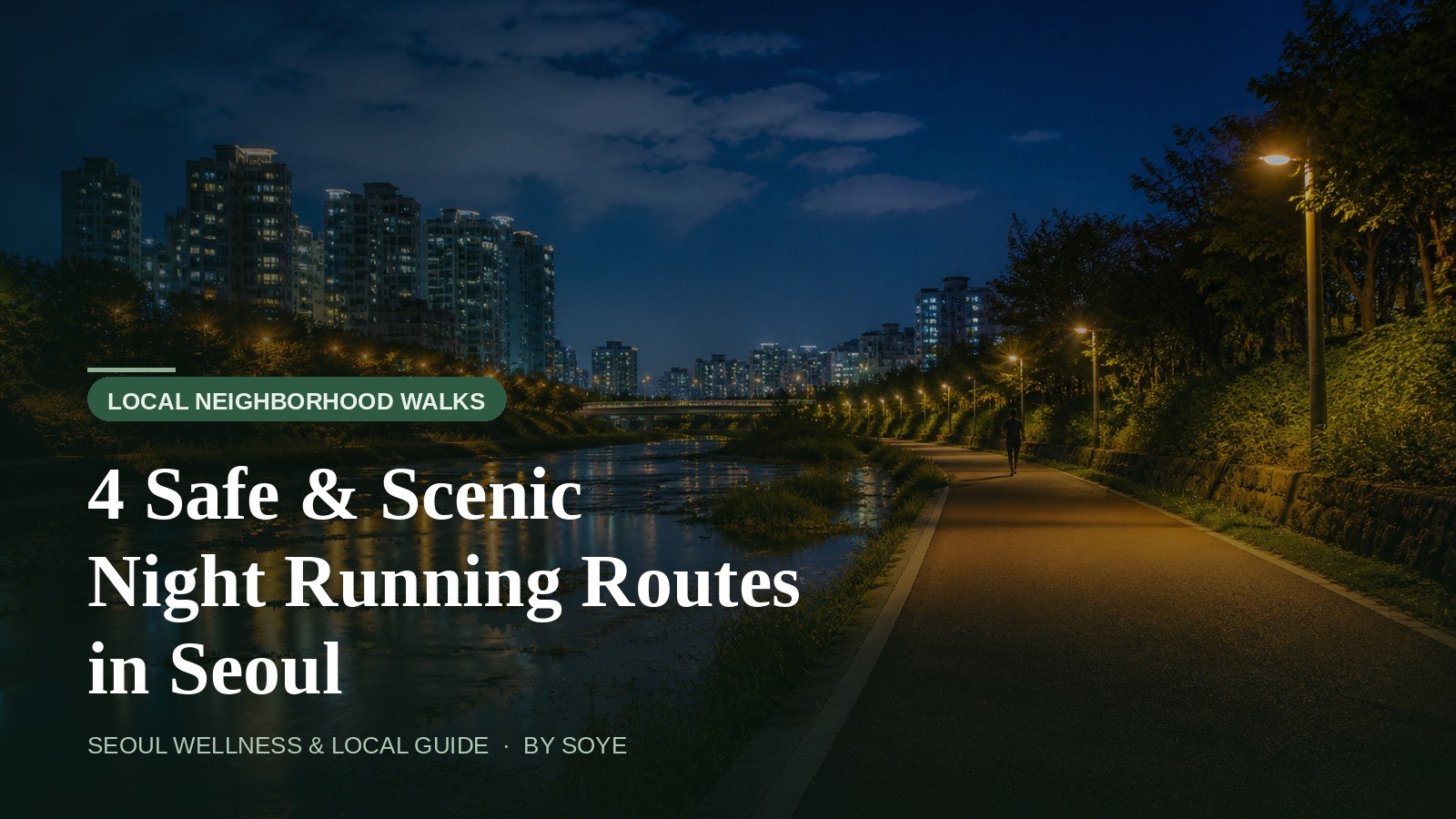
Seoul at night is a runner’s city. The temperature drops, the foot traffic empties out of the stream paths, and the same routes that are shoulder-to-shoulder at 7 a.m. become a lit corridor with your own footsteps in it. I run four of them regularly — one of them five minutes from my flat in Eunpyeong-gu — and I would send a visitor to any of them without a second thought about safety.
Below are the four routes I recommend for night running in Seoul, with honest notes on surface, lighting, water, toilets and the hour each one is actually at its best, plus the local habits that keep a night run uneventful.
Quick Verdict
For a first night run, take the Bulgwangcheon stream path (4.5 km one way): flat, brightly lit, distance markers every 100 m, and almost no traffic after 21:00. Choose Yeouido Hangang Park if you want a long, wide loop with the skyline (8.4 km park, 7–11 km island loop). Run Cheonggyecheon only late at night, when the walkers thin out. Olympic Park is the one route here that closes at night — it’s an evening course, not a midnight one.
The comparison table
| Route | Distance | Surface | Lighting | Water & toilets | Best hours | Nearest station |
|---|---|---|---|---|---|---|
| Bulgwangcheon Eunpyeong / Mapo |
~4.5 km one way (9 km out-and-back) |
Asphalt + rubberised track | Excellent — continuous lampposts, markers every 100 m | 24 h convenience stores at street level; no public toilets on the path | 20:00–23:00 | Bulgwang (Line 3/6), Yeonsinnae (3/6) |
| Yeouido Hangang Park Yeongdeungpo |
8.4 km park 7–11 km island loop |
Asphalt, wide and flat | Good — park lamps + skyline glow; a few dark patches under bridges | 24 h convenience stores, public toilets, seasonal drinking fountains | 19:00–23:00 | Yeouido (Line 5/9), Saetgang (9) |
| Cheonggyecheon Jongno / Jung-gu |
5.8 km restored section (8.1 km total) |
Stone and paved walkway, some stairs | Designed lighting along the water — the most scenic of the four | Few; use street-level convenience stores via the 57 entry ramps | 21:30–24:00, when walkers thin | Gwanghwamun (5), Jonggak (1), Euljiro 3-ga (2/3) |
| Olympic Park Songpa |
4.8 km loop (5 official courses, 1.3–4.3 km) |
Soft — packed earth and rubberised trail | Good inside the park, but the park closes in the evening | Toilets in the park; fountains seasonal | 18:00–21:30 (gate closing time applies) | Olympic Park (5/9), Mongchontoseong (8) |
1. Bulgwangcheon — the lit stream path
Bulgwangcheon is the stream that runs from Eunpyeong-gu down into Mapo, and the running path beside it is my default. The runnable stretch is roughly 4.5 km one way — about 9 km out and back — on a flat path with a rubberised lane next to the asphalt. Distance markers every 100 metres make pacing and intervals easy without a watch, and the lamps run continuously, so there is no section where you are running by feel.
At night this is a neighbourhood stream, not a destination: dog walkers until about 21:00, then runners, then almost nobody. The path crosses under roads rather than through them, so you do not stop for a single traffic light between the start and the turn-around point. Trees and planted beds line the water — beans, corn and flowers in the summer, frost and quiet in December.
How to run it: start at Bulgwang station, head downstream, and turn around at the Su saek end or wherever the 100 m markers tell you that you have hit your distance. Water and toilets are at street level — there are convenience stores along the way but nothing on the path itself, so carry what you need. If it has rained heavily, check the level before you go down: the low riverside path floods first and closes first.
2. Yeouido Hangang Park — the big loop
Yeouido is the classic Seoul running ground, and at night it earns the reputation. The park itself is 8.4 km of riverfront path; the full island circuit — the shape locals call the “sweet potato run” — is 7 to 11 km depending on which bridges you take. There is no hill anywhere, the path is wide enough to pass three abreast, and the skyline across the water does most of the work of making a hard run feel easy.
Lighting is good along the water but not perfect: under the bridges there are short dark patches, and the far western end gets quieter after 22:00. The park has public toilets and 24-hour convenience stores, which makes it the most self-sufficient route on this list — you can run 15 km here without carrying anything.
How to run it: from Yeouido station, walk to the Hangang park, then head anticlockwise along the river. If you want a short, repeatable loop, use Yeouido Park in the middle of the island instead — a 2.5 km circuit that is fully lit and easy to lap.
3. Cheonggyecheon — the downtown line
Cheonggyecheon is the restored stream that cuts east–west through the middle of the city: 5.8 km of restored waterway inside an 8.1 km total course, with around 57 ramps connecting it to street level. It is the most beautiful of these four at night — the lighting is designed, the water is close, and the walls of the channel cut the traffic noise away.
It is also the least suitable for a hard session before 21:30. This is a walking promenade first: couples, families and photographers use it until late, and the path narrows in places. Run it as a steady, quiet cruise rather than a tempo, keep left, and announce a pass. The stairs at each ramp make it a poor choice for anyone whose route needs uninterrupted rhythm.
How to run it: enter at Gwanghwamun and head east towards Sindang, or the reverse; the ramp entrances are frequent enough that you can bail out anywhere. Carry water — the stream level has few shops, and the nearest convenience store is up a ramp and across a road.
4. Olympic Park — the soft evening loop
Olympic Park in Songpa is the softest surface on this list: packed earth, rubberised jogging trail and wide paths through the trees, with five official courses from 1.3 km to 4.3 km and a combined loop of about 4.8 km. For knees that complain on concrete, this is the route to choose.
The catch is the clock. Olympic Park is not a 24-hour space — the gates close in the evening (22:00 as of 2026), so it is an evening course rather than a midnight one. Go at 19:00–21:00 and you get the best of it: cool air, lit paths, and a park emptying out. After closing, move to the riverside or the stream paths instead.
How to run it: take exit 3 from Olympic Park station, enter at the south gate and follow the lakeside path — the Hoban-gil (“lakeside road”, 1.3 km) is the shortest official loop, and the 4.3 km course gives you the full circuit. Combine two courses if you want 8–10 km without repeating the same ground.
Night-running safety, the local way
Seoul is a genuinely safe city for a late run — well lit, heavily covered by CCTV, never empty of people entirely, and with 112 (police) and 119 (fire/ambulance) reachable in English. That said, the risks that do exist are local, and they are not the ones visitors worry about.
- Bicycles, not strangers. The stream and river paths are shared with cyclists. Keep right, and do not change line without looking — a silent bike at 25 km/h is the most likely way to get hurt on a Seoul night run.
- Carry a card, not cash. Every route here passes a 24-hour convenience store within about a kilometre. That is your water, your toilet, your emergency taxi and your shelter if it starts raining.
- Use the bike-share for the way home. Ttareungi (따릉이) stations sit at most river and stream entrances; a single ride costs about ₩1,000 for the first half hour. Riding home beats a 40-minute walk when your legs are done.
- Know the last train. Seoul’s subway runs until roughly midnight, later on Fridays and Saturdays. After that, night buses (the N routes) run all night, and taxis are plentiful.
- Winter footing. From December to February, bridge decks and shaded stretches hold black ice. Run the asphalt centre, not the edges, and shorten your stride on anything that looks wet.
- After heavy rain. Stream paths flood first and close first. If there is a barrier line or a closed gate at the ramp, do not go down — the water can still be high an hour after the rain stops.
- Reflective anything. Most of these paths are lit, but drivers turning across the ramps are not looking for you. A reflective vest or a shoe clip costs little and shows up in headlights.
FAQ for night runners in Seoul
Is it safe to run alone at night in Seoul?
Yes, at the routes above and at normal hours. They are lit, open, covered by CCTV and used by other runners until late. The realistic hazards are bicycles on shared paths, black ice in winter and flooded stream paths after heavy rain — not crime.
Which route is best for a first night run?
Bulgwangcheon. It is flat, brightly lit, has distance markers every 100 metres and almost no road crossings, so you can focus on running rather than navigation. About 4.5 km one way, 9 km out and back.
Can I run along the Han River at midnight?
Yes. The Hangang parks are open 24 hours, and the Yeouido section is well lit and busy until late. Carry a card for the 24-hour convenience stores, and expect short dark patches under the bridges.
Is Olympic Park open at night?
Not all night. The gates close in the evening (22:00 as of 2026), so treat it as a 19:00–21:30 route. Check the closing time on the day you go, as it changes seasonally.
Where can I find water and toilets on these routes?
Yeouido Hangang Park has both, plus drinking fountains in season. Bulgwangcheon and Cheonggyecheon do not have water on the path — use the 24-hour convenience stores at street level. Olympic Park has toilets inside the park.
What should I carry on a Seoul night run?
A transit card, a small amount of cash or a card for convenience stores, a phone, and something reflective. In winter, a light windproof layer and gloves — the riverside is 3–5 °C colder than the streets.
Final Summary
- Bulgwangcheon (4.5 km one way) — the lit, flat, marker-every-100 m default. Best 20:00–23:00, easiest for intervals.
- Yeouido Hangang Park (8.4 km park, 7–11 km island loop) — the big scenic loop; toilets, water and 24 h stores on site.
- Cheonggyecheon (5.8 km) — the prettiest, the most crowded; run it after 21:30 and treat it as a cruise, not a tempo.
- Olympic Park (4.8 km loop, soft surface) — best for knees, but gates close around 22:00. Evening, not midnight.
- Locally: watch for bikes, carry a card, use Ttareungi to get home, check the last train, and never go down a closed stream ramp after rain.
Last checked: 15 November 2026. Distances are the official park and stream figures; opening hours, lighting and post-rain closures change, so check the park notice at the entrance.