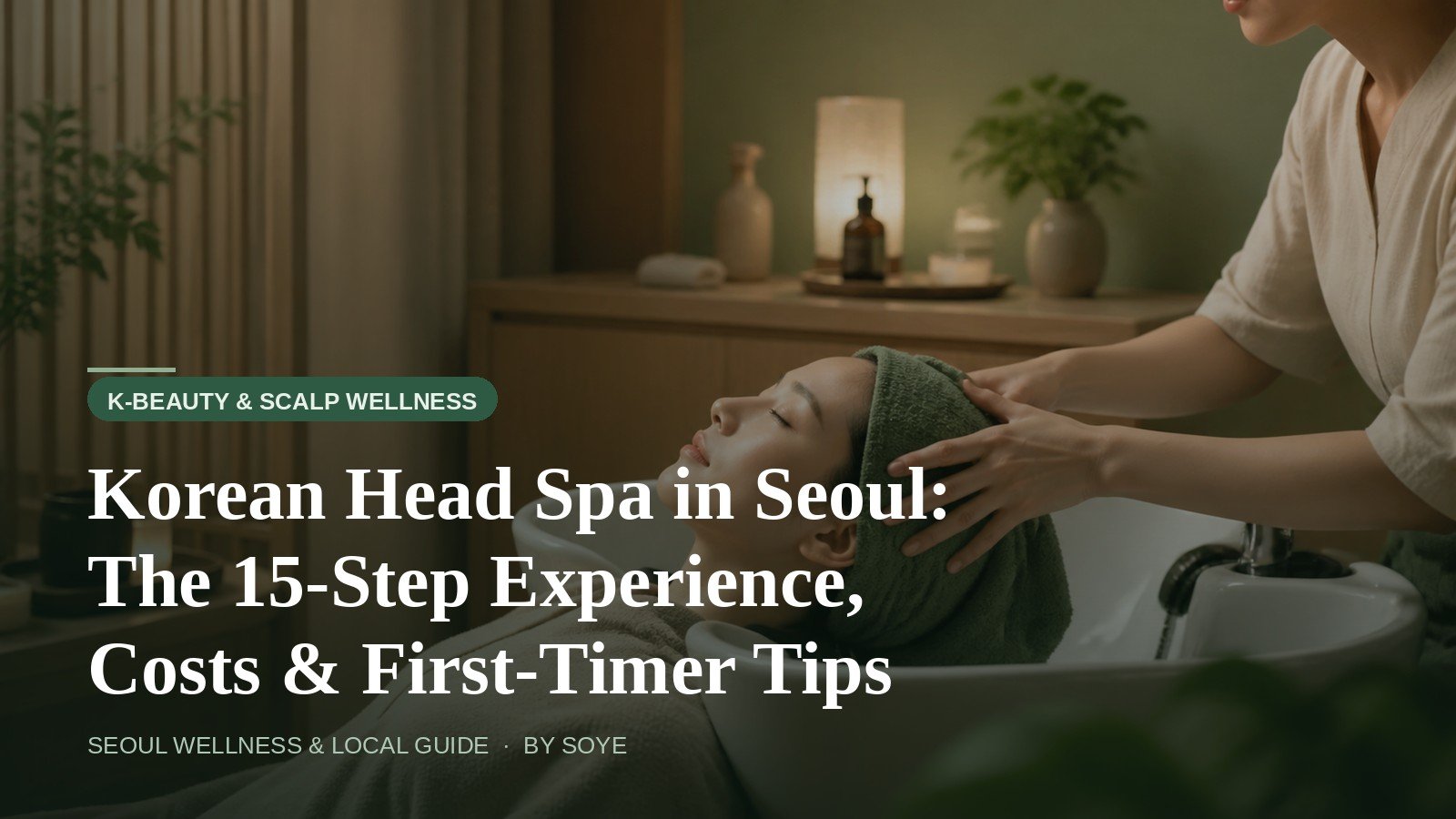
A Korean head spa is not a shampoo with a scalp massage bolted on. It is a 60-to-105-minute sequence in which a trained therapist looks at your scalp under a camera, removes the buildup you have been carrying for months, and works the muscles of your neck and head until your jaw unclenches. It is one of the few genuinely Korean wellness experiences you can buy for the price of a nice dinner — and one of the easiest to overpay for.
This guide explains what actually happens in a 15-step session, what each price tier buys you in 2026, where to book without speaking Korean, and the small things first-timers get wrong.
Quick Verdict
Book a 60-to-90-minute course in the ₩60,000–₩110,000 band for your first head spa. That range includes scalp-camera diagnosis, exfoliating scaling, a wash, a steam step and a real massage — the parts that make the treatment worth having. The ₩180,000–₩250,000 flagship courses buy a private room and a longer ritual, not a different result. Skip anything under ₩40,000 unless you only want a very good shampoo.
What a Korean head spa actually is
Seoul’s head spas sit somewhere between a hair salon and a spa, and the vocabulary is genuinely confusing: head spa, scalp spa, 두피관리 (scalp care) and 두피케어 (scalp treatment) are printed interchangeably. Three things separate the good ones from the marketing.
First, diagnosis. A proper Korean session starts by photographing your scalp through a magnifying scope and showing you the screen — oil, flakes, redness, follicle density. The therapist then adjusts what follows. A place that skips this is selling a shampoo.
Second, scaling. The step that produces the visible result is the removal of sebum and dead skin from the scalp with a soft brush, a vibrating tool or a gentle acidic solution. This is why your hair feels lighter afterwards, and why the treatment should not be done on freshly irritated skin.
Third, the massage. Korean scalp work sequences through the temples, occiput, neck and trapezius. Done properly it is closer to a physiotherapy session than a beauty treatment, and it is the reason people fall asleep in the chair.
What it is not: a medical treatment. Korean head spas are not clinics, the camera images are not a diagnosis of hair loss, and no reputable shop claims to cure anything. If you have a scalp condition, see a dermatologist.
Korean spa vs Japanese dry head spa
Japanese dry head spas work on a dry head, seated, with almost no water. Korean head spas are wet: you lie back at a basin, and the wash is part of the ritual. If you want the floating, waterless, 60-minute nap, look for shops that advertise 일본식 (Japanese-style) or 드라이 head spa. If you want your scalp actually cleaned, book the Korean version.
The 15 steps, in order
The numbering is not standardised — one salon’s 15 steps are another’s 13 — but the sequence below is what a full Korean 15-step course looks like at a flagship Seoul salon in 2026. Expect 90 minutes including a final blow-dry.
- Scalp diagnosis. You sit at a magnifying scope; the therapist photographs two or three zones and explains what they see.
- Scalp aromatherapy. A botanical oil or essence is applied and worked in with the fingertips.
- LED brush and gua sha. A light-emitting brush plus a flat stone tool loosen the scalp along the hairline and crown.
- Pore-cleansing scaling. Sebum and dead skin are lifted with a soft rotating brush or a gentle solution.
- Heated trapezius massage. A warm pack goes on the shoulders while the scalp work continues — this is where most people stop talking.
- Steam mist. Warm steam opens the follicles and softens what the scaling loosened.
- Bubble shampoo. A dense, low-friction foam wash, usually two rounds.
- Galvanic Y-bar massage. A metal bar with a mild current glides over the scalp; it is a tingling, not a shock.
- Water healing spa. A long, warm rinse at the basin with a scalp-focused water jet.
- Collagen scalp pack. A cooling mask sits on the scalp for several minutes.
- 70% dry. Hair is dried most of the way, scalp first, so the finishing products are not diluted.
- Ampoule tonic. A concentrated serum is applied along the parting and massaged in.
- Galvanic T-bar finish. A second, shorter pass to help the tonic absorb.
- Post-treatment check. The scope comes out again so you can compare before and after.
- Styling. Blow-dry and a simple finish — not a cut, not a colour.
Shorter courses compress this: a 60-minute treatment typically keeps diagnosis, scaling, shampoo, mask and massage, and drops the steam or one of the galvanic passes. When you compare two prices, compare minutes of scalp massage and whether diagnosis is included — not the number of steps.
What it costs in 2026 (four tiers)
Published prices in Seoul run from ₩25,000 to ₩250,000 for what everyone calls a “head spa”. The difference is what is inside the course, not the neighbourhood — the same district can hold a ₩60,000 and a ₩230,000 shop.
| Tier | Price | What you get | Example (published, 2026) |
|---|---|---|---|
| 1. Short wash | ₩25,000–₩40,000 | 25–30 min at the basin; a good shampoo with a scalp massage, usually no diagnosis | Hongdae salon: 25 min ₩25,000, 30 min carbonated spa ₩40,000 |
| 2. Standard course | ₩60,000–₩70,000 | 50–60 min: diagnosis, scaling, wash, treatment, massage | Myeongdong salon: 50 min ₩60,000 (long hair +₩10,000–20,000); Jamsil: weekday-morning 60 min ₩69,000 |
| 3. Private-room course | ₩88,000–₩110,000 | 60–90 min, 1:1 room, ampoule, aromatherapy, neck and shoulder work | Gangnam: 60 min ₩100,000, 80 min ₩150,000; Sinsa first-visit 60 min ₩95,000; Apgujeong 60 min ₩100,000 |
| 4. Flagship 15-step | ₩155,000–₩250,000 | 90–105 min, full ritual, premium products, styling included | Gangnam 15-step 90 min ₩180,000 (18-step 105 min ₩250,000); Seoul Station 15-step ₩210,000; Cheongdam 15-step ₩200,000 |
Three things move the number. Hair length: many salons add ₩10,000–₩20,000 for long or very thick hair — ask before you book. First-visit promotions: Korean shops routinely discount 20–50% for a first visit, often conditional on paying through a specific app or writing a photo review; the discount is real but the condition is real too. Add-ons: a “precision diagnosis” sold as an extra (₩20,000–₩22,000 at some clinics) or an upgrade from a basic ampoule can quietly add ₩30,000 to a ₩88,000 course.
For context: a 60-minute dry head spa in Tokyo runs about ₩55,000–₩75,000. Seoul’s second tier sits at the same money — but delivers a wet treatment with diagnosis and scaling rather than a nap on a dry head. That is the best-value point on this table.
How and where to book in English
Korean salons take bookings through apps, not email. The four routes that work for a visitor:
- Naver Booking (네이버 예약). The default for Korean salons. The listing shows real slots, prices and photos; the interface is in Korean but the flow is three taps. You need a Korean phone number or a Naver account to confirm — this is where many visitors get stuck.
- Foreigner-facing platforms. Creatrip, Klook and MyRealTrip list Seoul head spas with English descriptions, instant confirmation and foreign-card payment. Prices are sometimes higher than the shop’s own rate, sometimes lower with a promotion — compare against the shop’s Naver listing.
- The shop’s own booking link. Premium salons increasingly run English booking pages through their own site or Instagram profile link. If the shop has an English-language page, use it; the advertised price is usually the same.
- Walk in, weekday morning. Between 10:00 and 12:00 on a Tuesday or Wednesday, most neighbourhood salons have a free chair. Weekend afternoons and weekday evenings after 18:30 are the hardest slots.
Where to go depends on what you want. For a first, affordable, well-run session: a neighbourhood scalp salon in Hongdae, Jamsil or Myeongdong (₩60,000–₩70,000). For a private room and a long massage: the Sinsa–Apgujeong–Gangnam cluster (₩95,000–₩150,000). For the full flagship ritual with styling, and a location that makes sense on your arrival or departure day: the salon inside Seoul Station, which sits directly above the KTX and AREX platforms (₩180,000–₩210,000).
First-timer tips nobody tells you
- Arrive with dry hair and no styling product. Hairspray, wax and dry shampoo blunt the diagnosis and take time to strip. Coming straight from a flight or a day of walking is fine — this treatment is designed for that.
- Do not book 90 minutes before something important. A 15-step course plus check-in plus styling runs 2 hours door to door. Your hair will be styled at the end, but you will be very relaxed and possibly damp around the neckline.
- Say yes to the long-hair question. Ask “Is there an extra charge for long hair?” when booking. It is the single most common surprise at the counter.
- You will be asked about upgrades mid-course. It is normal and not aggressive. Ask “How much is the total with that added?” and, if the answer isn’t for you, “No, thank you” ends it cleanly.
- No tipping. The price on the menu is the price. Cards and mobile pay work everywhere; cash is not needed.
- Bring a hat in winter. Even with a blow-dry, the neck and hairline stay cool when you step out into a Seoul December.
- Language: flagship salons and tourist-district shops usually have English-capable staff; neighbourhood shops may not. A translation app with the phrase 두피가 예민해요 (“my scalp is sensitive”) covers the one instruction that matters.
FAQ before you book
How much should I budget for a first head spa in Seoul?
₩60,000–₩110,000 for a 50-to-90-minute course with diagnosis, scaling, wash and massage. That is the tier where the treatment is complete rather than abbreviated. Add ₩10,000–₩20,000 if your hair is long.
Is a Korean head spa good for hair loss?
No. It cleans the scalp, removes buildup and relaxes the muscles around the head and neck, which many people find makes the scalp feel healthier. It is not a medical treatment and does not regrow hair. For actual hair loss, see a dermatologist.
How long does a 15-step head spa take?
About 90 minutes for the treatment plus styling; an 18-step version can run 105 minutes. Allow two hours including arrival, consultation and payment.
Do I need to wash my hair before I go?
No — arriving with unwashed hair is normal and gives the therapist more to work with. Do avoid heavy styling products. The salon washes your hair as part of the course.
Can I book without a Korean phone number?
Yes, through foreigner-facing platforms (Creatrip, Klook, MyRealTrip) or a shop’s English booking page. Naver Booking usually needs a Naver account or Korean number to confirm, which is the main obstacle for visitors.
Is it appropriate for men?
Yes. Korean scalp care is unisex, and many shops list men’s courses or charge the same. Men’s hair being shorter, the session is sometimes slightly cheaper — ask.
Final Summary
- Budget ₩60,000–₩110,000 for a 50–90 minute course with diagnosis, scaling, wash, mask and massage — the sweet spot.
- Check three things in the listing: is diagnosis included, how many minutes of massage, and is long hair surcharged.
- The 15 steps run diagnosis → aromatherapy → LED/gua sha → scaling → shoulder heat → steam → bubble wash → galvanic → water spa → collagen pack → dry → tonic → galvanic finish → re-check → styling.
- Book Creatrip / Klook / MyRealTrip or the shop’s English page if you have no Korean number; weekday mornings work as walk-ins.
- Arrive with dry, product-free hair, no tip, allow 2 hours. Not a medical treatment — a very good cleaning and a better nap.
Last checked: 15 November 2026. Prices are taken from salons’ published 2026 course listings and are indicative; first-visit discounts, long-hair surcharges and holiday closures vary by shop — confirm the total when you book.